Ask AI for a short summary of this article
The Five Ws
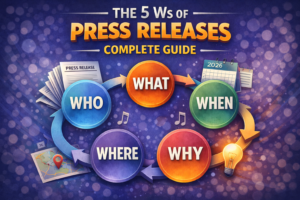 You’ve spent months developing your product. Weeks of planning your event. Days crafting the perfect company announcement. Now you need journalists to care.
Enter the 5 Ws—the framework that transforms promotional fluff into newsworthy content that journalists actually want to read. Master these five questions, and you’ll write press releases that get picked up, published, and generate real coverage for your brand.
What Are the 5 Ws (and H)?
The 5 Ws and H are six fundamental questions that every press release must answer to be complete and newsworthy:
- Who – The people or organizations involved in the announcement
- What – The specific event, product, or news you’re announcing
- When – The date and time of the announcement or event
- Where – The location or where readers can learn more/take action
- Why – The reason this matters and why readers should care (most important!)
- How – How readers can get involved, purchase, or learn more
Also called the “5W1H” or “Six Honest Serving Men” (from Rudyard Kipling’s 1902 poem), this framework originated in ancient Greek philosophy with Aristotle and became standard in journalism education by 1917. Today, it remains the gold standard for clear, effective press releases.
Why the 5 Ws Matter for Press Releases
According to Cision’s State of the Media Report, 63% of editors and journalists still cite press releases as their most valuable source of information. But here’s the catch: journalists receive hundreds of press releases daily. They’re scanning, not reading. Miss one of the 5 Ws, and your release goes straight to the trash.
The 5 Ws help you:
- Control your message – Tell your story your way, not leave it to interpretation
- Respect journalists’ time – Give them everything they need in seconds
- Improve pickup rates – Complete information means easier stories for editors
- Boost SEO – Structured content ranks better and drives organic traffic
- Enable republication – Many outlets will publish your release verbatim if it’s well-written
The Inverted Pyramid: Where the 5 Ws Live
Press releases are a key part of the “inverted pyramid” structure—a journalism format that places the most critical information at the top. Picture a triangle pointing downward:
Top (Widest part): Your lead paragraph containing all 5 Ws—the most important information
Middle: Supporting details, quotes, specifications, and context in descending order of importance
Bottom (Point): Your boilerplate, additional background, and contact information
Why this structure? Two reasons:
- Journalists are busy. If they only read your first paragraph, they should understand your entire story.
- Editors cut from the bottom. When space is tight, they’ll trim your last paragraphs. Your critical info must be at the top.
Writing the Perfect Lead Paragraph
Your lead paragraph (also called the “lede”) should be 25-35 words maximum and answer all 5 Ws. Yes, this is challenging. No, you shouldn’t make it longer.
Here’s why it works: When an editor with a full inbox scans your release, they’ll read your headline and first paragraph. If those don’t hook them immediately, they’re done. Your lead must deliver the complete story in one concise, compelling burst.
How to Use Each W in Your Press Release
Let’s break down each question with specific strategies and examples for press release writing.
Who: Identifying Your Key Players
Who answers: Who is making this announcement? Who will be affected? Who should care?
In your lead, include:
- Your company name (with relevant descriptor if not well-known)
- Key executives or spokespeople
- Target audience or beneficiaries
Example: “TechStart Solutions, a B2B SaaS platform serving 10,000 small businesses, today announced…”
Common mistakes:
- Assuming people know who you are (they don’t)
- Burying your company name
- Not explaining why your “who” matters
Pro tip: If you’re not a household name, add a brief descriptor: “ABC Corp, an Austin-based fintech startup…” or “John Smith, CEO of XYZ Industries and former Google executive…”
What: Making Your Announcement Crystal Clear
What answers: What exactly are you announcing? What is the core news?
Your “what” should be:
- Specific and concrete (not vague)
- Newsworthy (not just promotional)
- Action-oriented (use strong verbs)
Example: “…launched its AI-powered inventory management system that reduces stockouts by 47%.”
Not this: “…introduced an exciting new solution for modern businesses.”
Common mistakes:
- Being too vague (“new offering,” “innovative solution”)
- Using buzzwords without substance (“game-changing,” “revolutionary”)
- Making it about you, not the news
Pro tip: If you can’t clearly state what you’re announcing in 5-7 words, you don’t have a clear message yet. Keep refining.
When: Timing Is Everything
When answers: When is this happening? When can people take action?
For press releases, “when” covers:
- Release date (usually “today” or a specific date)
- Event dates and times
- Product availability dates
- Deadlines for participation
Example: “The software will be available starting March 15, 2025, with early bird pricing through March 31.”
Timing strategies:
- Product launches: Announce with enough lead time for press coverage
- Events: Give journalists 2-3 weeks’ notice minimum
- Conferences: Release 3-4 weeks before for maximum planning time
- Breaking news: Same-day releases for immediate newsworthy events
Common mistakes:
- Announcing events after they happen (unless it’s results/recap)
- Not giving clear dates
- Announcing “old” news that’s no longer timely
Where: Driving Action and Traffic
Where answers: Where is this happening? Where can people learn more or take action?
In press releases, “where” means:
- Physical locations (for events, store launches, etc.)
- Websites where products are available
- Booth numbers at trade shows
- Geographic regions affected
Example: “The conference will take place at the Austin Convention Center, booth #427, with additional information available at www.techstart.com/launch.”
Strategic use of “where”:
- Drive traffic to specific landing pages
- Highlight geographic expansion
- Create urgency for in-person events
- Provide clear calls-to-action
Common mistakes:
- Forgetting to include your website
- Using generic URLs instead of campaign-specific landing pages
- Not specifying physical addresses for events
Pro tip: Include trackable URLs so you can measure press release ROI.
Why: The Most Critical Question
If you remember nothing else from this article, remember this: WHY is the most important W in your press release.
Why answers: Why does this matter? Why should journalists care? Why should their readers care? Why now?
This is where most press releases fail. They nail the who, what, when, and where—but completely miss the why. Without context and significance, your announcement is just corporate noise.
Simon Sinek’s advice applies here: Start with why. People don’t buy what you do; they buy why you do it.
Your “why” should include:
- The problem you’re solving
- Industry context or trends
- Impact on customers or the market
- What makes this significant now
Example: “With 82% of small businesses citing inventory management as their top operational challenge and supply chain disruptions continuing post-pandemic, the new system addresses a critical pain point affecting millions of retailers.”
Common mistakes:
- No “why” at all (just announcing something happened)
- Making it about you, not the audience (“We’re excited to…”)
- Missing the broader context or industry significance
Pro tip: Before writing your release, complete this sentence: “Journalists should cover this because ___________.” If you can’t complete it compellingly, you might not have a newsworthy story yet.
How: Your Call to Action
How answers: How can readers learn more? How can they participate? How does it work?
In press releases, “how” typically appears:
- In the lead (if it’s critical to understanding)
- In body paragraphs (for process details)
- In the closing (for next steps/calls-to-action)
Example: “Interested companies can schedule a free demo at www.techstart.com/demo or contact the sales team directly at [email protected].”
Common mistakes:
- No clear call-to-action
- Making the “how” too complicated
- Forgetting to provide contact methods
Real-World Press Release Examples
Example 1: Product Launch (Strong Lead)
|
Lead paragraph:
“ZenHealth, a digital wellness platform serving 50,000 users, today launched its AI-powered mental health assessment tool that provides personalized therapy recommendations in under 60 seconds. The free tool addresses the growing mental health crisis affecting 1 in 5 Americans, offering immediate guidance during the critical window when individuals seek help. Available now at www.zenhealth.com/assessment, the tool has already processed 10,000 assessments in beta testing.”
|
Example 2: Event Announcement (Strong Lead)
|
“The Future of Retail Summit, an annual conference attracting 5,000 retail executives, will take place June 10-12, 2026, at Chicago’s McCormick Place, featuring keynotes from Amazon, Walmart, and Target on navigating the shift to omnichannel commerce. With 73% of retailers reporting difficulty adapting to hybrid shopping models, the summit offers actionable strategies for brands struggling to meet evolving consumer expectations. Registration is now open at www.retailsummit.com with early bird pricing through April 15.”
Analysis:
|
Example 3: What NOT to Do (Weak Lead)
|
“We are excited to announce that our company has developed an innovative new platform that will revolutionize the way businesses operate and help them achieve their goals in today’s dynamic marketplace.”
Problems: The fix: “CloudOps Inc., a DevOps automation company serving 2,000 enterprises, today launched OptiFlow, a platform that reduces cloud infrastructure costs by an average of 34% through AI-powered resource optimization. As cloud spending surpasses $500 billion globally with 60% waste reported, OptiFlow addresses the industry’s most pressing cost challenge. The platform is available now at www.cloudops.com/optiflow with a 30-day free trial.” |
Common Press Release Mistakes (And How to Fix Them)
Mistake #1: Burying the Lede
The problem: Your most newsworthy information is in paragraph three, buried under background.
The fix: Start with the news. Background belongs in later paragraphs.
Mistake #2: Missing the “Why”
The problem: You announce something happened, but never explain why anyone should care.
The fix: Add industry context, problems solved, or impact on customers. Ask yourself: “So what?”
Mistake #3: Writing in “Corporatese”
The problem: Filled with buzzwords like “synergy,” “leverage,” “game-changing,” “innovative solution.”
The fix: Use concrete, specific language. Say what your product does, not that it’s “innovative.”
Mistake #4: Lead Over 35 Words
The problem: Your lead is 60+ words, cramming in too much information.
The fix: Be ruthless. Save supporting details for paragraph two.
Mistake #5: No Clear Value Proposition
The problem: Journalists can’t tell why this matters within 10 seconds of reading.
The fix: In your “why,” include specific data, trends, or problems that establish significance.
The Digital Age: Modern Press Release Considerations
SEO Optimization
Your press release isn’t just for journalists—it’s for search engines and potential customers finding you online.
SEO best practices:
- Include target keywords in the headline and first paragraph naturally
- Use descriptive subheadings (H2s and H3s)
- Link to relevant landing pages
- Keep URLs clean and trackable
- Add multimedia (images, videos) when possible
Social Media Integration
Press releases now live across multiple platforms. Ensure your 5 Ws work in:
- Twitter/X (key points in 280 characters)
- LinkedIn posts (professional context)
- Email subject lines (compelling “what” and “why”)
Mobile-First Writing
Over 60% of press releases are now read on mobile devices. This makes the inverted pyramid more critical than ever—get to the point immediately.
Multimedia Elements
Modern press releases can include:
- Images and infographics
- Video content
- Data visualizations
- Downloadable assets
These don’t replace the 5 Ws—they enhance them. Your lead must still work as standalone text.
Press Release Checklist: Your 5 Ws
Before You Write:
- I can clearly state my announcement in one sentence
- I know why this is newsworthy (not just promotional)
- I have all the facts (dates, names, numbers)
- I understand my target audience and what they care about
- I can answer “why should journalists cover this?”
After You Write:
- All 5 Ws appear in my lead paragraph
- My lead is 25-35 words (40 words absolute maximum)
- A busy journalist could understand my story from the lead alone
- I’ve eliminated buzzwords and corporate jargon
- My “why” includes specific context or data
- I have a clear call-to-action
- I’ve included my website and contact information
- The most important information is at the top
The Final Test:
Read only your headline and first paragraph. Can you answer all 5 Ws? If not, revise until you can.
Frequently Asked Questions
Do I need all 5 Ws in the first sentence?
No, you need them all in the first paragraph. Trying to cram everything into one sentence oftentimes creates awkward, run-on text. Aim for 2-3 sentences maximum in your lead.
Which W is most important?
Why is the most critical element of your press release. You can have perfect who, what, when, and where—but without a compelling why, journalists won’t care. The “why” provides context and newsworthiness.
How long should my entire press release be?
Aim for 300-500 words total. Journalists prefer concise releases. If you can’t tell your story in 500 words, you’re including too much.
Should I include the H (how) in my lead?
Only if it’s essential to understanding the announcement. Usually, “how” belongs in body paragraphs or at the end as a call-to-action.
Can I write press releases about anything?
No. Not everything deserves a press release. Ask: Is this newsworthy? Does it affect people outside my company? If you’re just “excited to announce” something routine, skip the release.
What if some Ws don’t apply to my announcement?
This is rare. If “where” truly doesn’t matter (perhaps for a digital-only product), you can deemphasize it. But you should always have a strong who, what, when, why, and how.
How do I make my press release stand out?
Strong “why” with compelling data, specific (not vague) “what,” and a clear value proposition. Avoid buzzwords. Be concise. Lead with news, not promotional fluff.
Should I hire a PR professional to write my press releases?
If you’re struggling to identify the 5 Ws or make your announcement newsworthy, yes. A PR pro can spot the real story and frame it effectively for media pickup.
Start Writing Better Press Releases Today
- I can clearly state my announcement in one sentence
- I know why this is newsworthy (not just promotional)
- I have all the facts (dates, names, numbers)
- I understand my target audience and what they care about
- I can answer “why should journalists cover this?”
After You Write:
- All 5 Ws appear in my lead paragraph
- My lead is 25-35 words (40 words absolute maximum)
- A busy journalist could understand my story from the lead alone
- I’ve eliminated buzzwords and corporate jargon
- My “why” includes specific context or data
- I have a clear call-to-action
- I’ve included my website and contact information
- The most important information is at the top
The Final Test:
Read only your headline and first paragraph. Can you answer all 5 Ws? If not, revise until you can.
Frequently Asked Questions
Do I need all 5 Ws in the first sentence?
No, you need them all in the first paragraph. Trying to cram everything into one sentence oftentimes creates awkward, run-on text. Aim for 2-3 sentences maximum in your lead.
Which W is most important?
Why is the most critical element of your press release. You can have perfect who, what, when, and where—but without a compelling why, journalists won’t care. The “why” provides context and newsworthiness.
How long should my entire press release be?
Aim for 300-500 words total. Journalists prefer concise releases. If you can’t tell your story in 500 words, you’re including too much.
Should I include the H (how) in my lead?
Only if it’s essential to understanding the announcement. Usually, “how” belongs in body paragraphs or at the end as a call-to-action.
Can I write press releases about anything?
No. Not everything deserves a press release. Ask: Is this newsworthy? Does it affect people outside my company? If you’re just “excited to announce” something routine, skip the release.
What if some Ws don’t apply to my announcement?
This is rare. If “where” truly doesn’t matter (perhaps for a digital-only product), you can deemphasize it. But you should always have a strong who, what, when, why, and how.
How do I make my press release stand out?
Strong “why” with compelling data, specific (not vague) “what,” and a clear value proposition. Avoid buzzwords. Be concise. Lead with news, not promotional fluff.
Should I hire a PR professional to write my press releases?
If you’re struggling to identify the 5 Ws or make your announcement newsworthy, yes. A PR pro can spot the real story and frame it effectively for media pickup.
Start Writing Better Press Releases Today
- All 5 Ws appear in my lead paragraph
- My lead is 25-35 words (40 words absolute maximum)
- A busy journalist could understand my story from the lead alone
- I’ve eliminated buzzwords and corporate jargon
- My “why” includes specific context or data
- I have a clear call-to-action
- I’ve included my website and contact information
- The most important information is at the top
The Final Test:
Read only your headline and first paragraph. Can you answer all 5 Ws? If not, revise until you can.Frequently Asked Questions
Do I need all 5 Ws in the first sentence?
No, you need them all in the first paragraph. Trying to cram everything into one sentence oftentimes creates awkward, run-on text. Aim for 2-3 sentences maximum in your lead.
Which W is most important?
Why is the most critical element of your press release. You can have perfect who, what, when, and where—but without a compelling why, journalists won’t care. The “why” provides context and newsworthiness.
How long should my entire press release be?
Aim for 300-500 words total. Journalists prefer concise releases. If you can’t tell your story in 500 words, you’re including too much.
Should I include the H (how) in my lead?
Only if it’s essential to understanding the announcement. Usually, “how” belongs in body paragraphs or at the end as a call-to-action.
Can I write press releases about anything?
No. Not everything deserves a press release. Ask: Is this newsworthy? Does it affect people outside my company? If you’re just “excited to announce” something routine, skip the release.
What if some Ws don’t apply to my announcement?
This is rare. If “where” truly doesn’t matter (perhaps for a digital-only product), you can deemphasize it. But you should always have a strong who, what, when, why, and how.
How do I make my press release stand out?
Strong “why” with compelling data, specific (not vague) “what,” and a clear value proposition. Avoid buzzwords. Be concise. Lead with news, not promotional fluff.
Should I hire a PR professional to write my press releases?
If you’re struggling to identify the 5 Ws or make your announcement newsworthy, yes. A PR pro can spot the real story and frame it effectively for media pickup.
Start Writing Better Press Releases Today
The 5 Ws aren’t just a formula—they’re a mindset. They force you to think like a journalist, cut through promotional noise, and focus on what actually matters: newsworthy information delivered clearly and concisely.
Before you send your next press release, ask yourself:
- Can I answer all 5 Ws in my first paragraph?
- Is my “why” compelling enough to make a journalist stop scrolling?
- Would I cover this story if I received it?
Master these questions, and you’ll write press releases that get read, get picked up, and get results.
Ready to put this into practice? Take your current press release draft and run it through the checklist above. You might be surprised how much stronger it becomes when you let the 5 Ws guide your writing.
Press Release Examples Across Several Industries


















What Are You Announcing? Examples and Templates by Type of Press Release
- Launching a New Product
- Launching a Product Improvement
- An Event
- A Grand Opening
- Achievement of a Major Milestone
- Receipt of an Award or Recognition
- A New Hire or Promotion
- Dealing With a Crisis
- A Partnership With Another Organization
- An Acquisition or Merger
- Social Cause Activities
- Release of a New Book
- Political Campaign Activities
- Music-Related Announcement
- School/University Announcements
- Media, Network, and Local Station Announcements
- Announce an Art Exhibition
- Press Release for a Movie
- Press Releases for Tech Firms
- How to Distribute Law Firm Press Releases
- Press Release for Fashion Distribution Services
- 16 Press Release Examples For Unions to Use [+ 3 Templates]
- App Press Release Examples and Templates
- Magazine Press Release Examples and Templates
Finally, here are some tips and training to help you write an amazing press release:
Additional Press Release Resources
- Directory of Examples & Templates
- What is a Press Release?
- Press Release Template & Format (including a blank press release example)
- Learn How to Format a Press Release (+ Free Template and 80+ Examples)
- Learn How to Write a Press Release
- How to Submit a Press Release
- To Write a Press Release Yourself or Not?
- 80+ Example Press Releases
- Press Release Syndication Services
- Using AI For Press Releases
- Small Business PR: How to Get Big Media Coverage on a Small Business Budget
- Using Data to Create Newsworthy Press Releases
- The Value of Cision PR Newswire Distribution for Small Businesses
- The Importance of Strong Quotes in Press Releases
- The Ultimate Public Relations Dictionary – Terms Every PR Pro Should Know
- Top 10 PR KPI Metrics Every PR Pro Should Track
- Rebrand and Logo Redesign Press Release Examples and Templates