Product Launch Press Releases
 A product launch is a crucial moment for any business. It represents an opportunity to showcase your latest offering to the world and generate buzz among your target audience. One of the most effective ways to create anticipation and garner media attention for your product launch is through a well-crafted press release.
In this article, we’ll provide you with:
- 15 product launch press release examples to help you understand the key elements and structure required to make your launch successful
- Three templates to use in crafting your product launch press release
Product Launch Press Release Examples
We know it helps to see examples of how others have announced launches of their new products. Here are 15 examples you can use to get ideas as you write your own press release:
Product launch press release example #1: New product line announcement
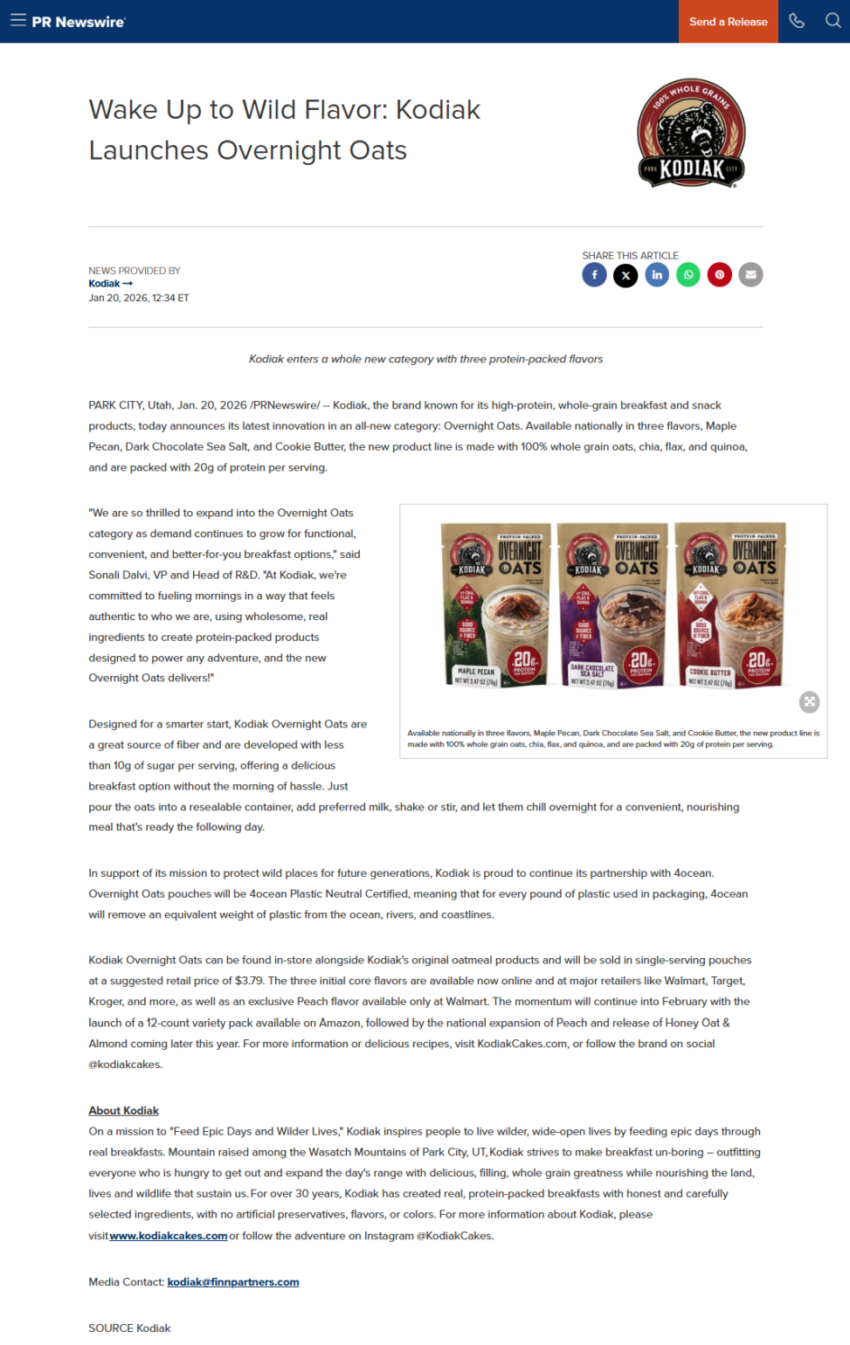
What Makes This Press Release Work:The Challenge: Breaking into a crowded overnight oats market while maintaining brand authenticity. Kodiak’s Solution: Position the launch as a natural extension of their protein-powered breakfast mission, not just trend-chasing. What Made It Work: Kodiak nailed the fundamentals most brands ignore. Their headline incorporated brand personality (“Wild Flavor”) instead of generic announcement-speak. The opening paragraph delivered everything journalists need in 50 words: credibility, innovation angle, differentiation (20g protein), and concrete details. They used an R&D executive quote to signal genuine innovation, included practical details (pricing, specific retailers, where to find it in-store), and wove in sustainability credentials naturally. Smart move: they teased upcoming flavors and exclusive partnerships to generate future coverage. Bottom Line: This press release respects journalists’ time with complete, specific information while maintaining brand voice throughout. It’s a masterclass in making product announcements actually newsworthy. |
Product launch press release example #2: Cruise Line Announces Rebrand
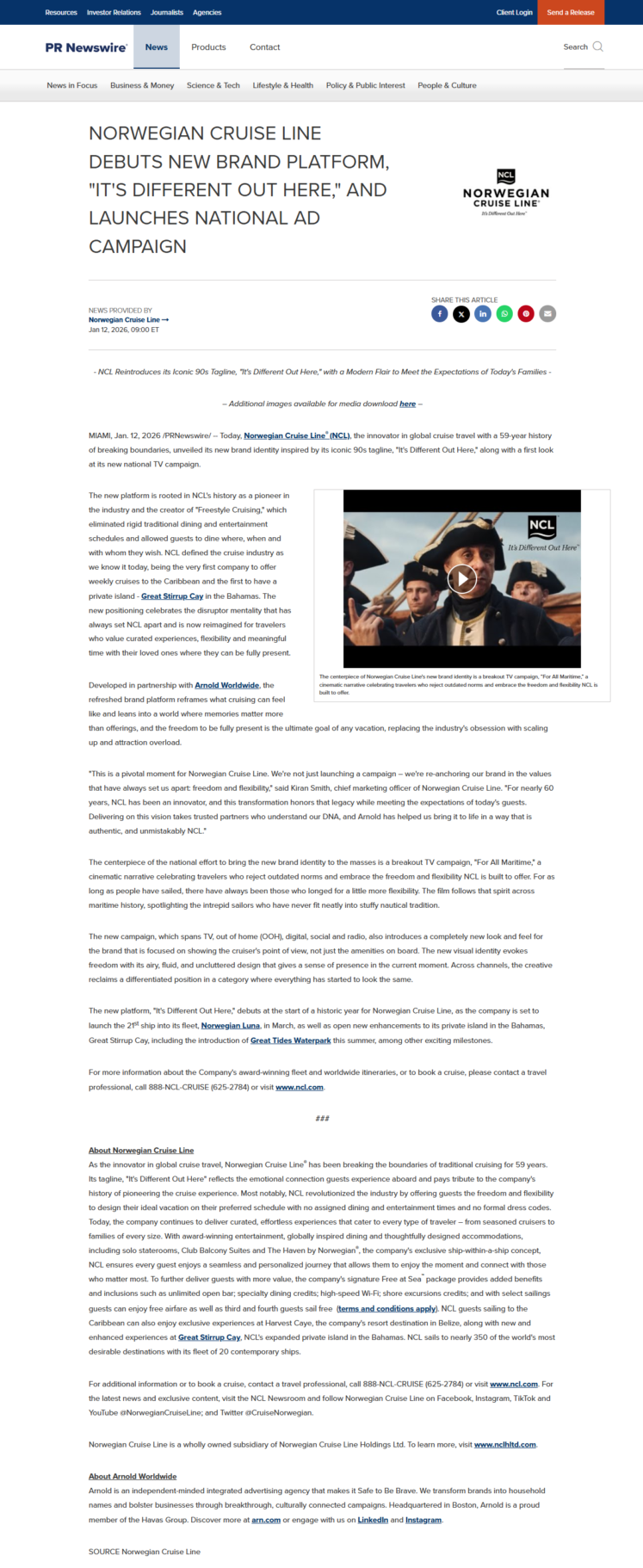
What Makes This Press Release Work:The Challenge: Standing out in a commoditized cruise market where every brand promises the same over-the-top amenities. NCL’s Solution: Revive their iconic 90s tagline “It’s Different Out Here” by repositioning it around modern values—presence, flexibility, and experiences over attractions. What Made It Work: Smart timing: they tied the rebrand to tangible milestones (new ship Norwegian Luna, waterpark opening) that give journalists multiple story angles. The campaign description is specific—”For All Maritime” with a cinematic maritime history narrative—making it memorable and giving media concrete details to reference. The agency partnership mention (Arnold Worldwide) adds credibility while the multi-channel rollout (TV, OOH, digital, social, radio) demonstrates serious investment behind the rebrand. Bottom Line: Successful nostalgia play that connects heritage to contemporary values while providing journalists multiple newsworthy angles. |
Product launch press release example #3: New B2B Service Launch
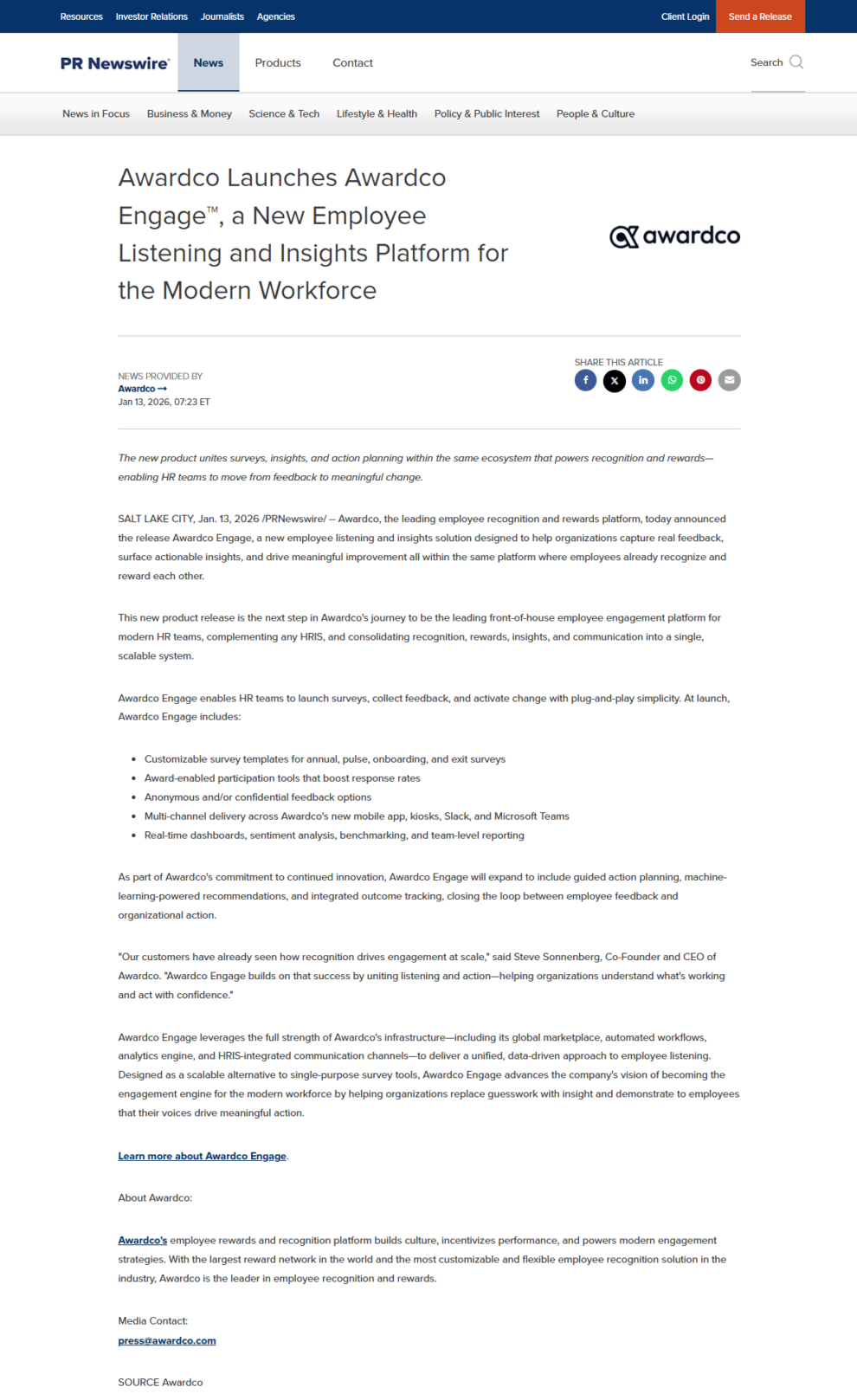
What Makes This Press Release Work:The Challenge: Entering the crowded employee survey market without diluting their core recognition platform focus. Awardco’s Solution: Position employee listening as a natural extension of recognition, not a separate product—”listen and act within the same ecosystem.” What Made It Work: Smart move: they previewed upcoming features (ML-powered recommendations, action planning) to signal continued investment. The CEO quote reinforced the integration angle—”uniting listening and action”—rather than just announcing another survey tool. What’s Missing: No customer testimonials, beta results, or pricing. The differentiation relies heavily on integration benefits without concrete proof points. Bottom Line: Solid B2B SaaS launch that positions a new feature as strategic platform expansion rather than feature bloat. |
Press release example #4: New product simplifies corporate travel planning
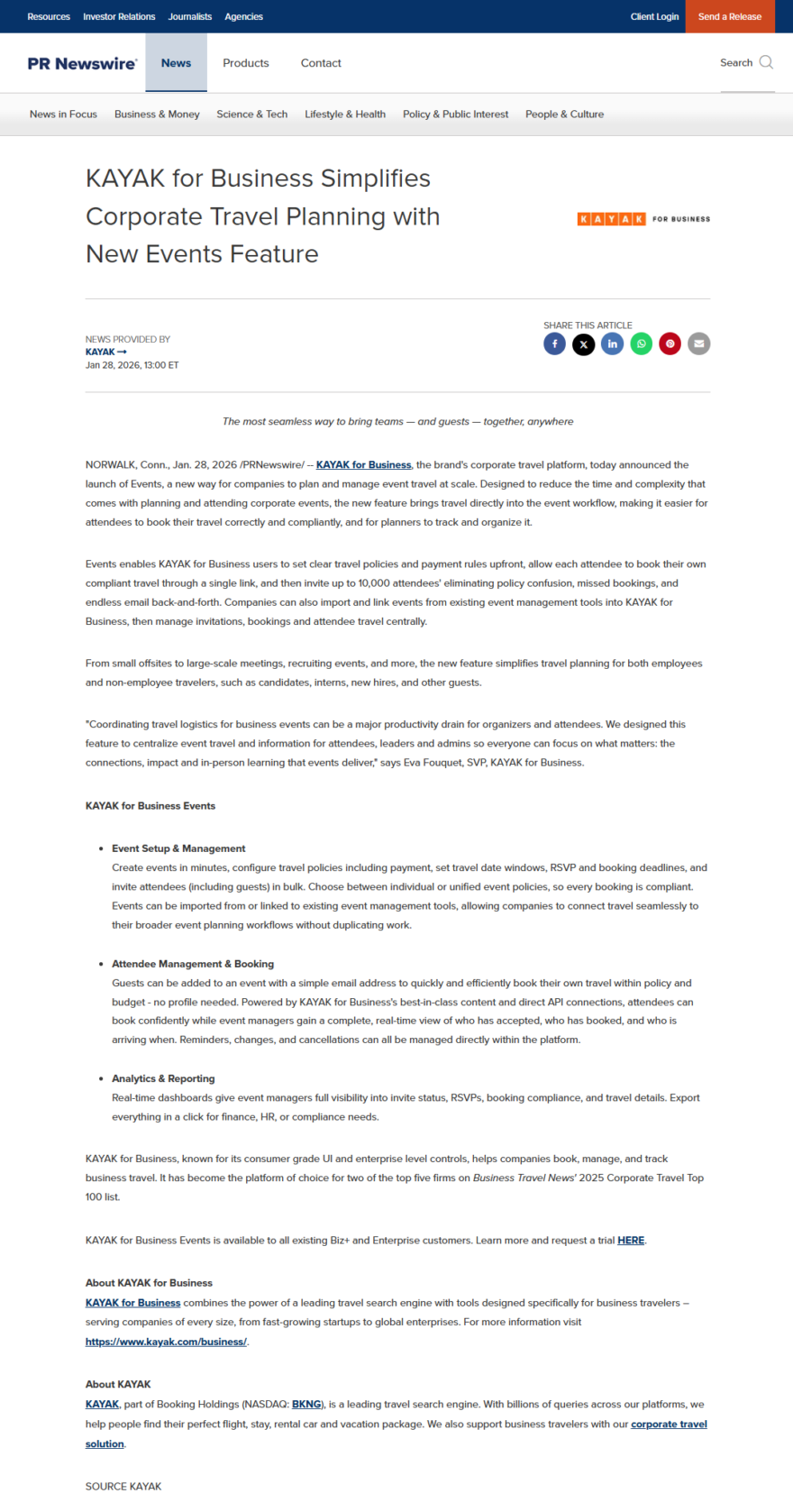
What Makes This Press Release Work:The Challenge: Corporate event travel coordination involves endless email chains, policy confusion, and booking chaos—especially at scale. KAYAK’s Solution: Build event travel management directly into their corporate travel platform, eliminating the need for separate tools and workflows. What Made It Work: The feature breakdown (Setup, Attendee Management, Analytics) makes the solution immediately understandable for buyers. Strong social proof: mentioning “two of the top five firms on Business Travel News’ 2025 Corporate Travel Top 100 list” adds enterprise credibility. The executive quote nailed the pain point—”major productivity drain”—before pivoting to outcomes that matter: “connections, impact and in-person learning.” Missing: Customer testimonials, beta results, or concrete time/cost savings metrics would strengthen the business case. Bottom Line: Solid B2B feature launch with clear value proposition and enterprise-ready positioning. |
Press release example #5: New product launch in non-U.S. market
Press release example #6: Food product launched in Target stores
Press release example #7: Software product enabled by another company’s technology
Press release example #8: Event based release – new product launched at the pyramids in Egypt
Press release example #9: Skin care company launches four new products
Press release example #10: Healthcare company launches new product updates
Press release example #11: Company launches new products at industry conference
Press release example #12: Learning company announces new features to improve customer experience
Press release example #13: Company is transforming its focus, launching 11 new products
Press release example #14: Site launches 100+ new products and features on its site
Press release example #15: New product wins award
Product Launch Press Release Templates
Writing a press release is always easier when you have a template into which you can plug your specific information. Here are three!
Product Launch Press Release Template 1: Standard Product Launch
|
[Company Logo]
FOR IMMEDIATE RELEASE [Headline: Company Name] Introduces [Product Name]: [Brief Catchy Description] [City, State, Date] – [Company Name], a [industry/sector] leader, proudly announces the release of its latest innovation – the [Product Name]. This cutting-edge [type of product] promises to [main benefit or value proposition] and revolutionize [industry/sector]. [Provide more details about the product and its significance, highlighting the company’s expertise and innovation.] [Key feature 1] The [Product Name] is available for [pre-order/online purchase] starting {date} at an exclusive introductory price of [$XX.XX]. It will officially hit the market on [Launch Date], with retail prices starting at [$XX.XX]. [Include quotes or endorsements from early testers or customers who have had a positive experience with the product.] To [pre-order/purchase] the [Product Name] or learn more about its features, visit our website at [Website URL]. For media inquiries, please contact [Media Contact Name] at [Media Contact Email] or [Media Contact Phone Number]. About [Company Name]: [Brief company description, highlighting key achievements and values.] [Reiterate the significance of the product launch and invite readers to be part of the innovation.] |
Product Launch Press Release Template 2: Software or App Launch
|
[Company Logo]
FOR IMMEDIATE RELEASE [Headline: Company Name] Unveils [Software/App Name]: [Brief Catchy Description] [Subheading or Summary: Additional context or exciting detail] [City, State, Date] – [Company Name], a leader in [industry/sector], is thrilled to introduce its latest software/application – [Software/App Name]. This groundbreaking [type of software/app] is set to [main benefit or value proposition] for [target audience or industry]. [Provide more details about the software/app, highlighting its uniqueness and the company’s expertise.] [Key feature 1] [Describe how users can access or download the software/app and mention any pricing details if applicable.] [Include quotes or endorsements from early users or beta testers who have had a positive experience with the software/app.] To [download/access] [Software/App Name] or learn more about its features, visit our website at [Website URL]. For media inquiries, please contact [Media Contact Name] at [Media Contact Email] or [Media Contact Phone Number]. About [Company Name]: [Brief company description, highlighting key achievements and values.] [Reiterate the significance of the software/app launch and invite users to explore its benefits.] |
Product Launch Press Release Template 3: Storytelling Press Release
|
FOR IMMEDIATE RELEASE
[Company Logo] Headline: [Company Name] Introduces [Product Name]: The Journey of Innovation Subheading or Summary: [Additional context or exciting detail] [City, State, Date] – In a tale of innovation and dedication, [Company Name] proudly introduces [Product Name], a product that has been years in the making. This remarkable journey is a testament to our commitment to [core value or mission] and our unwavering passion for [industry/sector]. [The Story Unfolds: Craft a narrative that tells the story behind the product launch, including challenges, breakthroughs, and the people involved.] [Key feature 1] – [Describe how it was conceived] The [Product Name] is available for pre-order starting today at an exclusive introductory price of [$XX.XX]. It will officially hit the market on [Launch Date], with retail prices starting at [$XX.XX]. [Include quotes or endorsements from early testers or customers, framed within the storytelling narrative.] To pre-order the [Product Name] and become a part of our innovation journey, visit our website at [Website URL]. For media inquiries and interview opportunities related to the product’s journey, please contact [Media Contact Name] at [Media Contact Email] or [Media Contact Phone Number]. |
How to Write a New Product Press Release
Writing a product launch press release doesn’t have to be complicated, but it does require a clear structure and strategic thinking. Here’s your step-by-step guide:
Start With a Compelling Headline
Your headline should accomplish three things: identify your company, name the product, and hint at the benefit. Avoid generic phrases like “announces new product” in favor of something more specific and engaging.
Generic: “Kodiak Announces New Product Launch”
Better: “Wake Up to Wild Flavor: Kodiak Launches Overnight Oats”
The second version incorporates brand personality (“Wild”), creates intrigue, and clearly states what’s new.Craft a Strong Lead Paragraph
Your opening paragraph needs to pack in the essentials without feeling cluttered. In 50-75 words, you should cover:
– Who you are (with brief credibility marker)
– What you’re launching (specific product name)
– Why it matters (key benefit or innovation)
– Core differentiation (what makes it unique)
– When/where it’s available
Look at how KAYAK did this: “KAYAK for Business, the brand’s corporate travel platform, today announced the launch of Events, a new way for companies to plan and manage event travel at scale. Designed to reduce the time and complexity that comes with planning and attending corporate events, the new feature brings travel directly into the event workflow…”
In two sentences, they established credibility, named the feature, explained the problem it solves, and hinted at the solution approach.Include a Strategic Executive Quote
Your executive quote should do more than say “we’re excited.” Use it to:
– Provide strategic context for the launch
– Connect to market trends or customer needs
– Reinforce your differentiation
– Show thought leadership
Match the executive to the message. If you’re announcing product innovation, quote your Head of R&D or Chief Product Officer. For strategic partnerships, use your CEO or Business Development lead. For category expansion, your CMO can speak to market positioning.Provide Practical Details Journalists Actually Need
Don’t make journalists hunt for basic information. Include:
– Pricing: Actual numbers, not “competitive pricing” or “contact us”
– Availability: Specific retailers, regions, or how to access
– Timeline: Launch dates, pre-order windows, future releases
– Specifications: Key features, technical details, what’s included
Kodiak nailed this by listing specific retailers (Walmart, Target, Kroger), pricing ($3.79), and a product roadmap (Amazon variety pack in February, new flavors later).Add Credibility Builders
Strengthen your announcement with:
– Third-party validation: Expert endorsements, beta tester quotes, industry analyst commentary
– Data points: Market growth statistics, customer problem quantification
– Partnerships: Technology integrations, distribution partnerships, celebrity/influencer connections
– Awards or certifications: Industry recognition, sustainability certifications
Norwegian Cruise Line mentioned their Arnold Worldwide partnership and tied the rebrand to tangible milestones (new ship launch, private island enhancements), giving journalists multiple angles to cover.Include Visual Assets
A press release without images is a missed opportunity. Provide:
– High-resolution product photos
– Lifestyle images showing the product in use
– Infographics highlighting key features or benefits
– Video content if available
– Logo files and brand assets
Make these easy to download and clearly indicate they’re available for media use.Write a Clear “About” Section
Your boilerplate should be concise (75-100 words) and include:
– What your company does
– Key differentiators or achievements
– Brief history if relevant
– Where you’re headquartered
– Where to learn moreAdd Contact Information
Make it ridiculously easy for journalists to reach you:
– Media contact name and title
– Direct phone number
– Email address
– Link to press kit or media resources
– Social media handles, if appropriateStructure for Scannability
Most people won’t read every word. Make it easy to scan:
– Use short paragraphs (2-4 sentences max)
– Add subheadings for longer releases
– Bold key facts sparingly
– Use bullet points only for feature lists or specifications
– Keep total length to 400-600 words (one page)
The Critical Elements Checklist
Before hitting send, make sure your press release includes:
- Compelling, specific headline
- Clear lead paragraph with all essentials
- Strategic executive quote that adds value
- Concrete pricing and availability details
- Third-party validation or credibility markers
- Product roadmap or “what’s next” teaser
- High-quality visual assets
- Complete contact information
- Professional boilerplate
- Zero typos or formatting errors
What to Avoid
Don’t: Use excessive marketing hyperbole (“revolutionary,” “game-changing,” “industry-leading” without proof)
Don’t: Bury key information in later paragraphs
Don’t: Skip specifics in favor of vague promises
Don’t: Forget to proofread (seriously, typos kill credibility)
Don’t: Make it all about features—connect to customer benefits
Don’t: Send without testing all links
The Real Secret: Make Journalists’ Jobs Easier
The best product launch press releases give journalists everything they need to write a story without conducting additional research. If a reporter can draft an article using only your press release, you’ve succeeded.
Think of your press release as a gift to busy journalists: a complete, pre-researched story package they can quickly adapt and publish. That’s how you get coverage.
Product Launch Press Release FAQ
When should I send out a product launch press release?
Timing depends on your product and industry. For consumer products, send your press release 2-3 weeks before launch to give journalists time to review and write stories that publish on launch day. For B2B products, you can send closer to launch (1-2 weeks) since the sales cycle is longer. Tech products often benefit from embargoed releases sent to key publications 1-2 weeks early with a specific publish date.
Pro tip: Check your industry’s major conference schedule. Launching just before a major trade show can generate buzz, but launching during one means your news competes with hundreds of other announcements.
How long should a product launch press release be?
Aim for 400-600 words—roughly one page. This gives you enough space to cover all essential information without losing readers’ attention. Our analysis of successful press releases shows they typically run 450-550 words. Anything longer than 750 words is too long; anything shorter than 300 words probably lacks important details.
Should I include pricing in my press release?
Almost certainly, yes. One of the biggest mistakes we see is companies avoiding pricing details. Journalists need this information, and omitting it makes them hunt for details or skip your story entirely. If pricing varies significantly, provide a range or starting price. The only exception: if you’re in enterprise B2B where pricing is truly custom, say “pricing available upon request” and link to your sales team.
Who should I send my press release to?
Start with your target media list: journalists who cover your industry, beat reporters at major publications, bloggers in your niche, and industry trade publications. Use press release distribution services (eReleases) for broad distribution, but also send personalized pitches to key journalists. Don’t forget to share with your email list, post on social media, and add to your website’s press room.
Can I use marketing language in a press release?
Use it sparingly. While you want your product to sound appealing, excessive marketing hyperbole (“revolutionary,” “game-changing,” “world’s best”) without supporting evidence undermines credibility. Journalists prefer factual, specific language. Instead of “revolutionary AI technology,” say “AI-powered document analysis that reduces review time by 60%.” Let the facts speak for themselves.
What if my product isn’t actually that newsworthy?
Then find an angle that is. Can you tie it to a trend, market shift, or customer problem? Do you have an interesting founder backstory or partnership news? Are you entering a new category or solving a problem in a novel way? Norwegian Cruise Line turned a rebrand into news by connecting it to their heritage and upcoming milestones. If you truly can’t find a newsworthy angle, consider whether a press release is the right format—a blog post or social campaign might serve you better.
How do I handle multiple products or features launching at once?
You have two options: Bundle them into one announcement with a unifying theme (like Kodiak’s three flavors positioned as a new category entry), or stagger releases over several weeks. Bundle when products are related or support a larger story. Stagger when each product deserves its own spotlight or targets different audiences. Don’t just list features—tell the story of why they matter together.
Should I include customer testimonials or case studies?
If you have them, absolutely include them. Third-party validation from customers, beta testers, or early adopters significantly strengthens your press release. Even one sentence from a customer about how your product solved their problem adds credibility. This was a notable weakness in several examples we analyzed—Covenant and Awardco would have been much stronger with customer proof points.
What should I do after sending my press release?
Follow up strategically. Wait 2-3 days, then send personalized follow-up emails to your top-tier targets offering additional information, interviews, or exclusive angles. Monitor coverage and share any pickup on social media (journalists love when their work gets shared). Track metrics: how many outlets picked it up, what traffic came to your site, and any leads generated. Add the press release to your website’s press room. Most importantly, respond quickly to any journalist inquiries—you have maybe 2-4 hours to respond before they move on to another story.
Learn More About Writing New Product Press Releases
Product launches are such a vital part of your business that we have written an entire tutorial on how to write a new product press release. You can access it here.
Finally, here are some tips and training to help you write an amazing press release:
Additional Press Release Resources
- Directory of Examples & Templates
- What is a Press Release?
- Press Release Template & Format (including a blank press release example)
- Learn How to Format a Press Release (+ Free Template and 80+ Examples)
- Learn How to Write a Press Release
- How to Submit a Press Release
- To Write a Press Release Yourself or Not?
- 80+ Example Press Releases
- Press Release Syndication Services
- Using AI For Press Releases
- Small Business PR: How to Get Big Media Coverage on a Small Business Budget
- Using Data to Create Newsworthy Press Releases
- The Value of Cision PR Newswire Distribution for Small Businesses
- The Importance of Strong Quotes in Press Releases
- The Ultimate Public Relations Dictionary – Terms Every PR Pro Should Know
- Top 10 PR KPI Metrics Every PR Pro Should Track
- Rebrand and Logo Redesign Press Release Examples and Templates
Get real ROI on your press release, plus save 30% on your first order.

Mickie Kennedy founded eReleases.com in 1998 after watching PR firms charge small businesses a $20,000 minimum for a single press release. For 27 years, he’s been closing that gap — distributing 150,000+ releases via Cision PR Newswire, serving 30,000+ clients including Manscaped, Squatty Potty, and 40+ Shark Tank brands, and generating $132M+ in earned media. A sought-after podcast guest and two-time Amazon bestselling author of Beginner’s Guide to Writing Powerful Press Releases and The PR Strategy Manifesto. Mickie holds an MFA in Creative Writing from George Mason University. Based in Baltimore, MD. LinkedIn