 A good partnership gives you more than a relationship. It gives you a story.
That story may be a new product, a shared service, a community effort, a research project, or a distribution agreement. The mistake many businesses make is treating a partnership announcement as a formality: “Company A partners with Company B.”
That may be true, but it is rarely enough to interest a journalist.
The real question is: what changes because of this partnership?
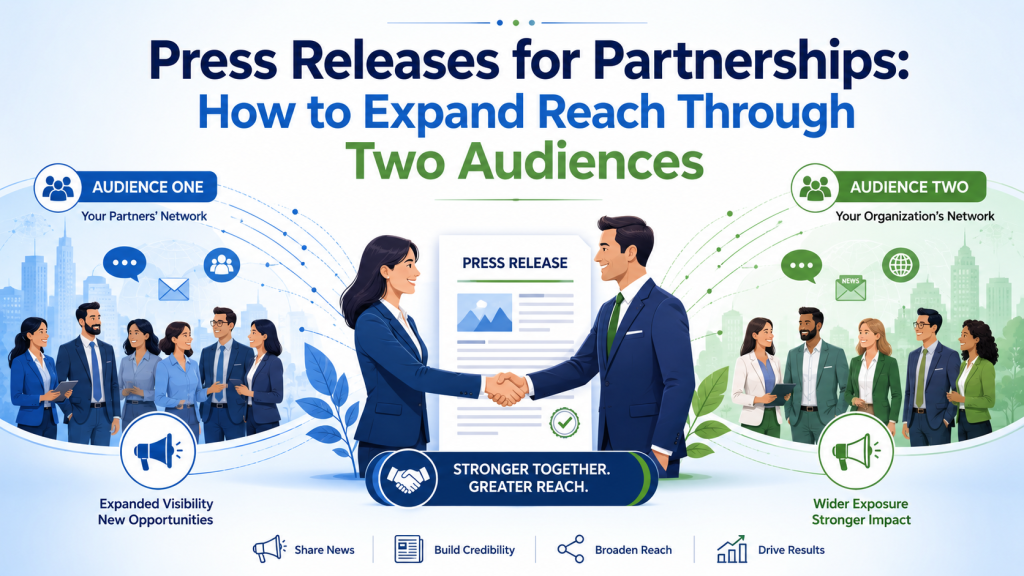
When two organizations come together, you have two audiences, two credibility pools, and often two sets of media contacts. A strong press release turns that combined attention into a clear, useful story.
Why Partnership Announcements Work
Partnerships are newsworthy when they create something new.
A company hiring a vendor is not usually news. A company teaming up with another organization to solve a customer problem, enter a market, expand access, or launch something useful may be.
Journalists do not cover partnerships because two executives shook hands. They cover them because the partnership points to a larger need, trend, or problem being solved.
A healthcare clinic partnering with a transportation nonprofit is a story about improving access to care. That is where the release should focus.
Start With the Shared Audience
Before writing the release, ask a simple question: who benefits?
Not who signed the agreement. Not who gets the logo placement. Who actually gets something useful?
The answer may be customers, patients, students, franchise owners, local residents, nonprofit donors, or industry professionals.
Once you know the shared audience, the release gets easier to write. Your headline becomes clearer. Your opening paragraph has a purpose. Your quotes sound less like promotion and more like explanation.
A weak angle says:
“ABC Company Announces Strategic Partnership with XYZ Company.”
A stronger angle says:
“ABC and XYZ Partner to Help Independent Retailers Cut Inventory Costs.”
The second version gives the reader a reason to care.
Use Both Brands, But Keep One Clear Story
A partnership release should mention both organizations clearly. It should explain what each partner brings to the table. But it should not read like two company brochures stapled together.
Pick one central news angle. Then show how each partner supports it.
One partner may bring technology. The other may bring local reach, funding, expertise, a product, or distribution.
Keep the focus on the outcome, not the internal arrangement. Think of it like a recipe. The ingredients matter, but people care most about the meal.
Build the Release Around the “Why Now?”
Partnership announcements become stronger when you explain timing.
Why is this happening now? What changed in the market? What customer problem became more urgent?
Maybe small businesses are struggling with hiring. Maybe schools need new mental health resources. Maybe homeowners are looking for energy savings.
The “why now” gives the release context. A release without timing can feel like corporate housekeeping. A release with timing can feel like news.
Give Each Partner a Distinct Role
One of the easiest ways to make a partnership release stronger is to define each partner’s role in one sentence.
For example:
“Under the partnership, BrightPath will provide the software platform, while Northside Credit Union will offer the program to its small business members.”
That sentence tells the reader what is happening. It avoids vague phrases like “leverage synergies” or “combine strengths.” It makes the relationship easy to understand.
If you cannot explain each partner’s role in plain English, the announcement is not ready.
Write Quotes That Add Meaning
Quotes in partnership releases often fall flat because they sound interchangeable.
“We are excited to partner with…”
“We look forward to working together…”
“This partnership reflects our shared commitment…”
Those lines are safe, but they do not add much.
Use quotes to explain why the partnership matters. One quote can focus on the customer problem. The other can focus on the solution or future impact.
For example:
“Independent restaurants do not need another dashboard,” said Jane Smith, CEO of MarketTable. “They need a simple way to see what is selling, what is sitting, and where they are losing money.”
That quote has a point of view. It helps the journalist understand the story.
Share the Release With Both Audiences
A partnership gives you a built-in distribution advantage, but only if both sides use it.
Each partner should share the announcement through its own channels: email lists, social media accounts, customer newsletters, trade associations, sales teams, and media contacts.
The release should live on both websites, when appropriate. Each company can write a short intro tailored to its audience and link to the full announcement.
Do not assume one partner will carry the promotion. Plan it together before the release goes out.
A simple checklist helps:
- Agree on the main message.
- Approve the release and quotes.
- Decide who handles media outreach.
- Prepare social posts for both companies.
- Notify customers or stakeholders.
- Track inquiries, coverage, and referral traffic.
That little bit of planning can double the reach.
Pitch Different Angles to Different Media
The same partnership can mean different things to different reporters.
Local media may care about jobs, community impact, or regional growth. Trade media may care about the industry problem being solved. Business media may care about market expansion or customer demand.
Do not send every reporter the same pitch.
If a local company partners with a national brand, the local angle might be, “Local company expands reach through national partnership.” The trade angle might be, “New partnership helps manufacturers reduce compliance delays.”
Same release. Different doorway.
That is how you make outreach feel relevant instead of random.
Include Practical Details
A partnership release should answer the basics quickly:
Who are the partners?
What are they doing together?
Who benefits?
When does it begin?
Where is it available?
Why does it matter?
How can customers, members, or stakeholders take part?
If the partnership includes a new service, explain how someone can access it. If it includes a product launch, explain availability. If it includes an event, include the date and location.
Clear details prevent confusion. They also make the release easier for a journalist to use.
Avoid Hype. Use Specifics.
Partnership language can get inflated fast. “Transformative,” “game-changing,” and “revolutionary” are rarely needed.
Be specific instead.
Say the partnership expands delivery to 12 new states. Say it gives 50,000 members access to a new tool. Say it reduces onboarding time from three weeks to three days.
Specifics beat adjectives.
The Best Partnership Releases Create Momentum
A press release should not be the only thing you do with a partnership announcement. It should be the starting point.
After distribution, both partners can use the news in follow-up emails, sales conversations, investor updates, speaking pitches, webinars, case studies, and customer onboarding.
The release gives the partnership a public record. The follow-up turns it into momentum.
You are not just telling the market that two companies are working together. You are showing two audiences why the work matters.
When the story is clear, both partners benefit. Each one brings trust, reach, and relationships. The press release simply gives all of that a common message.

Mickie Kennedy founded eReleases.com in 1998 after watching PR firms charge small businesses a $20,000 minimum for a single press release. For 27 years, he’s been closing that gap — distributing 150,000+ releases via Cision PR Newswire, serving 30,000+ clients including Manscaped, Squatty Potty, and 40+ Shark Tank brands, and generating $132M+ in earned media. A sought-after podcast guest and two-time Amazon bestselling author of Beginner’s Guide to Writing Powerful Press Releases and The PR Strategy Manifesto. Mickie holds an MFA in Creative Writing from George Mason University. Based in Baltimore, MD. LinkedIn