Ask AI for a short summary of this article
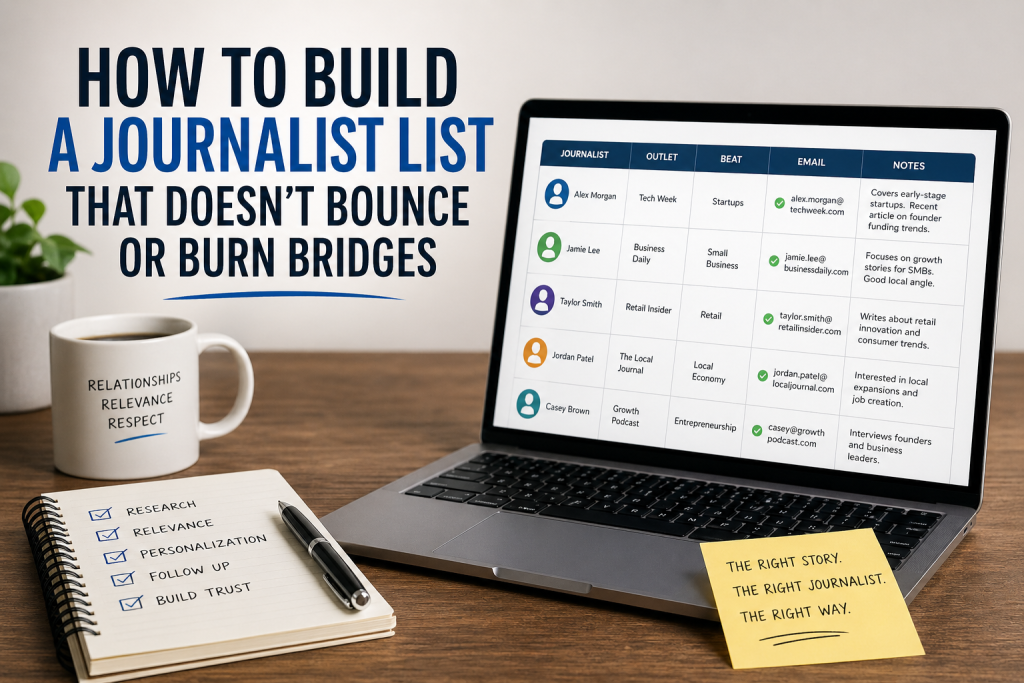
A good journalist list is not a spreadsheet full of names.
It is a working map of people who may genuinely care about your story.
That difference matters.
Too many businesses treat media lists like volume plays. They grab a database, export hundreds or thousands of contacts, paste them into an email platform, and hope… The result is usually predictable: bounced emails, spam complaints, annoyed reporters, and little – usually no – coverage.
A smaller, cleaner, better-researched journalist list will almost always outperform a large, sloppy one.
Why?
Because journalists are not leads. They are not prospects. They are people with beats, deadlines, inbox overload, and a very low tolerance for irrelevant pitches.
If you want media coverage, your list has to be built with care. Not because “relationship building” sounds nice, but because it is practical. It improves delivery. It improves response rates. It protects your reputation. And it keeps you from burning bridges before you ever get a chance to cross them.
Let’s walk through how to build a journalist list that works.
Start With the Story, Not the Spreadsheet
Before you look for a single journalist, get clear on the story.
This sounds obvious, but it is where many media lists go wrong.
A business says, “We want coverage,” then builds a list of every reporter who has ever written about startups, small business, tech, health, finance, or lifestyle.
That is not targeting. That is wishful thinking with columns.
Start by asking:
- What is actually newsworthy here?
- Who would care about this?
- Is the story local, industry-specific, consumer-focused, data-driven, seasonal, or tied to a trend?
- What kind of outlet would realistically cover this?
- What kind of journalist has written about similar stories before?
A new product launch may interest trade publications if it solves a real industry problem. A local expansion may interest business reporters in your city. A study with surprising findings may appeal to data-driven journalists or trend reporters. A founder story may work for podcasts, local media, or entrepreneurial outlets.
The story determines the list.
Not the other way around.
Define Your Media Categories
Once you know the story, break your list into practical categories.
For most small businesses, these categories might include:
- Local media
Newspapers, local business journals, TV assignment desks, local radio, and community publications. For a deeper look at local outreach, this guide to local press release distribution explains how to build a media list around geography, relevance, and coverage fit. - Trade media
Publications that cover your industry, niche, or professional audience. - Consumer media
Outlets that reach your target customers directly. - Podcasts and newsletters
Often overlooked, but frequently more accessible and more targeted. - Freelance journalists
Writers who contribute to multiple outlets and may be interested in fresh sources or story angles. - Influential bloggers or niche publishers
Not every valuable media mention comes from a traditional newsroom.
This helps you avoid building one giant, unfocused list. Instead, you create smaller groups with different pitch angles.
A local business reporter may care that your company is hiring 40 people in Baltimore. A trade editor may care that your new service solves a common bottleneck in the industry. A podcast host may care about the founder’s unusual path.
Same announcement. Different angles. Different contacts.
That is how good outreach works.
Look for Beat Fit First
The most important question when adding a journalist to your list is simple:
“Does this person actually cover stories like mine?”
Not “Could they maybe be interested?”
Not “They work at a big outlet.”
Not “They covered something vaguely related three years ago.”
Look at what they have written recently.
A journalist’s beat is their coverage area. It may be listed in their bio, but the best evidence is their actual work.
Read several of their recent articles. Look for patterns.
Do they cover small businesses? Funding? Retail? Restaurants? Healthcare startups? Workplace trends? Personal finance? Local development? Legal issues? Technology? Consumer behavior?
A reporter who covers venture capital is not automatically a fit for your small business announcement. A health reporter may not cover your wellness product unless there is a credible research or public health angle. A local business reporter may cover your expansion, but not your generic product update.
This is where many businesses get impatient.
They want to move quickly, so they add anyone with a title that looks close enough.
But “close enough” is where bad pitches go to die.
Check Recent Activity
Google’s email sender guidelines are a good reminder that sloppy outreach can become a deliverability problem, not just a PR problem.
A journalist list goes stale quickly.
Reporters change jobs. Publications shut down sections. Freelancers shift beats. Email addresses stop working. Some writers leave journalism entirely.
That is why you need to check recent activity before pitching.
Look for signs that the journalist is still active:
- Have they published recently?
- Is their outlet profile current?
- Are they active on LinkedIn, X, Bluesky, Threads, or another public platform?
- Have they changed publications?
- Do they list a preferred contact method?
- Do they say they are not accepting pitches?
You do not need to become a private investigator. You just need to avoid sending your news to abandoned inboxes or outdated addresses.
This also helps reduce bounces.
High bounce rates hurt your sender reputation. If you are emailing from your company domain, that matters. Email providers pay attention. A sloppy list can affect your ability to reach not only journalists, but customers, partners, and vendors.
A clean list is not just a PR asset. It is an email deliverability asset.
Use the Right Email Address
Finding the right journalist is only half the job.
You also need the right email address.
Start with the journalist’s outlet bio page. Many reporters list their email there. If not, check their social profiles, personal website, Muck Rack profile, author page, or recent bylines.
Some outlets use standard email formats. But do not guess unless you have some confidence. Guessing at scale creates bounces.
Also, avoid sending sensitive or personalized pitches to generic inboxes unless that is clearly the outlet’s preferred method.
Generic addresses like news@, tips@, editor@, or assignmentdesk@ can be useful for certain local or breaking news announcements. But they are rarely a substitute for a relevant journalist who covers your topic.
Think of it this way: if your story needs context, pitch a person. If it is a broad local announcement or event notice, a general newsroom address may have a role.
But do not rely on “editor@” and call it media outreach.
That is usually just shouting into the lobby.
Keep the List Small Enough to Manage
A strong journalist list does not have to be huge.
For many small business announcements, a targeted list of 25 to 75 journalists may be more effective than a list of 500.
For a local story, you may only need 15 to 30 solid contacts.
For a niche trade story, 30 to 60 well-matched writers and editors may be enough.
For a national consumer story with broad appeal, the list can be larger, but it still needs segmentation.
The point is not to impress yourself with the number of rows in the spreadsheet. The point is to give each pitch a fair shot.
Can you personalize the pitch enough to show relevance? Can you track responses? Can you avoid sending the same stale note to people with very different beats?
If the list is too large to handle thoughtfully, it is probably too large.
Build Useful Columns
Your journalist list should help you make better decisions.
At minimum, include columns such as:
- Journalist name
- Outlet
- Email address
- Beat or coverage area
- Recent relevant article
- Link to article
- Why they are a fit
- Location
- Media category
- Preferred contact notes
- Date verified
- Outreach status
- Response notes
- Follow-up date
The “why they are a fit” column may be the most important one.
It forces you to justify every contact.
If you cannot explain why a reporter belongs on the list, they probably do not belong there.
Here is a simple example.
Instead of adding:
“Jane Smith — Business Reporter — Daily News”
Add:
“Jane Smith — Daily News — Covers local small business growth and workforce stories. Recently wrote about a family-owned manufacturer expanding into a second facility. Possible fit for our hiring and expansion announcement.”
That one sentence tells you how to pitch her.
It also prevents lazy outreach later.
Segment Before You Pitch
Do not send the same pitch to everyone.
Segment your list by angle.
For example, if your announcement is a new product from a small business, your segments might look like this:
- Local business reporters: focus on the company’s growth, jobs, local founder, or regional impact.
- Trade media: focus on the problem the product solves for the industry.
- Consumer media: focus on the customer benefit or trend.
- Podcasts: focus on the founder’s story, lessons learned, or contrarian viewpoint.
- Newsletters: focus on useful takeaways for their specific audience.
This does not mean rewriting everything from scratch.
It means leading with the part of the story that matters most to that journalist’s readers.
A reporter should not have to figure out why your pitch belongs in their inbox. That is your job.
Respect What Journalists Do Not Want
The fastest way to burn a bridge is to ignore clear signals.
If a journalist says they do not cover product launches, do not send them your product launch.
If they say they prefer email, do not DM them repeatedly.
If they say they are on leave, do not follow up three times.
If they cover enterprise software, do not pitch them a local bakery opening unless there is a real business angle that fits their work.
This is not complicated. It is basic respect.
Journalists remember people who waste their time. They also remember people who consistently send relevant, clear, useful information.
You want to be in the second group.
Avoid Mass-Blast Behavior
Even if you use an email tool, your outreach should not feel like a blast.
Here are a few mistakes that damage relationships:
- Sending one generic pitch to hundreds of journalists.
- Using mail merge fields that break or look awkward.
- Pitching multiple journalists at the same outlet with the exact same note at the same time.
- Adding journalists to newsletters without permission.
- Sending repeated follow-ups after no response.
- Using misleading subject lines.
- Pretending you read their work when you clearly did not.
Journalists can spot fake personalization immediately.
“Hi [First Name], I loved your recent article” is not personalization.
Referencing a specific article and explaining the connection in one sentence is.
For example:
“I saw your recent piece on how independent retailers are using loyalty programs to compete with larger chains. Our new survey found that repeat customers now account for 64% of revenue for small specialty retailers, which may be useful for a follow-up story.”
That is relevant. It connects to their work. It gives them something they can use.
Verify Before Every Campaign
Do not assume last quarter’s list is still good.
Before each campaign, review and update it.
Check:
- Is the journalist still at the outlet?
- Do they still cover the same beat?
- Is the email address still valid?
- Have they recently written about this topic?
- Have you pitched them recently?
- Did they respond positively or negatively last time?
This step saves embarrassment.
It also protects relationships.
There are few things more frustrating for a journalist than receiving a pitch that proves the sender did not bother to check whether they still work there.
A list is not a one-time asset. It is a living file.
Treat it that way.
Track Responses Like a Human, Not a Sales Machine
When a journalist responds, update your list.
That includes:
- Interested
- Not interested
- Wrong beat
- Asked for more information
- Requested interview
- Out of office
- Asked not to be pitched
- Preferred a different contact
- Covered the story
- No response
These notes help you improve future outreach.
If a journalist tells you, “I don’t cover this beat anymore, but my colleague does,” that is valuable. Update the list. Thank them. Do not pitch them the same irrelevant story next month.
If a reporter covers your story, make a note of it. Share the article. Thank them. Do not immediately ask for another favor.
PR is not just getting the hit. It is earning the next conversation.
Follow Up Without Being a Pest
A follow-up can help.
Three follow-ups can hurt.
For most pitches, one thoughtful follow-up is enough. Sometimes two, if the story is timely and genuinely relevant. But after that, move on.
A good follow-up is short. It adds value or clarifies why the story matters now.
For example:
“Just following up in case this is useful for your small business coverage this week. The local angle is that we’re adding 18 jobs in the county and opening the new facility on May 14. Happy to send photos or make the founder available.”
That is useful.
A bad follow-up says:
“Just bumping this to the top of your inbox.”
That helps no one.
If there is no response, do not take it personally. Journalists miss good stories every day because they are busy, understaffed, or focused elsewhere. Silence is not always rejection. But it is also not permission to keep nudging forever.
Remove People When Needed
A healthy list gets smaller as well as larger.
Remove or suppress contacts when:
- Their email bounces.
- They leave journalism.
- They change beats.
- They ask not to be contacted.
- They consistently prove to be a poor fit.
- You cannot verify their contact details.
- The outlet is no longer relevant.
This is where discipline matters.
Many businesses keep bad contacts because they do not want the list to shrink. But a smaller clean list is better than a large messy one.
Dead contacts do not create coverage. They create deliverability problems.
Wrong contacts do not create opportunities. They create irritation.
Use Media Databases Carefully
If you are starting from scratch, a simple media list example can help you decide which columns to include before you begin pitching.
Media databases can be useful.
They can help you discover journalists, identify beats, find contact information, and build a starting point faster than manual research alone.
But a database is not a substitute for judgment.
Do not export a list and assume it is ready.
Review each contact. Check recent articles. Confirm the beat. Verify the outlet. Segment the list. Add notes.
The database gives you raw material. You still have to build the list.
Think of it like buying ingredients. You still have to cook.
The Best Lists Are Built Over Time
Your first journalist list does not need to be perfect.
It needs to be thoughtful.
Start with the best-fit contacts. Pitch them respectfully. Track what happens. Improve the list after every campaign.
Over time, you will learn which reporters respond, which outlets care about your kind of news, which angles work, and which topics fall flat.
That knowledge is hard to buy. It comes from doing the work.
A business that sends five relevant pitches over six months will usually build more goodwill than a business that blasts 500 people once and disappears.
Media relationships are not built by one big push. They are built by repeated relevance.
That is why your list should also include relationship notes, not just contact details. Track who responded, what they cared about, and how they prefer to be approached. Over time, those small details help you do a better job of maintaining relationships with the media instead of starting cold with every new announcement.
A Simple Process You Can Follow
Here is a practical way to build your list:
- Define the story.
Write one sentence explaining why the announcement matters. - Choose your media categories.
Local, trade, consumer, podcast, newsletter, freelance, or niche. - Find journalists by beat.
Search recent coverage, not just job titles. - Read before adding.
Review at least two or three recent pieces when possible. - Verify the contact.
Use the outlet page, journalist bio, social profile, or trusted database. - Add the reason they fit.
If you cannot write the reason, do not add them. - Segment the list.
Group contacts by the angle you will pitch. - Personalize lightly but honestly.
One relevant sentence is better than fake flattery. - Track every outcome.
Responses, bounces, coverage, wrong-beat notes, and opt-outs. - Clean the list after each campaign.
Remove bad contacts. Update good ones. Add better fits.
This process takes more time than exporting a giant list.
It also works better.
Final Thought
A journalist list should not be built to make you feel busy.
It should be built to give your story the best chance of being seen by the right person.
That means fewer contacts, better research, cleaner data, and more respect for the person on the other side of the inbox.
Will that take longer?
Yes.
But so does repairing your reputation after a bad blast.
Build the list like you expect to use it again. Because if your business keeps doing newsworthy things, you will.
And when that next story comes along, you will not be starting from zero. You will have a cleaner list, better notes, and a stronger sense of who actually cares.
That is how media outreach gets easier.
Not because journalists suddenly have more time.
Because you stop wasting theirs.

Mickie Kennedy founded eReleases.com in 1998 after watching PR firms charge small businesses a $20,000 minimum for a single press release. For 27 years, he’s been closing that gap — distributing 150,000+ releases via Cision PR Newswire, serving 30,000+ clients including Manscaped, Squatty Potty, and 40+ Shark Tank brands, and generating $132M+ in earned media. A sought-after podcast guest and two-time Amazon bestselling author of Beginner’s Guide to Writing Powerful Press Releases and The PR Strategy Manifesto. Mickie holds an MFA in Creative Writing from George Mason University. Based in Baltimore, MD. LinkedIn