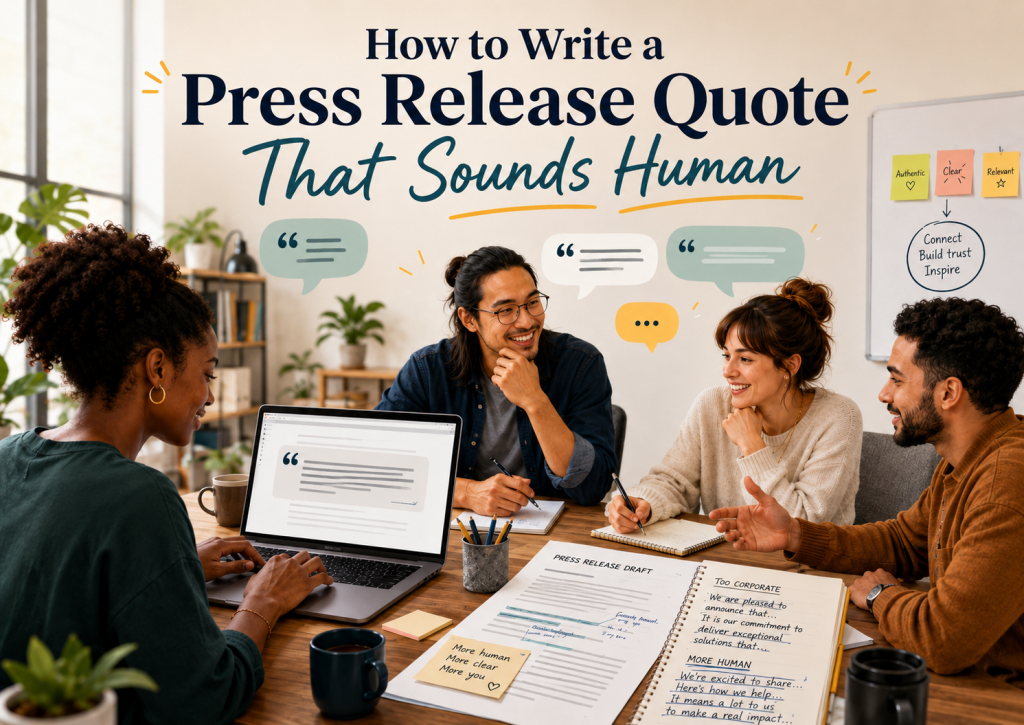
Most press release quotes sound like they were assembled in a conference room by people trying not to offend anyone.
You’ve seen them.
“We are thrilled to leverage our innovative solutions to drive value for our customers and stakeholders.”
No one talks like that. More important, no journalist wants to quote that.
A good press release quote does something the rest of the release cannot do. It adds judgment. It gives context. It shows why the announcement matters. It should sound like a real person stepped into the story and said something useful.
Here’s how to write one.
Start with the point, not the title
Many quotes begin with the speaker’s role instead of the speaker’s thought. That usually leads to bland language.
Weak quote:
“As CEO of BrightPath Software, I am excited to announce our new platform.”
Better quote:
“Small businesses do not need more dashboards. They need clearer answers. That is what we built this platform to provide.”
The second quote has a point of view. It tells the reader what problem the company sees and why the news exists.
Before you write the quote, ask: What would this person say over coffee?
Say what the news means
The body of the press release should cover the facts. The quote should explain the meaning.
If you are announcing a new hire, do not waste the quote saying you are “pleased to welcome” them. Say why the hire matters.
For example:
“Maria has spent her career helping manufacturers shorten the gap between a good idea and a finished product. That is the experience we need as more customers ask us to support faster product launches.”
That gives the reader a reason to care.
The body of the press release should cover the facts. The quote should explain the meaning. For the full structure around the quote, start with a clear press release format for small businesses before polishing the language.
Cut the empty praise
Most quotes are stuffed with words that add no weight: excited, thrilled, delighted, innovative, unique, best-in-class, game-changing.
If the quote depends on those words, it is weak.
Replace praise with specifics.
Instead of:
“We are thrilled to partner with GreenWay Foods, a leader in sustainable meal delivery.”
Try:
“GreenWay Foods has already solved one of the hardest parts of sustainable meal delivery: getting customers to come back week after week. Our role is to help them expand that model into three new markets.”
Specifics sound more human because people speak from what they know.
Keep the rhythm natural
A quote should be easy to read aloud. If you stumble, rewrite it.
Use shorter sentences. Remove anything that feels like brochure copy.
A good test: Would the speaker say this on a phone call with a reporter?
If not, it is not ready.
Give the quote one job
Do not ask one quote to explain the product, thank the team, praise the customer, describe the market, and forecast the future.
That is how you end up with a paragraph that says nothing.
Pick one job:
- Explain the problem.
- Show why the announcement matters now.
- Add credibility.
- Point to what happens next.
One quote. One job. Much better.
Let the person sound like a person
Not every quote needs to be clever. It needs to be clear.
A founder might sound plainspoken. A scientist might sound precise. A nonprofit director might sound grounded and urgent. Let that voice come through.
The goal is not to make everyone sound casual. The goal is to make them sound real.
Journalists care about who is speaking and why that person is credible. The AP’s guidance on attribution in news writing is a useful reminder: quotes work best when they help the reader understand the source, not just the company’s enthusiasm.
Before approving the quote, ask: Did a human being say this, or did the company say it through a human being?
That question will save you from most bad press release quotes.

Mickie Kennedy founded eReleases.com in 1998 after watching PR firms charge small businesses a $20,000 minimum for a single press release. For 27 years, he’s been closing that gap — distributing 150,000+ releases via Cision PR Newswire, serving 30,000+ clients including Manscaped, Squatty Potty, and 40+ Shark Tank brands, and generating $132M+ in earned media. A sought-after podcast guest and two-time Amazon bestselling author of Beginner’s Guide to Writing Powerful Press Releases and The PR Strategy Manifesto. Mickie holds an MFA in Creative Writing from George Mason University. Based in Baltimore, MD. LinkedIn