Ask AI for a short summary of this article
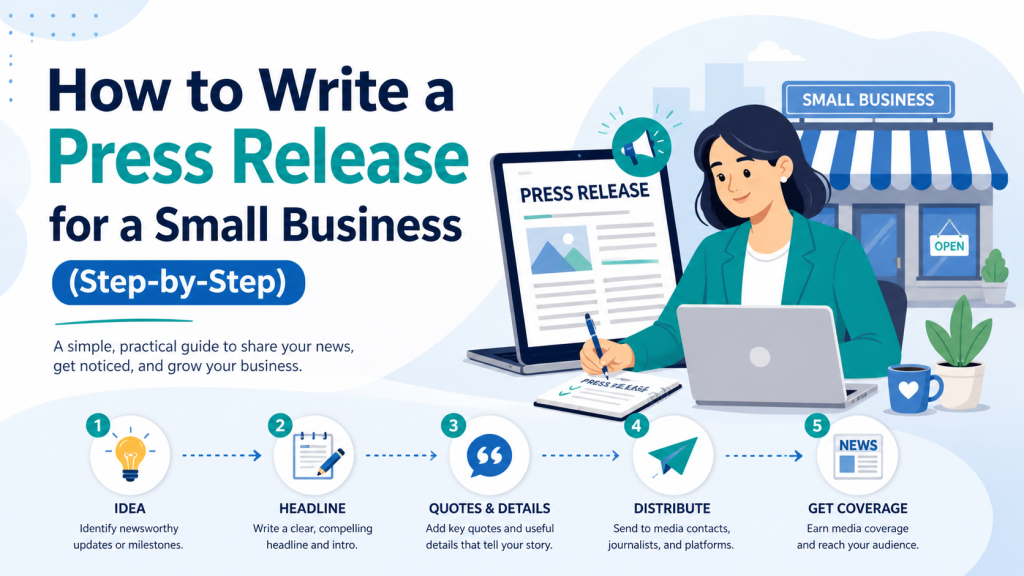
A press release is a short, factual document that announces news to journalists. To write one for your small business, you need a genuinely newsworthy story, the standard 7-part press release format, and a distribution plan. Skip any of those three, and you’re sending that info into a void. This guide covers all of them, including a fully annotated example you can adapt today.
What Is a Press Release?
A press release is a one-page document, typically 400-600 words, written in journalistic style. You send it to reporters who cover your industry or region. If the story is strong enough, they pick it up and either write story about it or run it as is. That’s earned media coverage; you didn’t pay for it.
Small businesses use press releases to announce product launches, expansions, awards, hires, events, and partnerships. The goal is not to tell your whole story. The goal is to give a reporter enough to write their own.
In the press releases we’ve run for more than 27,000 small businesses over the last 27 years, the single most common problem we see at eReleases is that the “release” isn’t announcing news. It’s announcing something the company wants you to know. Those types of releases don’t get picked up.
Before You Write: Is Your News Actually Newsworthy?
Most press release guides skip this part. They teach you how to format a release, but not how to decide whether you should write one at all.
Sending a release about something that isn’t news doesn’t hurt you. It wastes everyone’s time, your money, and erodes your credibility with journalists who remember the senders who waste theirs.
What counts as news for a small business press release
These types of stories get coverage:
- Opening or expanding a physical location, especially if it creates local jobs
- A product launch with a specific problem it solves and a price point
- A notable award or recognition from a credible third party
- A strategic partnership with a recognizable business or organization
- A study, survey, or original data your company conducted
- A significant hire: CEO, founder, or recognized industry figure
- A community milestone: 25 years in business, 10,000 customers served
Here’s the test we recommend you use to determine whether your story is newsworthy: would a local reporter assign this story to a staff writer? If you genuinely can’t answer yes, don’t send the release.
What doesn’t belong in a press release
These are not news:
- “We’re excited to announce our new website”
- “We now offer 15% off for new customers”
- Generic rebranding with no strategic rationale
- A blog post dressed up in press release format
A press release announces an event. A discount is a marketing offer. Keep them in separate channels.
How to Write a Press Release for a Small Business: The 7-Part Format
Every press release follows the same structure. Reporters expect it. Deviating from it signals that you don’t know how this works.
Headline.
One sentence, in active voice, written in present tense.
Starting a press release with a strong headline is the first test of whether your story is real: if you can’t write a clear, factual headline, the news isn’t defined yet. “Rivertown Bakery Opens Second Location in Millbridge, Creating 12 New Jobs” is stronger than “Rivertown Bakery Announces Exciting Expansion Plans.” Keep it under 100 characters. No puns, no hype, no exclamation points.Dateline.
City and date in caps before your first sentence: PORTLAND, Maine, April 27, 2026. This tells the reporter where the news is based and when it was issued.
Lead paragraph.
Answer who, what, when, where, and why in 35-50 words.
This is the most important paragraph you’ll write. Reporters decide in 10 seconds whether to read further. If they can’t extract the core story from your first paragraph, they stop.Body paragraphs.
Use the inverted pyramid: most important information first, supporting detail second, background last.
One idea per paragraph. Two to three sentences max. This structure lets editors cut from the bottom without losing the story.Quote from a company spokesperson.
One or two sentences. Attributable to a named person with their title.
The quote should add perspective or context, not restate facts. “We’ve been serving the Millbridge community for 12 years, and this expansion is our way of meeting the demand we’ve built,” said owner Maria Chen. Don’t write quotes that sound like press release copy.Boilerplate.
A short “About [Company Name]” paragraph, 50-75 words.
Founding date, what you do, where you operate, contact website. This is evergreen: write it once and paste it into every release.Contact information + ### end marker.
Below the boilerplate: PR contact name, phone, email. Then three pound signs centered on the last line: ###. That’s the industry signal that the release has ended.
Small Business Press Release Writing Tips
- Keep it to 400-600 words. A release of over 600 words is an essay. Reporters don’t want essays.
- Write in third person. “The company announced,” not “we announced.” You’re writing as if you’re a journalist covering your own news.
- One story per release. Don’t bundle a product launch with a new hire or a partnership. Send three releases.
- Cut jargon. If a reader outside your industry wouldn’t understand the word, replace it. “Enterprise-grade SaaS solution” tells a reporter nothing.
- Active voice throughout. “The bakery hired 12 people,” not “12 people were hired by the bakery.”
- Never use superlatives you can’t prove. “Leading,” “best-in-class,” and “revolutionary” trigger immediate distrust. Specific numbers do the opposite: “third-largest commercial bakery in the county” is verifiable.
- Use a press release template as a starting point, not a crutch. Templates give you the structure; your news fills it. The annotated example below is your template.
Small Business Press Release Example
Here’s an annotated press release for a fictional small business. Every section is labeled so you know exactly what it’s doing.
|
[HEADLINE: Specific, factual, active voice] Rivertown Bakery Opens Second Location in Millbridge, Adding 12 Jobs to Local Economy
[DATELINE: City of news origin + date issued] PORTLAND, Maine, April 27, 2026 [LEAD: Answers who, what, when, where, why in under 50 words] Rivertown Bakery, a family-owned Portland institution since 2012, will open its second location at 44 Commerce Street in Millbridge on May 15, 2026. The 2,800-square-foot bakery will serve the same from-scratch menu and employ 12 full-time workers from the Millbridge area. [BODY PARAGRAPH 1: Key supporting detail] The Millbridge location marks the first expansion for Rivertown after 14 years at its flagship Portland store. Owner Maria Chen cited a two-year waitlist for wholesale accounts in the south county region as the primary driver. [BODY PARAGRAPH 2: Additional context] The new space will include a café counter and a dedicated commercial kitchen for the bakery’s growing wholesale business, which supplies 18 local restaurants. [QUOTE: Real perspective from a named source, not a restated fact] “We never planned to expand this fast,” said Chen. “But when you have 800 people on a waitlist, you stop waiting for the perfect moment.” [BACKGROUND: Company history, relevant context] Rivertown Bakery has been recognized by Portland Magazine as one of the top 10 local food businesses for three consecutive years and was named Maine’s Small Business of the Year in 2024 by the Maine Small Business Association. [BOILERPLATE: Evergreen company description, 50-75 words] About Rivertown Bakery: Rivertown Bakery has served the Portland, Maine community since 2012. Founded by Maria and James Chen, the bakery specializes in artisan breads, pastries, and wholesale baked goods for regional restaurants and retailers. The company operates with a zero-waste kitchen program and sources 80% of ingredients from Maine farms. Learn more at rivertownbakery.com. [CONTACT INFO: Real person, real phone, real email] Media Contact: Sarah Dunlap, Communications Manager (207) 555-0142 [email protected] |
Where to Send Your Small Business Press Release
Writing a strong release is half the job. Distribution determines whether anyone sees it. You have three paths.
1. PR wire services – Wire services push your release to a network of journalists, newsrooms, and databases simultaneously. eReleases distributes through PR Newswire, the largest wire network in North America, with access to 1.7 million journalists and outlets, starting at $399. That’s national reach at a price built for small business budgets.
2. Direct journalist outreach – Identify beat reporters who cover your industry or geographic area. Local business editors, regional trade publications, and vertical blogs are often more likely to cover a small business than national outlets. Send the release directly to a named journalist, not a generic inbox. Personalize the email: one sentence connecting the story to their beat.
3. Your own channels – Post the release on your website’s newsroom or press page. Share the news (not the release itself) on LinkedIn and in your email newsletter. Your existing audience is the easiest media to get.
Do Press Releases Still Work for Small Businesses?
Yes, with the right story and the right distribution. The press release isn’t dead; the bad press release is dead. A release about a non-event sent to a generic list is ignored in 2026, just as it was in 2006.
A well-written release on a genuine news hook, sent through a credible distribution channel to journalists who cover that beat, still generates coverage. Over 27 years, eReleases has placed small-business press releases in outlets ranging from local business journals to USA Today, the Wall Street Journal, and the LA Times, because the stories were real and the targeting was right.
The question isn’t whether press releases work. It’s whether your news is worth writing about.
If you’d rather have a professional write and distribute your release, eReleases handles both — writing, editing, and national wire distribution — starting at $399.
Frequently Asked Questions
What are the 7 parts of a press release?
Every press release includes a headline, dateline, lead paragraph, body paragraphs, a spokesperson quote, a company boilerplate, and contact information, followed by the ### end marker. These elements appear in this order in every professional release.
How long should a small business press release be?
A press release should be 400-600 words. Anything shorter may lack necessary detail; anything over 600 words rarely gets read in full. One page is the professional standard.
How much does it cost to send a press release?
Distribution costs vary by service and reach. eReleases pricing starts at $399 for national distribution through the PR Newswire network. Some services offer lower prices but with smaller or lower-quality distribution lists. Free options exist but typically offer no real reach.
Can I write a press release myself?
Yes. You don’t need a PR agency to write a press release. You need a real news story, the standard 7-part format, and clean, factual writing. The example in this article is a template you can adapt directly. See more press release examples here.
How do I write a press release headline?
Write the headline in active voice, present tense, and lead with the most important fact. Name the company, the action, and the outcome. Keep it under 100 characters. Avoid adjectives that aren’t facts: “leading,” “exciting,” and “innovative” weaken headlines. Specific numbers and proper nouns strengthen them.
Where do small businesses send press releases?
Small businesses send press releases through wire distribution services like eReleases, directly to local and trade journalists by email, and through their own website newsroom. Wire services offer the broadest reach; direct outreach offers the most targeted placement.
What makes a press release newsworthy?
A press release is newsworthy when a reporter’s audience would care about the information on its own. Openings, expansions, awards from credible organizations, original data, notable hires, and significant partnerships typically qualify. Discounts, website updates, and general company announcements typically don’t.
How do I write a press release for a new business opening?
A new business opening press release leads with the location, opening date, and what makes the business worth covering: jobs created, a gap it fills in the market, or a notable founder. Include a quote from the owner, a boilerplate about the business, and a media contact. Keep it under 600 words.
Can ChatGPT write a press release?
ChatGPT can draft the format and structure of a press release, but it can’t tell you whether your story is news, it doesn’t know your distribution options, and it won’t personalize your outreach to the right journalists. Use it as a drafting tool, not a strategy tool. The decisions that make a release succeed happen before you write the first word.
The press release doesn’t get you coverage. Your story does. The press release just delivers it.

Mickie Kennedy founded eReleases.com in 1998 after watching PR firms charge small businesses a $20,000 minimum for a single press release. For 27 years, he’s been closing that gap — distributing 150,000+ releases via Cision PR Newswire, serving 30,000+ clients including Manscaped, Squatty Potty, and 40+ Shark Tank brands, and generating $132M+ in earned media. A sought-after podcast guest and two-time Amazon bestselling author of Beginner’s Guide to Writing Powerful Press Releases and The PR Strategy Manifesto. Mickie holds an MFA in Creative Writing from George Mason University. Based in Baltimore, MD. LinkedIn