 Not every business update deserves a press release.
That may sound odd coming from someone who believes in press releases. But it’s true. A release works best when there is real news: something timely, useful, relevant, or interesting to people outside your company.
The mistake many businesses make is confusing “important to us” with “important to the public.”
A new internal process may matter to your team. But will customers care? Will a journalist’s readers care? Will it say something useful about your industry, community, or market?
That is the newsworthiness test.
Before you write a release, ask one simple question:
Who cares besides us?
If you can answer that clearly, you may have a story. If you cannot, you may have an internal announcement, a customer email, a blog post, or a social media update — but not a press release.
Why Newsworthiness Matters
Journalists are not looking for company updates. They are looking for stories their audience will care about.
“We launched a new website” is not much of a story.
“We launched a free tool that helps small businesses estimate shipping costs before they lose money on fulfillment” is stronger.
The first version is about the company. The second is about the customer’s problem.
The Seven-Question Newsworthiness Test
Use these questions before deciding whether to send a release.
1. Is it timely?
A press release needs a reason to exist today.
Did something just launch? Is an event coming up? Did your company release a study, open a location, hire a key executive, win a notable contract, or respond to a current issue?
If there is no “why now,” the release may feel stale before it starts.
2. Does it affect a clear audience?
Who is this for?
Customers? Local residents? Business owners? Parents? Healthcare leaders? Restaurant operators? Nonprofit directors?
If you cannot name the audience, the release is not ready.
A new service is more interesting when you can explain who it helps and how. A new partnership is stronger when you can show what it makes possible.
3. Is there a real benefit?
This is where many press releases fall apart.
They describe what the company did, but they never explain why anyone else should care.
A release should answer: What changes for the reader?
Does this update save time? Reduce costs? Improve access? Solve a problem? Create jobs? Fill a local need?
If the benefit is not clear, the announcement will feel thin.
4. Is it specific?
Specific details make a story stronger.
Names, dates, numbers, locations, customer examples, and measurable outcomes all help. Vague claims do not.
Weak: “ABC Company is proud to announce a major expansion.”
Better: “ABC Company will open a second warehouse in Columbus this spring, adding 18 jobs and cutting Midwest delivery times by two days.”
The second version gives a journalist something to work with.
5. Does it connect to a larger trend?
Some company updates become more interesting when they fit into a bigger picture.
Maybe your business is responding to rising customer demand. Maybe you are addressing a supply chain issue, a change in regulation, a shift in technology, or a local economic need.
Context gives the announcement weight.
6. Is there a local, industry, or human angle?
A story becomes more useful when it has a clear lane.
Local media care about local impact: jobs, neighborhoods, community programs, local founders, events, and milestones.
Trade media care about industry meaning: trends, data, innovation, leadership changes, or problems their readers face.
Human-interest stories care about people: founders, customers, employees, families, or communities affected by the update.
One business update may not work for every outlet. The goal is to know where it belongs.
7. Can you prove it?
A strong release does not depend on hype.
Avoid empty words like “game-changing,” “revolutionary,” or “world-class” unless you can back them up. Most of the time, you do not need those words at all.
Proof can include data, customer results, a credible quote, a real example, a third-party award, a milestone, or a clear before-and-after result.
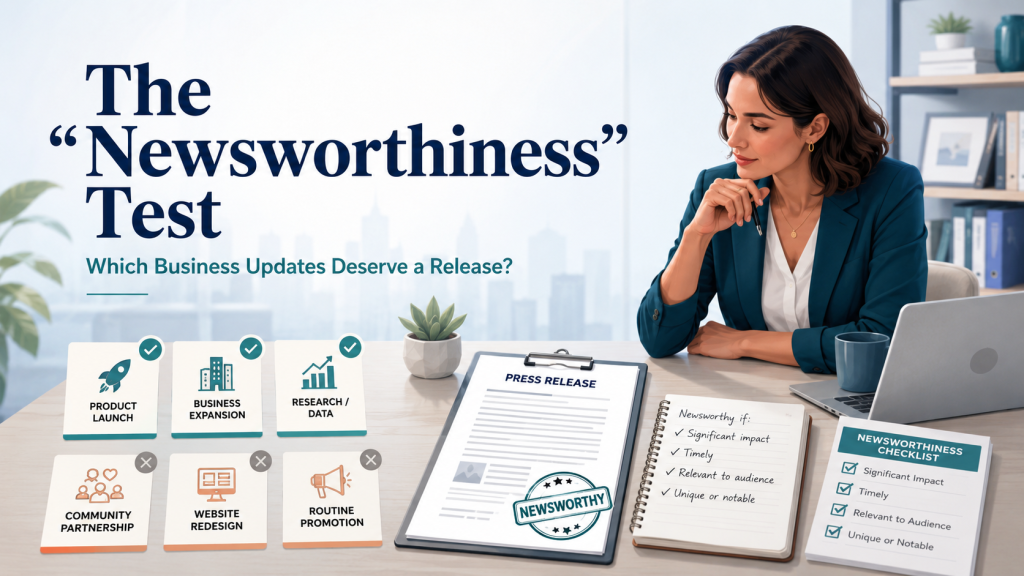
Updates That Often Deserve a Release
Some business updates are good candidates, especially when they include a clear benefit or strong angle.
These include new product launches, business expansions, major partnerships, notable executive hires, acquisitions, original research, customer milestones, community programs, credible awards, and public or industry events.
Even then, the update still needs a story.
A new hire may be newsworthy if the person brings major experience, supports expansion, or signals a new direction. A new product may be newsworthy if it solves a real problem.
The category does not carry the release. The angle does.
Updates That Usually Do Not Need a Release
Some updates are better handled elsewhere.
These include minor website changes, routine internal promotions, small feature tweaks, general company news with no outside impact, vague “we are excited to announce” updates, weak awards, and events that only matter to your existing audience.
That does not mean these updates have no value. They may belong in an email newsletter, blog post, customer update, LinkedIn post, or internal note.
The key is choosing the right channel.
A press release is not a junk drawer. Use it when the news has enough value to travel beyond your own list.
A Simple Scoring Method
Give your update one point for each “yes”:
- Is it timely?
- Does it affect a clear audience?
- Is there a real outside benefit?
- Is it specific?
- Does it connect to a trend, local issue, or industry need?
- Does it have a human angle?
- Can you prove the claim?
If you score six or seven, you likely have a strong release.
If you score four or five, the idea may work, but the angle needs sharpening.
If you score three or less, use another channel or wait until the story is stronger.
This is not a perfect formula. But it keeps you from sending weak announcements that train journalists to ignore you.
How to Strengthen a Weak Announcement
Sometimes the update is real, but the story is buried.
Ask:
- Why now?
- Who benefits most?
- What problem does this solve?
- What trend does this reflect?
- What proof can we include?
- Is there a customer, founder, or community example?
Let’s say your company hired a new operations manager.
By itself, that may not be enough.
But if that hire supports a new facility, faster delivery, 25 planned jobs, or expansion into a new region, now there is a stronger story.
The announcement is the starting point. The impact is the story.
The Bottom Line
A press release should not be your default way to announce everything.
Use it when you have real news: something timely, specific, credible, and useful to an audience beyond your own company.
When the story is weak, wait. Build the angle. Gather proof. Find the customer, community, or industry impact.
A good press release does not say, “Please pay attention to us.”
It says, “Here is something worth knowing.”

Mickie Kennedy founded eReleases.com in 1998 after watching PR firms charge small businesses a $20,000 minimum for a single press release. For 27 years, he’s been closing that gap — distributing 150,000+ releases via Cision PR Newswire, serving 30,000+ clients including Manscaped, Squatty Potty, and 40+ Shark Tank brands, and generating $132M+ in earned media. A sought-after podcast guest and two-time Amazon bestselling author of Beginner’s Guide to Writing Powerful Press Releases and The PR Strategy Manifesto. Mickie holds an MFA in Creative Writing from George Mason University. Based in Baltimore, MD. LinkedIn