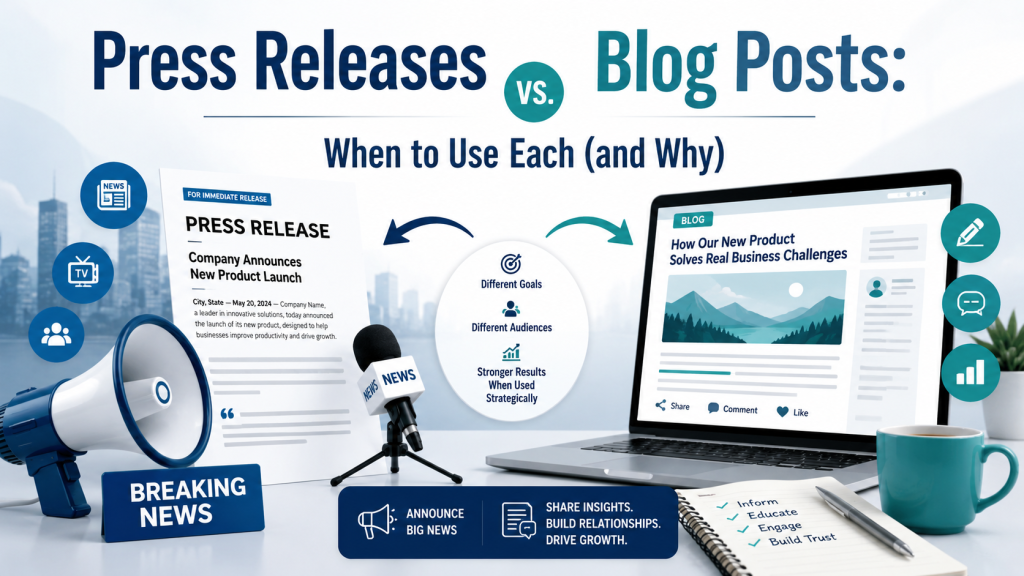
 Press releases and blog posts both help you tell your story. But they do different jobs.
A press release is for news. A blog post is for education, explanation, and trust-building.
Many businesses blur the line. They send a press release when they should write a helpful article. Or they bury real news in a blog post and wonder why journalists never notice.
The better question is not, “Which one is better?” It is, “What am I trying to accomplish?”
Use a press release when you have real news
A press release works best when something has happened.
You launched a product. Opened a new location. Hired a key executive. Won an award. Raised funding. Released a study. Announced a partnership. Created something timely that matters beyond your own walls.
If you are not sure how to shape that announcement, this guide on how to write a press release for a small business walks through the basic structure and news angle.
The audience for a press release is not just your customers. It is also journalists, editors, industry writers, local media, investors, partners, and searchers.
That means a release needs a clear news angle. It should answer the basic questions quickly: What happened? Who is involved? Why does it matter? Why now?
A weak release says, “We are proud to announce…” and then talks mostly about the company.
A stronger release says, “Here is what changed, who it affects, and why it is worth attention.”
For example, “We added a new service” may not be enough. But “A local accounting firm launched a flat-fee tax rescue service after seeing more IRS notices among small business clients” gives the media something to work with.
Use a blog post when you want to teach or persuade
A blog post gives you more room to explain.
Use it when your reader needs context, advice, comparison, or a practical next step. Blog posts are ideal for answering common questions, breaking down a process, comparing options, or helping a buyer understand a problem.
A blog post can be timely, but it does not need to be news. It can live on your site for months or years, bringing in readers who are searching for help.
A good blog post should focus on being useful to the reader first; Google’s guidance on helpful, reliable, people-first content is a solid reminder of that standard.
Where a press release says, “Here is what happened,” a blog post says, “Here is what this means for you.”
For example, if your company releases a cybersecurity report, the press release announces the report and highlights the strongest finding. The blog post explains what small businesses should do differently because of it.
Same source material. Different job.
Use both when the story has depth
Often, the best move is to use both.
The press release gets the news into the public record and in front of media. The blog post gives customers and prospects a deeper explanation.
Think of it this way:
Use a press release to announce.
Use a blog post to explain.
Use both when the announcement deserves context.
A product launch might need a press release for visibility and a blog post showing how the product solves a customer problem. A new study might need a release with the strongest data point and a blog post walking through the lessons.
The practical test
Before you choose, ask one question: “Would someone outside our company care that this happened?”
If yes, you may have a press release.
If the answer is, “They would care if we explained it well,” you probably have a blog post.
Strong companies do not treat press releases and blog posts as rivals. They use each one for the job it does best.
News earns attention. Useful explanation earns trust.
You need both. Just not always at the same time.

Mickie Kennedy founded eReleases.com in 1998 after watching PR firms charge small businesses a $20,000 minimum for a single press release. For 27 years, he’s been closing that gap — distributing 150,000+ releases via Cision PR Newswire, serving 30,000+ clients including Manscaped, Squatty Potty, and 40+ Shark Tank brands, and generating $132M+ in earned media. A sought-after podcast guest and two-time Amazon bestselling author of Beginner’s Guide to Writing Powerful Press Releases and The PR Strategy Manifesto. Mickie holds an MFA in Creative Writing from George Mason University. Based in Baltimore, MD. LinkedIn