Ask AI for a short summary of this article
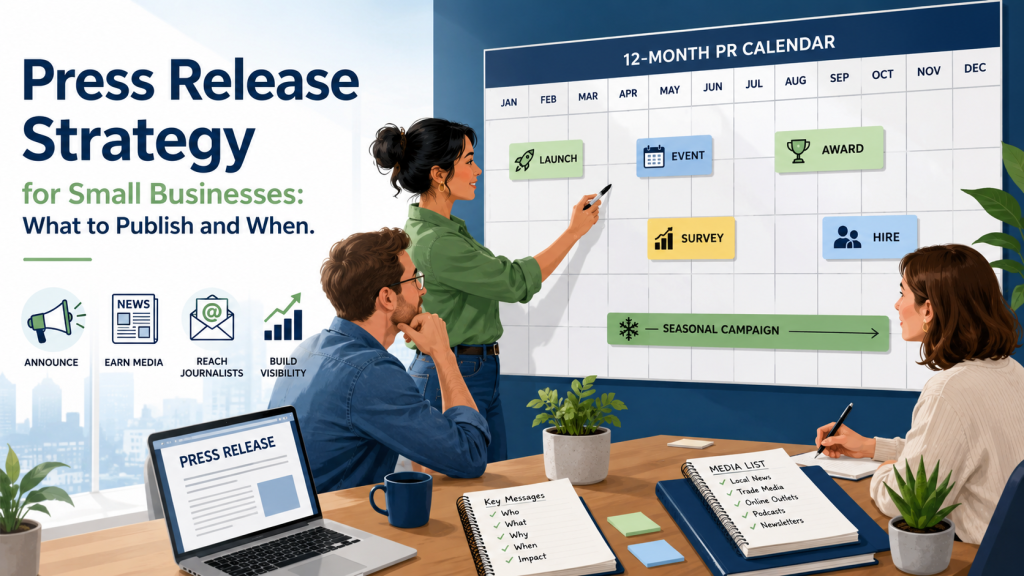 A press release works best when it is part of a plan.
Too many small businesses treat press releases like emergency tools. Something happens, they rush to write one, send it once, and hope for the best.
A better approach is simple: know what kinds of news are worth announcing, plan the moments you can see coming, and leave room for timely opportunities.
You do not need a large PR department. You need a calendar, a clear news angle, and the discipline to publish only when you have something useful to say.
Start With the Right Question
Most business owners begin with, “What do we want to promote?”
The better question is:
Why would someone outside our company care?
That one question separates useful press releases from self-serving announcements.
A journalist is not looking for a brochure. A customer is not looking for a corporate diary. Both are looking for something timely, useful, interesting, or relevant.
Before you write, ask:
- Is this new?
- Does it affect customers, employees, a local community, or an industry?
- Does it connect to a larger trend?
- Is there a clear date, milestone, number, or outcome?
- Can we explain why it matters in one sentence?
If not, the idea may still work for your blog, email list, or social media. But it may not be ready for a press release.
What Small Businesses Should Publish
Small businesses often assume they do not have enough news. Usually, the problem is not a lack of news. It is a lack of framing.
Before you draft the announcement, it helps to understand the basic structure of how to write a press release for a small business so your idea is shaped like news, not a sales pitch.
Here are the strongest categories to build your strategy around.
1. Launches and New Offerings
A new product, service, location, feature, menu item, program, or package can make a strong release if it solves a specific problem.
The mistake is announcing the thing without explaining the need behind it.
Weak angle: “Company launches new accounting service.”
Stronger angle: “Local accounting firm launches flat-rate bookkeeping service for freelancers facing quarterly tax pressure.”
The second version gives the reader context. It identifies the audience, problem, and timing.
2. Company Milestones
Milestones can work well, especially for local businesses, family-owned companies, startups, and brands with strong community ties.
Examples include years in business, a notable customer count, a new office, a hiring milestone, production growth, revenue growth, or expansion into a new region.
The key is not the milestone itself. It is what the milestone represents.
A company turning 10 is nice. A company turning 10 after starting in a garage, surviving a downturn, and now employing 40 local people is a story.
3. Research, Surveys, and Data
Original data is one of the most useful things a small business can publish.
You do not need a university-grade study. You need a finding that says something useful about your market.
A home services company might survey homeowners about repair costs. A software company might analyze customer usage trends. A staffing firm might publish hiring patterns from its own client base.
Lead with the finding, not the company.
Weak angle: “Company releases annual survey.”
Stronger angle: “New survey finds 62% of small retailers plan to cut holiday discounting this year.”
Data gives journalists something concrete. It also gives your business authority without requiring you to brag.
4. Awards and Recognition
Awards can be useful trust signals, but they need context.
“Company wins award” is usually not enough. Explain what the award recognizes, who gives it, how competitive it is, and why it matters to customers.
If the award reflects a real business improvement, tell that story. Process changes, customer results, community impact, or measurable growth all give the award substance.
5. Events and Community Involvement
Events are natural press release opportunities because they have a date and a reason to act now.
Good candidates include grand openings, fundraisers, workshops, conferences, local partnerships, charity drives, public events, and educational sessions.
Send event releases early enough for calendars and local media, usually two to four weeks ahead. Then consider a post-event release if there are strong photos, attendance numbers, donations raised, or outcomes worth sharing.
6. Partnerships
A partnership release works when the partnership creates something new.
Two companies “joining forces” is not enough. What will customers get? Does it expand access, lower cost, improve service, or solve a problem?
A stronger angle would be: “Regional pharmacy group partners with telehealth provider to offer same-day virtual visits in rural communities.”
That tells the reader what changed.
7. Expert Commentary and Trend Response
Small businesses can use press releases to comment on trends when they have real expertise.
The timing matters. A trend response release should connect your expertise to something already in the news or on the calendar.
A tax preparer can discuss filing mistakes before tax deadlines. A cybersecurity consultant can respond to a rise in small-business phishing attacks. A wedding planner can share cost trends before engagement season.
This type of release positions you as a source, not just a company with something to sell.
8. New Hires and Leadership Changes
New hire releases are worth publishing when the person’s role affects growth, customers, strategy, or the community.
A new receptionist probably does not need a release. A new chief revenue officer, medical director, head chef, partner, principal, or board member may.
Include the person’s background, why they were hired, and what they will help the company do next.
9. Customer Success Stories
A customer story can make a strong release when it includes a measurable outcome and the customer is willing to participate.
A software company might announce that a customer reduced processing time by 40%. A nonprofit might highlight a local family helped through a new program.
Keep the focus on the result, not on how wonderful your company is.
A good customer story says, “Here is a problem, here is what changed, and here is why it matters.”
10. Seasonal and Calendar-Based News
The calendar is one of the easiest planning tools for small-business PR.
Every industry has seasonal moments: tax season, back-to-school, summer travel, holiday shopping, wedding season, storm season, open enrollment, New Year planning, home improvement season, and Small Business Saturday.
Build releases around the moments when your audience is already paying attention.
A release tied to timing often performs better than the same idea sent in a random month.
When to Publish Press Releases
The best cadence depends on your business, your news, and your goals.
For many small businesses, a good starting point is one release every four to eight weeks. That is often enough to build visibility without forcing weak announcements.
A fast-growing startup, franchise brand, nonprofit, event organization, or company with frequent product updates may have real news monthly. Others may publish quarterly and do just fine.
The goal is not volume. The goal is consistency with quality.
A Simple Annual PR Calendar
Use the year as a planning tool. A PR calendar should support your broader marketing plan, not sit off to the side as a separate activity; the U.S. Small Business Administration offers a helpful overview of marketing and sales planning for small businesses.
In the first quarter, publish data, forecasts, expert commentary, new services, or business outlook pieces. This is a good time to show where your market is heading.
In the second quarter, focus on growth and community. Grand openings, new locations, local events, partnerships, and seasonal launches all fit well here.
In the third quarter, show proof. Use midyear data, customer success stories, milestones, award wins, new hires, or back-to-school angles to show momentum.
In the fourth quarter, keep the hook clear. Holiday campaigns, charitable giving, year-end milestones, consumer tips, industry predictions, Small Business Saturday tie-ins, and year-in-review announcements can all work. Do not wait until the week before a holiday. Media calendars fill up fast.
How Far Ahead to Plan
Some releases can be planned months ahead. Others happen quickly.
Use this simple timing guide:
- Event release: send 2 to 4 weeks before the event
- Product launch: send when the product is available or preorders open
- Seasonal advice: send 3 to 6 weeks before the seasonal moment
- Award release: send soon after the award is announced
- New hire release: send when the person starts or the role is official
- Survey or data release: send when the findings are fresh and relevant
- Crisis or response release: send only when you have verified facts and a clear reason to speak
Timing is part of the story. A holiday retail release sent on December 23 is probably too late. A tax tips release sent after filing season has lost its edge.
Build a “News Bank”
One of the best habits a small business can build is keeping a news bank.
This is a running list of possible announcements, proof points, customer stories, data, dates, photos, and quotes.
Add to it when something happens, not when you need a release tomorrow.
Your news bank might include customer wins, new products, interesting statistics, employee achievements, community involvement, founder observations, common customer questions, seasonal trends, photos, and testimonials.
This keeps you from staring at a blank screen when it is time to publish.
Do Not Publish Everything
A strategy also tells you what not to publish.
Do not issue a press release for every minor update. Do not dress up a discount as news unless there is a real story around it. Do not send a release just because you have gone quiet for a few weeks.
Bad press releases train people to ignore you.
Good press releases train people to understand what you stand for, what you know, and why your business matters.
Match the Release to the Audience
Not every release needs the same distribution plan.
A local grand opening may need local newspapers, TV assignment desks, business journals, community calendars, and neighborhood publications.
A B2B software release may need trade media, industry newsletters, podcasts, analysts, and niche bloggers.
A consumer product release may need lifestyle editors, gift guide writers, influencers, and ecommerce publications.
The press release is the starting point. Distribution and follow-up determine whether the right people see it.
Measure What Matters
After you publish, look beyond vanity numbers.
Syndication can help visibility, but it is not the same as earned coverage. Track the signals that connect to business value:
- Media pickups
- Journalist responses
- Referral traffic
- Search visibility
- Leads or inquiries
- Event registrations
- Sales conversations
- Backlinks from relevant sites
- Social sharing by credible sources
The point is not just to be seen. The point is to be seen by the right people for the right reason.
A Practical Monthly Rhythm
At the start of each month, review your calendar. Ask what is happening in the next 30, 60, and 90 days. Look for launches, events, trends, seasonal hooks, and customer proof.
Then choose one of three paths:
- Publish a release because there is real news.
- Prepare a release for an upcoming date.
- Skip the release and build owned content instead.
That third option matters. Sometimes the best PR decision is not to force a press release.
The Bottom Line
A small-business press release strategy does not need to be complicated.
Publish real news. Tie it to timing. Explain why it matters. Build a steady rhythm. Follow up with the right media. Measure outcomes that connect to visibility, trust, and sales.
You do not need to sound bigger than you are. In fact, that often works against you.
Small businesses have an advantage when they tell clear, specific, human stories: the founder who saw a problem, the local team solving something practical, the customer who got a measurable result, or the company responding to a real market need.
That is what journalists can use. That is what readers remember.
The next step is simple: open a calendar and mark the next six moments your business could credibly speak to. Then choose the strongest one and build a release around it.
That is how PR becomes a habit, not a scramble.

Mickie Kennedy founded eReleases.com in 1998 after watching PR firms charge small businesses a $20,000 minimum for a single press release. For 27 years, he’s been closing that gap — distributing 150,000+ releases via Cision PR Newswire, serving 30,000+ clients including Manscaped, Squatty Potty, and 40+ Shark Tank brands, and generating $132M+ in earned media. A sought-after podcast guest and two-time Amazon bestselling author of Beginner’s Guide to Writing Powerful Press Releases and The PR Strategy Manifesto. Mickie holds an MFA in Creative Writing from George Mason University. Based in Baltimore, MD. LinkedIn