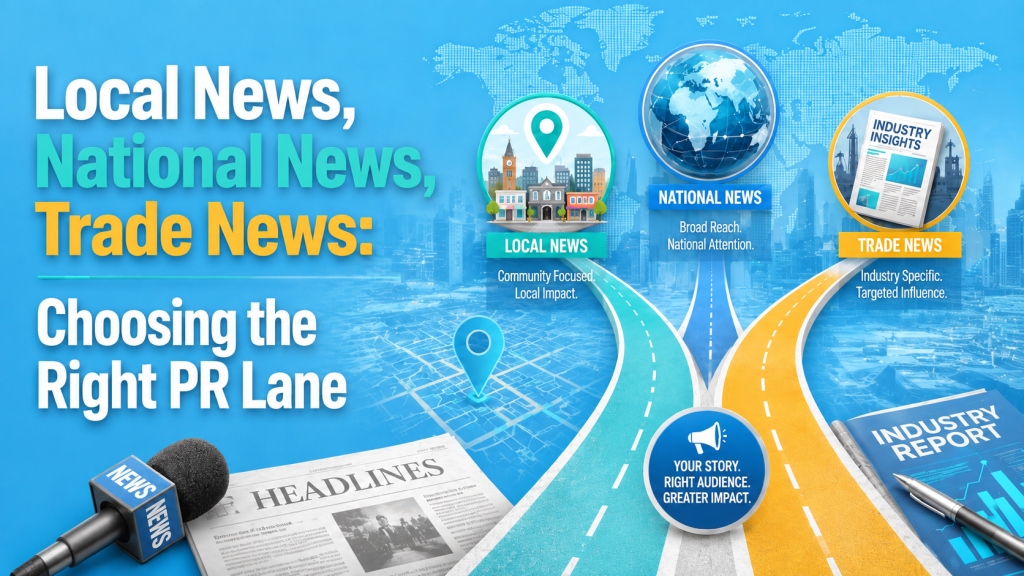
Not every story belongs in the same place.
That sounds obvious, but it’s one of the most common mistakes businesses make with PR. They write one press release, send it everywhere, and hope the right people notice. Sometimes that works. Usually, it doesn’t.
Why? Because local reporters, national reporters, and trade reporters are not looking for the same thing.
A local journalist wants to know, “Why does this matter to people here?”
A national journalist wants to know, “Why does this matter to a much larger audience?”
A trade journalist wants to know, “Why does this matter to this industry?”
Same story. Three different doors.
The better you understand which door your story fits, the better your chances of getting real coverage.
The local news lane: “Why does this matter here?”
Local news is often the best starting point for small businesses.
If your announcement is tied to a specific city, region, or community, start by thinking through your local press release distribution strategy before you chase broader outlets.
That’s not because local coverage is “smaller” or less important. It’s because local relevance is powerful. A story that might seem ordinary on a national level can be meaningful in your city, county, or region.
A bakery hiring 10 people may not be national news. But in a small town, that can matter. A family-owned manufacturer expanding into a larger facility may not interest a national business desk. But the local paper may see jobs, economic growth, and a business rooted in the community.
Local news works well when your story connects to:
- New jobs or expansion
- A new location
- A local founder or family story
- A community event
- A charity effort
- A local milestone
- A response to a local problem
- A customer base concentrated in one area
The key is to make the local angle clear. That is especially true when the news is a new office, store, clinic, restaurant, or service area. A press release for a new location should connect the opening to local impact — jobs, access, neighborhood growth, or a better option for nearby customers — so reporters and searchers both understand why the location matters.
Don’t just say, “Company launches new service.”
Say, “Baltimore company launches new service to help local restaurants manage rising delivery costs.”
That gives the reporter a reason to care. It tells them where the story lives.
The national news lane: “Why does this matter beyond you?”
National news is a tougher lane.
That doesn’t mean you should avoid it. It means the story needs a wider reason to exist.
National reporters are not usually looking for “Company X announces Y.” They are looking for patterns, tension, change, conflict, data, and broader public interest.
A product launch by itself is rarely national news. But a product launch tied to a larger shift might be.
For example, “A new scheduling app launches” is not much of a national story.
But “Small businesses are using new scheduling tools to reduce no-shows as labor costs rise” has a broader hook.
See the difference?
National news often works when your story ties into:
- A major trend
- New research or data
- A cultural shift
- A public debate
- A timely issue
- A surprising business outcome
- A strong human-interest story
- A new solution to a widespread problem
This is where many businesses get tripped up. They think bigger distribution automatically creates national interest. It doesn’t.
National interest comes from the story itself.
That is why understanding what newswire distribution actually includes can help you separate broad visibility from true media relevance.
If you want national coverage, ask yourself one hard question:
Would someone outside my city, outside my customer base, and outside my industry care about this?
If the honest answer is no, that’s fine. It may still be a great local or trade story. But don’t force it into the national lane.
The trade news lane: “Why does this matter to this industry?”
Trade media is often overlooked. That’s a mistake.
For many businesses, trade coverage is more valuable than general news coverage because it reaches the people who understand the problem, buy the product, influence the market, or work inside the industry.
Trade journalists don’t always need the broad human-interest angle local media wants. They don’t always need the sweeping national trend angle national media wants.
They want relevance to their readers.
If you serve dentists, restaurant owners, warehouse managers, HR leaders, software developers, school administrators, or franchise operators, trade media may be your best PR lane.
Trade news works well for:
- New products or services in a specific field
- Industry data or survey results
- Case studies
- Partnerships
- New hires with industry credibility
- Conference announcements
- Regulatory or compliance insights
- Operational improvements
- Niche trends
A general assignment reporter may not care that your company created a new tool for independent veterinary clinics.
But a veterinary business publication might.
That’s the beauty of trade media. The audience is narrower, but the relevance is much higher.
One story can have more than one lane
You don’t always have to choose only one.
A strong story can often be framed three different ways.
Let’s say a small company in Cleveland develops packaging that helps restaurants reduce food waste.
For local media, the angle might be:
“Cleveland startup helps local restaurants cut food waste and save money.”
For trade media, the angle might be:
“New packaging system helps independent restaurants reduce waste without changing kitchen workflows.”
For national media, the angle might be:
“As restaurants face tighter margins, new tools aim to reduce billions in food waste.”
Same company. Same announcement. Different frame.
This is where PR starts to work better. You stop blasting the same message to everyone and start shaping the story for the audience.
That doesn’t mean you need three completely different press releases. But your pitch should change. Your subject line should change. Your opening sentence should change.
The reporter should feel like the story was sent to them for a reason.
How to decide which lane fits your story
Here’s a simple way to think about it.
Start with local if the story is rooted in a specific place.
Are you hiring, expanding, opening, relocating, hosting, donating, or serving a clear geographic community? Local media may be the strongest fit.
Start with trade if the story matters most to a specific profession or industry.
Does your news solve a problem for a niche audience? Does it reveal something useful about how an industry is changing? Trade media may be the right lane.
Start with national if the story connects to a larger issue.
Does your news reflect a trend? Do you have original data? Is there a timely hook that matters to a broad audience? National media may be worth pursuing.
And be honest. That matters.
A regional restaurant opening its third location is probably not national news. But it may be a very good local business story. A niche software update may not interest the local TV station. But it may be perfect for a trade publication read by your buyers.
Good PR is not about pretending every story is huge.
It’s about finding where the story actually belongs.
Common mistake: chasing the biggest outlet first
A lot of business owners want national coverage right away.
That’s understandable. Everyone likes the idea of seeing their company in a major publication.
But the biggest outlet is not always the best first target.
Sometimes a local story builds proof. Sometimes a trade article reaches more qualified buyers. Sometimes a regional feature gives you the credibility you need before a national reporter takes interest.
PR often builds in layers.
A local newspaper covers your expansion. A trade outlet covers your process. A podcast invites you to discuss what you’re seeing in the market. Then a larger outlet starts to see a pattern.
That’s not a consolation prize. That’s how visibility often works.
The best lane is the one with the clearest reader benefit
Before you send a release or pitch, stop and ask:
Who is this for?
Not “Who do I want to impress?”
Who would actually benefit from knowing this?
If the answer is nearby residents, go local.
If the answer is industry insiders, go trade.
If the answer is the general public or a broad business audience, go national.
The clearer the audience, the sharper the story.
And the sharper the story, the better your odds of getting covered.
Final thought
Choosing the right PR lane is not about lowering your expectations. It’s about improving your aim.
A good local story can drive trust in your community. That matters because Pew Research Center reports that most U.S. adults still view local news outlets as important to their communities.
A good trade story can put you in front of buyers and peers. A good national story can introduce you to a much larger audience.
Each lane has value. The mistake is treating them all the same.
Start with the audience. Shape the angle. Send the story where it naturally belongs.

Mickie Kennedy founded eReleases.com in 1998 after watching PR firms charge small businesses a $20,000 minimum for a single press release. For 27 years, he’s been closing that gap — distributing 150,000+ releases via Cision PR Newswire, serving 30,000+ clients including Manscaped, Squatty Potty, and 40+ Shark Tank brands, and generating $132M+ in earned media. A sought-after podcast guest and two-time Amazon bestselling author of Beginner’s Guide to Writing Powerful Press Releases and The PR Strategy Manifesto. Mickie holds an MFA in Creative Writing from George Mason University. Based in Baltimore, MD. LinkedIn