A good press release starts before you write the first sentence.
That may sound obvious, but it is where many small businesses go wrong. They open a blank document, write what happened, add a quote, and hope it feels newsworthy by the end.
Hope is not a plan.
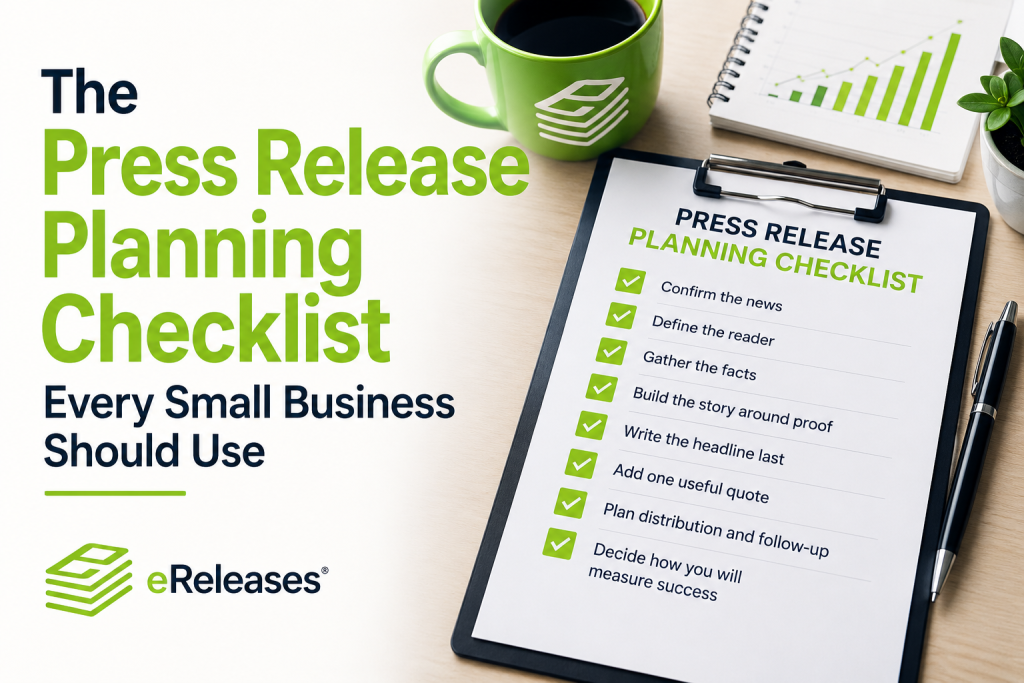
A press release works best when you know three things before you write: what the news is, who should care, and what you want a journalist to understand quickly. The checklist below will help you slow down just enough to make the release stronger without turning the process into a committee exercise.
1. Confirm the news
Start with the simple question: why now?
A press release should announce something timely. That might be a product launch, funding announcement, new location, award, partnership, milestone, event, study, leadership hire, or major customer win.
If the answer is only “we want attention,” keep digging. There may still be a story there, but it needs a sharper hook.
Ask:
- What changed?
- Why does it matter now?
- Who is affected?
- Is there proof this is more than routine company activity?
For example, “we hired a new sales director” may not be enough. “We hired a sales leader to support expansion into three new regional markets” gives the journalist a clearer reason to care.
2. Define the reader before the writer
Before you write for the media, decide who the release is really for.
Are you trying to reach customers, investors, trade publications, local business reporters, industry analysts, partners, or job candidates? Each audience cares about a different part of the story.
A local reporter may care about jobs and economic impact. A trade editor may care about a new method, market shift, or industry problem. A customer may care about what changes for them.
You do not need five different releases. You need one clear release with the right angle up front.
3. Gather the facts
Weak releases often come from vague source material.
Before drafting, collect the basics: names, dates, locations, product details, pricing if relevant, customer benefits, company background, and contact information. Check spellings. Confirm titles. Verify numbers.
If you use a statistic, make sure it is sourced. If you mention a customer, partner, or investor, confirm you have permission. If legal or leadership approval is needed, get that process started early.
This is not glamorous work. It is also where you prevent embarrassing corrections later. Once those facts are in place, use a clear structure like this step-by-step press release format for small businesses before you start drafting.
4. Build the story around proof
Journalists do not need adjectives. They need evidence.
Instead of saying your company is “innovative,” show what is new. Instead of saying the product is “game-changing,” explain the problem it solves. Instead of claiming “rapid growth,” share a real milestone, expansion, customer count, revenue marker, geographic move, or other concrete signal.
One strong detail beats six soft claims.
5. Write the headline last
Many teams start with the headline. That can work, but only if the story is already clear.
For most small businesses, it is easier to draft the body first. Once the lead paragraph says what happened and why it matters, the headline becomes easier.
A strong press release headline usually includes:
- The company or organization name
- The action or announcement
- A clear benefit, market, location, or proof point
Avoid clever headlines unless the news is still obvious. A journalist should understand the announcement in a few seconds. If you want to clean up dates, titles, capitalization, and numbers before sending, Purdue OWL’s AP style guide is a useful reference.
6. Add one useful quote
A quote should add perspective, not repeat facts.
Bad quote: “We are excited to announce this new product.”
Better quote: “Small manufacturers often delay automation because the tools are too expensive or too complex. We built this release to give them a simpler first step.”
The second quote tells the reader why the announcement matters. That is the job.
7. Plan distribution and follow-up before launch
Do not wait until the release is approved to think about who should see it.
Make a short media list. Include trade reporters, local business writers, podcast hosts, newsletter editors, and industry publications that cover your space. Prepare a short pitch note that explains why the release may fit their audience.
Distribution can put the news in motion. Follow-up helps turn that motion into actual coverage.
8. Decide how you will measure success
Press releases are not magic. They are part of a larger communication system.
Before launch, decide what you will track. That may include media pickups, referral traffic, branded search, quote requests, demo requests, backlinks, partner interest, or sales conversations influenced by the news.
Pick a few useful measures. Vanity metrics can make a report look busy while telling you very little.
Use the checklist every time
Free downloadable Press Release Planning Checklist – click here!
The value of a checklist is not that it makes you perfect. It helps you avoid preventable mistakes.
Before your next release, print the checklist and mark it up. If an item is not relevant, skip it. If an item reveals a gap, fix it before distribution.
That small pause can make the difference between a release that simply goes out and one that gives a journalist a real reason to keep reading.

Mickie Kennedy founded eReleases.com in 1998 after watching PR firms charge small businesses a $20,000 minimum for a single press release. For 27 years, he’s been closing that gap — distributing 150,000+ releases via Cision PR Newswire, serving 30,000+ clients including Manscaped, Squatty Potty, and 40+ Shark Tank brands, and generating $132M+ in earned media. A sought-after podcast guest and two-time Amazon bestselling author of Beginner’s Guide to Writing Powerful Press Releases and The PR Strategy Manifesto. Mickie holds an MFA in Creative Writing from George Mason University. Based in Baltimore, MD. LinkedIn