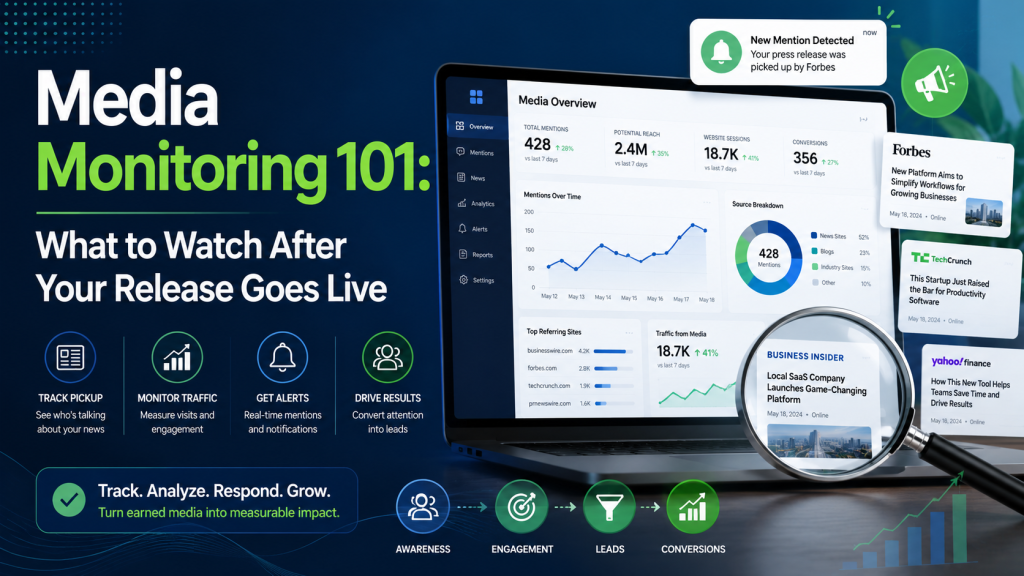
A press release does not end when it goes live.
That is when you start learning what worked.
Distribution puts your announcement in front of people. Media monitoring tells you who noticed, where your release appeared, what traffic it sent, and what follow-up opportunities you may have missed.
For small businesses, this matters because PR can feel vague. You send the release, get a report, and wonder: Did this help?
Monitoring gives you a better answer.
Start With Pickup
The first thing to check is pickup. This means the websites, news platforms, and industry pages that published or syndicated your release through your press release distribution.
Pickup matters. It shows your release is out in the world. But it is not the whole story.
A pickup report tells you where the release appeared. It does not always tell you whether a journalist read it, whether a customer clicked, or whether the release helped generate a lead.
Review the basics first:
- Did the headline appear correctly?
- Is your company name right?
- Do the links work?
- Are the quotes, images, and boilerplate correct?
- Does the release appear in search for your company name?
Small errors can weaken a good release. Catch them early.
Look for Earned Media
Syndication is not the same as earned media.
Syndication means your release was published as submitted. Earned media means a journalist, blogger, podcaster, newsletter writer, or trade publication used your news in their own coverage.
That is where PR gets more valuable.
A syndicated release says, “Here is our announcement.”
Earned media says, “Someone else thought this was worth sharing.”
That outside validation builds trust.
After your release goes live, check whether people clicked. One simple place to start is the Traffic acquisition report in Google Analytics 4, which helps you see where website visitors are coming from.
Monitor your company name, product name, spokesperson name, and key phrases from the announcement. Some mentions will not show up in a distribution report.
For example, a restaurant may announce a second location. The pickup report may show dozens of placements. But the real win might be a short article in a local business journal or a neighborhood newsletter that sends people through the door.
That is easy to miss if you only scan the automated report.
Watch Website Traffic
A strong release should give interested readers somewhere to go next.
That might be a product page, event registration page, media kit, report download, or contact form. Once the release is live, check whether people clicked.
Look for:
- Referral traffic from news sites
- Direct traffic increases
- Traffic to the page linked in the release
- Branded search increases
- Time on page and engagement
Do not expect every release to create a flood of visits. Most will not. PR often works through trust, repetition, and discovery.
Still, traffic tells you whether the release gave readers a reason to act.
If you used UTM links, review those results separately. They help separate release traffic from email, social, paid ads, and other campaigns.
Track Leads and Conversions
Traffic is useful. Leads matter more.
After your release goes live, check whether forms, calls, demo requests, downloads, registrations, or purchases increased.
Ask simple questions:
- Did more people contact us?
- Did any leads mention the release or coverage?
- Did sales calls reference the announcement?
- Did newsletter signups or downloads increase?
- Did the release support an existing campaign?
Not every PR result will show up neatly. A prospect may see your release today and call three weeks from now. A journalist may save your company as a source for a future story.
But you should still track what you can.
Monitor Social and Community Mentions
Some release activity happens outside traditional media.
People may share your announcement on LinkedIn. Customers may comment on Facebook. Industry peers may discuss it in forums, Slack groups, Reddit threads, or niche communities.
These mentions can teach you a lot.
Are people excited? Confused? Skeptical? Are they asking questions? Are they repeating the message you hoped would land?
That feedback can sharpen your next release.
Find Follow-Up Opportunities
Monitoring is not just measurement. It is also a source of next steps.
Look for journalists who cover your industry, even if they did not cover your release. If they recently wrote about the larger trend behind your announcement, you may have a reason to follow up.
Keep it short and useful.
For example:
“I saw your recent piece on independent retailers using automation. We just released data on how small ecommerce shops are using press releases to support product launches. Happy to share a few details if useful.”
That works because it connects your news to their beat. You are not blasting a generic pitch. You are offering something relevant.
Often, the best coverage comes after the release, not from the release alone.
Keep a Simple Dashboard
You do not need expensive software to start.
A spreadsheet can work fine. Track:
- Release date
- Topic
- Main link
- Pickup count
- Earned media mentions
- Referral traffic
- Leads or conversions
- Social mentions
- Journalist follow-ups
- Lessons learned
That last item is the most important.
Which angles worked? Which headlines got attention? Which reporters responded? Which links drove action? Which announcements fell flat?
PR improves when you treat each release as feedback.
Give It Time
The first 24 to 48 hours matter, but they are not the whole story.
Some coverage happens quickly. Other results take days or weeks. Search visibility can build gradually. Journalists may return to your announcement later when they need a source.
Monitor closely during the first week. Then check again over the next month.
The Bottom Line
Media monitoring helps you move from “we sent a release” to “we understand what happened.”
Watch pickup, but do not stop there. Look for earned media, traffic, leads, social mentions, search visibility, and follow-up opportunities.
A release is not just a one-day announcement. It is a signal.
Your job after distribution is to listen, follow the trail, and use what you learn next time.

Mickie Kennedy founded eReleases.com in 1998 after watching PR firms charge small businesses a $20,000 minimum for a single press release. For 27 years, he’s been closing that gap — distributing 150,000+ releases via Cision PR Newswire, serving 30,000+ clients including Manscaped, Squatty Potty, and 40+ Shark Tank brands, and generating $132M+ in earned media. A sought-after podcast guest and two-time Amazon bestselling author of Beginner’s Guide to Writing Powerful Press Releases and The PR Strategy Manifesto. Mickie holds an MFA in Creative Writing from George Mason University. Based in Baltimore, MD. LinkedIn