A press release should go as far as the story can honestly carry it.
That is where many businesses get stuck. They either choose the cheapest option and wonder why no one sees the news, or they buy the biggest package when the story only matters to a narrow audience.
The right distribution level depends on three things: who cares, where they are, and what you want them to do next.
Start with the audience
Before you pick a distribution level, ask a basic question: who would actually find this useful?
If your announcement affects customers in one city, local distribution may be enough. A new restaurant opening, community event, local award, or regional hiring push usually belongs in local media first.
If your news matters to a specific industry, trade distribution should be part of the plan. A manufacturer launching a new safety process may not need national consumer attention. It may need editors, analysts, and buyers in that industry to notice.
If your story has broad public interest, national distribution can make sense. This might include major funding, original research, a widely relevant product launch, a legal issue, or a trend that affects many people.
Bigger is not always better. Better is better.
Match the level to the news
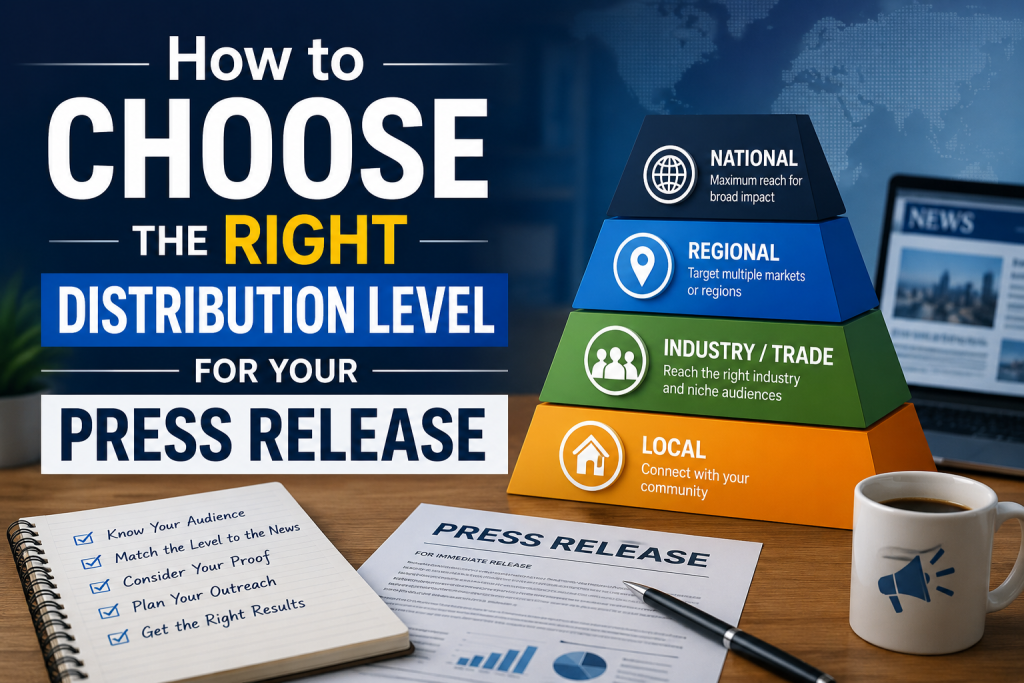
Local distribution works best when geography is the hook. You are opening a location, sponsoring a local cause, hiring in a region, or serving a specific market.
Industry distribution works best when the story needs the right readers more than the most readers. Think trade publications, niche reporters, and professional audiences.
Regional distribution works when the announcement spans several markets but does not need national attention. A company expanding across the Southeast, for example, may be a better regional story than a national one.
National distribution makes sense when the news has scale, urgency, data, or a larger trend behind it. If a reporter outside your market can see why the story matters, national distribution may be justified.
Local, trade, regional, and national distribution each have a place; the real question is which audience has a reason to care. For another useful breakdown, PR Newswire explains the difference between local and national press release distribution and when each makes sense.
Consider your proof
The stronger your evidence, the more distribution you can support.
A claim like “we are changing the industry” is not enough. But original survey data, customer growth, a notable partnership, funding, or a measurable result gives journalists something to work with.
For example, “Local bakery launches gluten-free cupcakes” is probably local. “Bakery chain opens 40 gluten-free production hubs after 300% growth in allergy-friendly orders” has a wider story.
Same basic category. Very different reach.
Do not confuse distribution with coverage
Distribution gets your news in front of the right places. It does not force reporters to write about it.
That is why your press release distribution plan should include both the right wire reach and targeted follow-up.
That is why the level you choose should support a real outreach plan. If you distribute nationally, identify the reporters and outlets that fit the story. If you distribute locally, prepare a short pitch for nearby editors. If you distribute by industry, know which trade publications matter most.
The wire is the road. The story still has to travel.
A simple rule
Choose the smallest distribution level that fully reaches the audience most likely to care.
Then add targeted outreach where it counts.
That keeps your budget focused. It also keeps your expectations sane. A smart local release with follow-up can outperform a national release sent for the wrong reason.
Your goal is not to make the release look big. Your goal is to put a clear, useful story in front of the people most likely to act on it.

Mickie Kennedy founded eReleases.com in 1998 after watching PR firms charge small businesses a $20,000 minimum for a single press release. For 27 years, he’s been closing that gap — distributing 150,000+ releases via Cision PR Newswire, serving 30,000+ clients including Manscaped, Squatty Potty, and 40+ Shark Tank brands, and generating $132M+ in earned media. A sought-after podcast guest and two-time Amazon bestselling author of Beginner’s Guide to Writing Powerful Press Releases and The PR Strategy Manifesto. Mickie holds an MFA in Creative Writing from George Mason University. Based in Baltimore, MD. LinkedIn