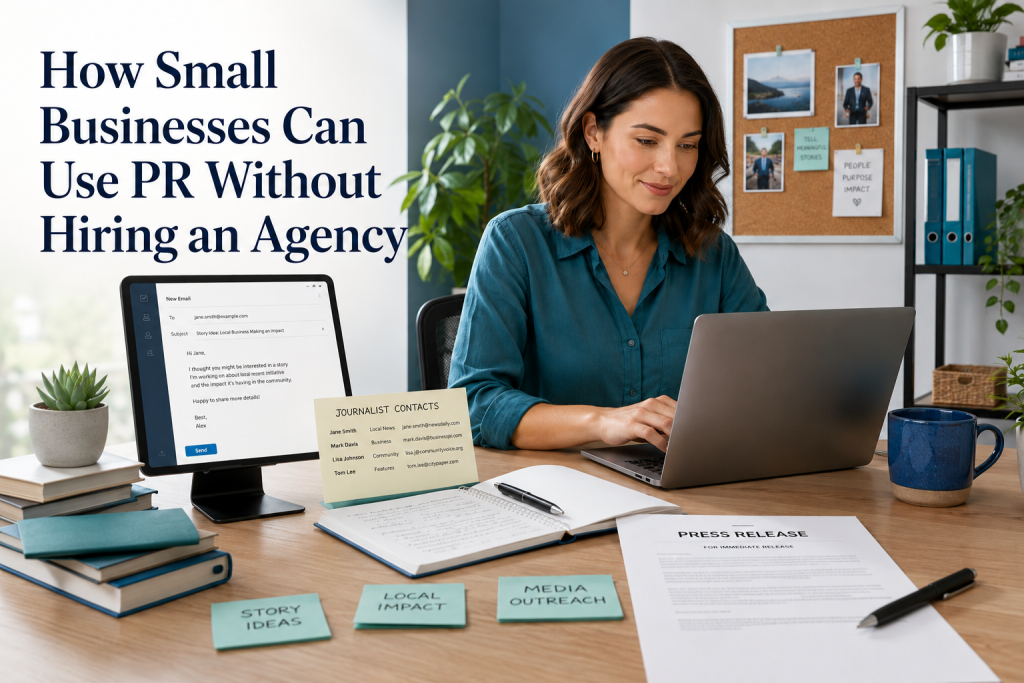
You do not need a PR agency to get publicity.
An agency can help when you need crisis support, ongoing strategy, or media relationships. But small businesses can do steady PR on their own if they understand what PR is really about.
It is not about “getting famous.” It is about giving the right people a clear reason to care.
Start with real news
The biggest mistake small businesses make is treating PR like advertising.
A journalist is not looking for your sales pitch. They are looking for something timely, useful, surprising, local, or relevant to their audience.
Good small-business PR usually starts with a product launch, partnership, milestone, customer success story, community event, local expansion, useful data, or expert comment on a current trend.
The test is simple: would someone outside your company care?
If the answer is “only if they want to buy from us,” you probably have an ad, not a PR story.
Write it clearly
A press release does not need to be fancy. In fact, fancy usually hurts. For a simple structure, use this
Put the news in the first sentence. Say who is involved, what happened, where it is happening, and why readers should care.
Here is a plain example:
“BrightPath Tutoring, a Baltimore-based education company, has launched a free Saturday math clinic for middle school students preparing for high school placement tests.”
That works because it is specific.
Compare that with:
“BrightPath Tutoring is excited to announce an innovative new educational initiative designed to empower tomorrow’s leaders.”
That says almost nothing. And reporters are very good at ignoring almost nothing.
Build a small media list
You do not need 500 contacts. You need the right 20.
Start with local business reporters, trade publication editors, community calendar editors, podcast hosts, newsletter writers, and bloggers who already cover your kind of story.
Read their work first. Then send a short, relevant note.
A good pitch can be three paragraphs:
- Here is the news.
- Here is why it matters to your readers.
- Here is who can speak and what they can share.
You can also review SCORE’s tips for crafting a press release if you want a second small-business-friendly reference before pitching reporters.
Keep it human. No “Dear media professional.” No long backstory. No attachments unless requested.
Use distribution wisely
Press release distribution can help your announcement get indexed, published across news sites, and delivered through professional news channels. But distribution is not a substitute for targeting.
Distribution gives your news a formal path. Outreach gives it a personal path.
Send the release through a credible distribution service, then follow up with a small group of handpicked journalists who are most likely to care.
Reuse the story
One release can do more than one job.
Turn it into a blog post. Share a short version on LinkedIn. Add it to your email newsletter. Send it to customers, partners, donors, investors, or franchisees.
PR is not just about media pickup. It is also about creating public proof that your business is active, credible, and moving.
Keep going
One press release will not build your reputation. A steady pattern will.
Most small businesses have more story material than they realize. Look at your customers, data, milestones, local involvement, founder’s point of view, and lessons learned.
The next step is simple: write down three things your business has done in the last 90 days that someone outside your company might care about. Pick the strongest one. Make it clear. Make it useful. Then put it in front of the right people.
That is PR without an agency. Not magic. Just a good story, told well, to people who can help it travel.

Mickie Kennedy founded eReleases.com in 1998 after watching PR firms charge small businesses a $20,000 minimum for a single press release. For 27 years, he’s been closing that gap — distributing 150,000+ releases via Cision PR Newswire, serving 30,000+ clients including Manscaped, Squatty Potty, and 40+ Shark Tank brands, and generating $132M+ in earned media. A sought-after podcast guest and two-time Amazon bestselling author of Beginner’s Guide to Writing Powerful Press Releases and The PR Strategy Manifesto. Mickie holds an MFA in Creative Writing from George Mason University. Based in Baltimore, MD. LinkedIn