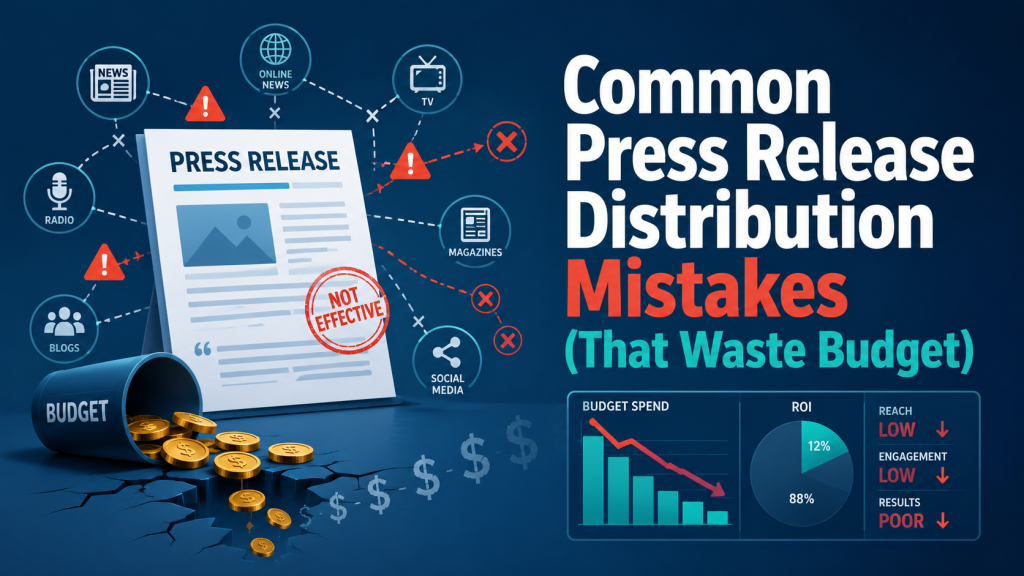
A press release can be a smart investment. But only when the news, the audience, and the distribution line up.
Too many businesses treat distribution like a magic button. They pay, send the release, and wait for reporters to appear. That’s not PR. That’s hope with an invoice.
Here are the mistakes that waste budget — and how to avoid them.
1. Sending news that is not really news
A discount code is not always news. A minor website update is not always news. A vague “we are excited to announce” release usually gives journalists nothing to work with.
Before you distribute, ask: who outside our company would care?
Good topics often include launches, funding, expansion, research, partnerships, awards, events, executive hires, or a clear response to a timely trend. The key is relevance.
2. Choosing reach over fit
Big numbers look comforting. Thousands of outlets. Millions of impressions. Massive databases.
But PR does not work because you reached “everyone.” It works because you reached the right people.
A trade reporter covering your industry matters more than a giant list of unrelated contacts. A local business editor matters more than a generic inbox. Distribution should put your release where it belongs, not just where it can be counted.
Before you pay for reach, make sure you know how to submit your press release to the right journalists — because targeting is where budget starts working harder.
3. Treating syndication as coverage
Pickup is useful. It gives your announcement a public footprint. It may help with credibility, search visibility, and record-keeping.
But syndication is not the same as earned coverage.
Earned coverage means a journalist saw something worth reporting and wrote their own story. That usually requires a strong angle, a clean release, and smart follow-up. If you judge success only by reposts, you may miss the real goal.
4. Writing for the company instead of the reporter
Many press releases read like internal announcements dressed up for the public.
Reporters need facts, context, and a clear hook. They need to know why this matters now.
Cut the puffery. Replace “industry-leading solution” with what the product does. Replace “thrilled to announce” with a useful detail. Add numbers when you have them. Include a quote that says something human.
5. Waiting until the last minute
Distribution should not be an afterthought.
If your event is tomorrow, most journalists are already out. If your product launches today and you wanted pre-launch coverage, you are late. If your announcement ties to a seasonal trend, pitch before that trend peaks.
Draft early. Review early. Distribute when reporters still have time to act.
6. Ignoring follow-up
A press release can open the door. It rarely walks through it by itself.
After distribution, identify the reporters most likely to care. Send a short, personal follow-up. Mention the angle that fits their beat. Offer an interview, data, photos, or a local example.
Do not pester. Do not send a novel. Make it easy for the right person to say, “This might be useful.”
7. Measuring the wrong things
A thick report can feel impressive. But ask what actually happened.
Did referral traffic increase? Tools like Google Analytics can help you see where your website visitors are coming from, which makes it easier to connect PR activity to real traffic instead of vague impressions. Did leads come in? Did a reporter reply? Did sales conversations get easier?
Good PR measurement is not about collecting the biggest numbers. It is about finding the signals that connect visibility to business value.
The better approach
Spend less energy chasing the widest possible blast and more energy building a release worth sending.
Start with a real story. Write it clearly. Distribute it to the right audience. Follow up with care. Then measure what matters.
That is how you protect your budget and give your news a fair chance to become coverage.

Mickie Kennedy founded eReleases.com in 1998 after watching PR firms charge small businesses a $20,000 minimum for a single press release. For 27 years, he’s been closing that gap — distributing 150,000+ releases via Cision PR Newswire, serving 30,000+ clients including Manscaped, Squatty Potty, and 40+ Shark Tank brands, and generating $132M+ in earned media. A sought-after podcast guest and two-time Amazon bestselling author of Beginner’s Guide to Writing Powerful Press Releases and The PR Strategy Manifesto. Mickie holds an MFA in Creative Writing from George Mason University. Based in Baltimore, MD. LinkedIn