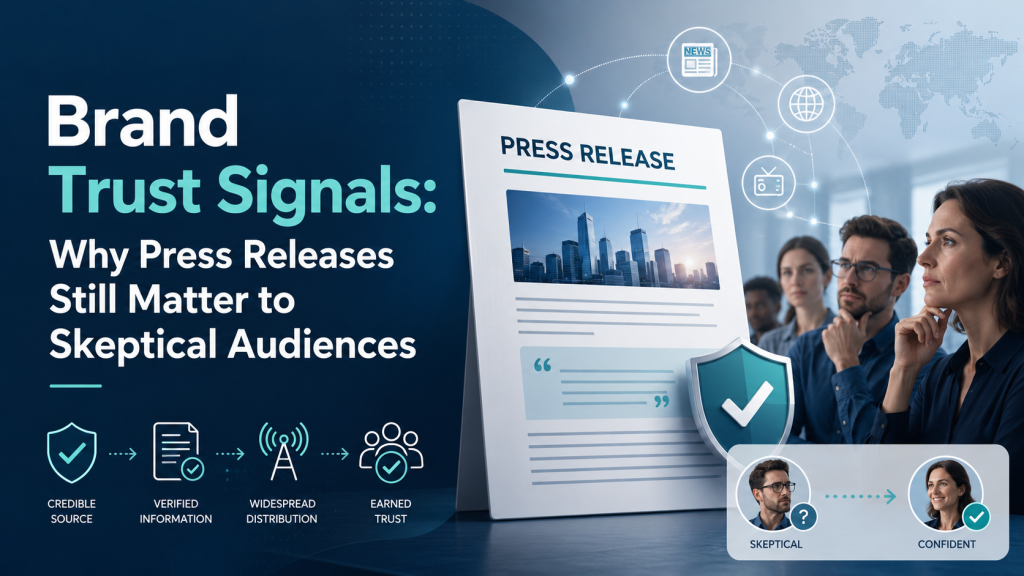
 People are more skeptical than ever.
Customers have seen too many exaggerated claims, too many “game-changing” announcements, and too many companies treating routine updates like revolutions.
So when you say your business is credible, growing, innovative, or trusted, many people quietly ask the same question:
Says who?
That is where press releases still matter.
A press release will not magically make people trust you. It is not a shortcut. It is not a substitute for doing good work or having a real story to tell.
But when used properly, a press release creates useful trust signals. It gives your news structure. It gives journalists, customers, partners, investors, and searchers a clear record of what happened. It also shows that your company is active, accountable, and willing to put its news into the public conversation.
In a skeptical market, that matters.
Trust Is Built Through Repetition
Most people do not trust a brand because of one message. They trust a brand because they see a pattern.
A company launches a useful product. Then it announces a customer milestone, partnership, award, or expansion. Over time, those signals add up.
A press release helps document those moments.
For a small business, this is especially valuable. You may not have the name recognition of a larger competitor, the ad budget, or years of national coverage behind you. But you can still build a public record of progress.
That record matters when someone searches your company name, a prospect is deciding whether to book a call, or a journalist wants to know whether your company has momentum.
One release may not change everything. Ten strong, relevant announcements can change how your company is perceived.
Press Releases Create a Public Proof Point
A sales page is controlled by you. An ad is bought by you. A social post is easy to publish and easy to forget.
A press release is different. It is a formal statement of news. It has a date, headline, quote, contact information, company background, and specific facts behind the announcement.
That structure gives the reader something to evaluate.
Did the company raise funding? Hire an executive? Launch a product? Open a location? Win an award? Publish research? Partner with another organization?
A good press release answers those questions clearly. It does not ask the reader to believe vague claims. It gives them something concrete.
A well-written release follows a familiar format that helps readers, journalists, and search engines understand the news quickly.
Skeptical audiences do not need louder marketing. They need proof.
Credibility Comes From Specifics
The weakest press releases read like advertisements.
They are filled with big claims and thin details. They say the company is “revolutionizing” something. They call the product “cutting-edge.”
Readers tune that out.
A trust-building press release does the opposite. It gets specific.
Instead of saying, “We are a leading provider,” explain what you do and who you help. Instead of saying, “Customers love our platform,” share a measurable milestone or a clear use case. Instead of saying, “This partnership is exciting,” explain what changes for the customer, the market, or the community.
Specifics turn promotion into information.
A weak announcement says: “ABC Software is proud to announce an innovative new solution for small businesses.”
A stronger version says: “ABC Software has launched a scheduling tool that helps independent dental practices reduce missed appointments by sending automated reminders through text and email.”
The second version is better because it gives the reader something real to understand.
Press Releases Help Journalists Verify the Story
Journalists are skeptical by trade. That is part of the job.
If you pitch a reporter, they need to know what is new, why it matters, and whether the facts hold up. A strong press release makes that easier.
It gives them the basic details in one place: names, dates, quotes, context, contact information, and supporting assets. That does not guarantee coverage. Nothing does. But it reduces friction.
Reporters are busy. If your story is hard to understand, hard to verify, or hard to explain to their audience, it is easier to pass.
A clear press release helps the journalist quickly answer, “Is there a story here?”
Press Releases Support Search Trust, Too
Many people do not go straight from hearing about a company to buying from it. They search first.
They look up the brand name. They scan headlines. They check whether the company has been mentioned anywhere beyond its own website. They look for signs that the business is legitimate.
That search behavior matters because audiences often look for outside signals before they decide whether a company is credible.
Press releases can help fill that gap.
When someone searches your company, your announcement history can show that you are active and real. Product launches, partnerships, awards, executive hires, research reports, events, and expansions all create context around your brand.
This is not about stuffing keywords into a release and hoping for SEO magic. The better goal is visibility and credibility.
A release gives searchers a dated, structured record of your news. It can also support AI search by giving answer engines clearer information about what your company does, who you serve, and what you have announced.
Again, the value comes from clarity, not hype.
Trust Signals Work Best When They Are Earned
A press release should not be used for every small update.
If your company changes the color of a button on your website, that is not news. If you publish a routine blog post, that is probably not news either. If you add a minor feature that only current users will understand, a customer email may be a better fit.
The strongest press releases are tied to real milestones, such as product launches, funding, partnerships, customer milestones, major hires, awards, original research, expansions, or timely industry responses.
The test is simple: would anyone outside your company care?
When you respect the audience’s attention, you build trust. When you dress up every internal update as breaking news, you spend trust.
Press Releases Are Part of the Trust Stack
A press release works best when it is not alone.
Think of it as one layer in your trust stack.
Your website explains what you do. Customer reviews show real experience. Case studies show outcomes. Social channels show activity. Media coverage shows third-party interest. Press releases document your news.
Imagine a small manufacturer announces a second facility. The release explains the expansion. The website adds production details. A local reporter covers the jobs angle. A customer testimonial explains how the expansion will reduce lead times.
No single piece carries the whole story. Together, they create confidence.
The Bottom Line
Skeptical audiences are not the enemy. In many ways, they make companies better.
They force you to be clear. They force you to prove your claims. They force you to stop hiding behind vague language.
That is exactly why press releases still matter.
A good press release gives your brand a public, structured, verifiable way to share real news. It helps journalists understand the story. It helps customers see momentum. It helps searchers find proof that your company is active and credible.
But the release has to be grounded in something real.
Do not use a press release to shout louder. Use it to make the truth easier to see.
That is the trust signal that still works.

Mickie Kennedy founded eReleases.com in 1998 after watching PR firms charge small businesses a $20,000 minimum for a single press release. For 27 years, he’s been closing that gap — distributing 150,000+ releases via Cision PR Newswire, serving 30,000+ clients including Manscaped, Squatty Potty, and 40+ Shark Tank brands, and generating $132M+ in earned media. A sought-after podcast guest and two-time Amazon bestselling author of Beginner’s Guide to Writing Powerful Press Releases and The PR Strategy Manifesto. Mickie holds an MFA in Creative Writing from George Mason University. Based in Baltimore, MD. LinkedIn