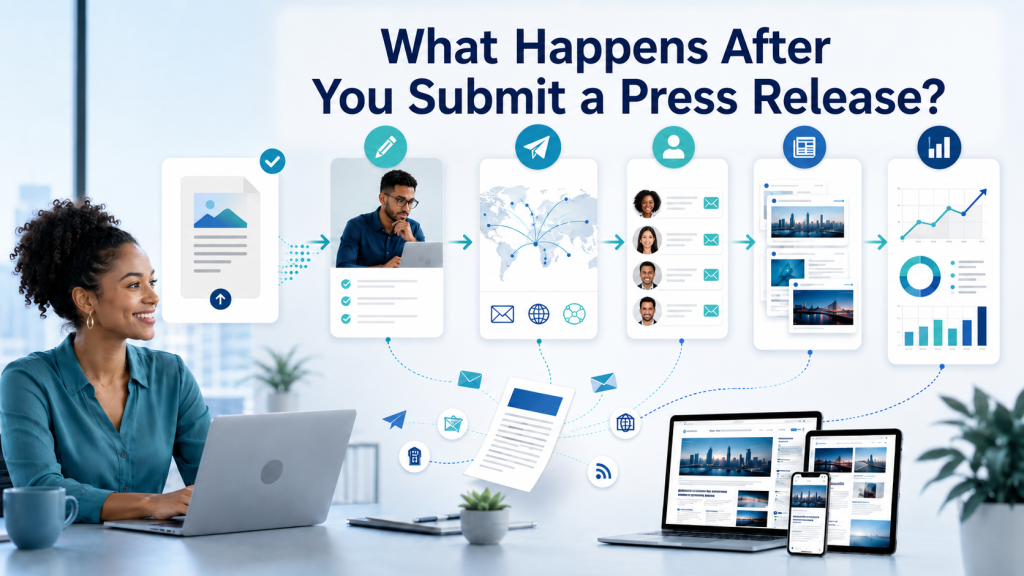
Submitting a press release can feel like the finish line.
You wrote the announcement. You approved the quote. You checked the links and hit submit.
But submission is not the end. It is the handoff.
What happens next depends on the service you use, the quality of your release, and how ready you are to support the story.
1. Your release gets reviewed
A real press release distribution service does not simply push your release out the moment you upload it.
First, it should go through editorial review. Someone checks for missing contact information, broken links, unclear dates, unsupported claims, formatting issues, or language that sounds more like an ad than news.
This step matters. A release with mistakes can hurt your credibility before a journalist even reads it.
Think of it like sending a resume. The story may be strong, but a typo in the first line still hurts.
2. The release is scheduled or distributed
Once approved, the release is scheduled for your chosen date and time or sent according to the distribution window. From there, it may go to news websites, newsroom systems, trade outlets, local media, or targeted journalist lists, depending on the press release distribution service you selected.
From there, it may go to news websites, newsroom systems, trade outlets, local media, or targeted journalist lists, depending on the distribution you selected.
This is where many business owners get confused.
Distribution does not mean every journalist will write about you. It means your news is being delivered through the right channels. Media coverage still depends on the story, timing, relevance, and follow-up.
3. Online pickup begins to appear
After distribution, you may start seeing your release appear on news and media websites.
This pickup can help with visibility, credibility, search discovery, and giving prospects a third-party place to see your announcement. Just remember: links in syndicated or paid placements should be handled carefully, since Google provides guidance on how to identify paid or sponsored links using attributes like nofollow and sponsored.
But pickup is not the same as earned media.
A posted release is useful. A journalist-written article is something different. Both have value.
4. Journalists may read, save, ignore, or respond
A journalist who receives your release may act on it right away. More often, they may file it away, pass it to a colleague, use it later, or ignore it because it does not fit their beat.
That is normal.
Journalists are busy, skeptical, and overloaded.
Your job is to make the story easy to understand and easy to use. A clear headline, specific facts, a useful quote, and obvious relevance all help.
5. Follow-up can make the difference
After your release goes out, your next step is follow-up.
Send a short, personal note to the most relevant journalists. Do not resend the whole release with “just checking in.” Explain why the story fits their audience.
For example: “I saw your recent coverage of independent bookstores using events to grow foot traffic. We just released data from 200 small retailers showing which events drove the strongest local turnout.”
That gives the journalist a reason to care.
6. You track results and reuse the news
Finally, watch what happens.
Look for pickups, referral traffic, media replies, social sharing, inbound leads, and sales conversations that mention the announcement.
Then reuse the release. Turn it into a blog post, email, LinkedIn update, customer note, sales proof point, or pitch angle for a trade publication.
A press release should not be a one-day event.
The bottom line
After you submit a press release, the real work begins.
The release gets reviewed, distributed, published, read, ignored, shared, or acted on. Some of that is out of your hands.
But the parts you control matter: a clear story, clean details, smart targeting, and thoughtful follow-up.
That is where press releases stop being paperwork and start becoming publicity.

Mickie Kennedy founded eReleases.com in 1998 after watching PR firms charge small businesses a $20,000 minimum for a single press release. For 27 years, he’s been closing that gap — distributing 150,000+ releases via Cision PR Newswire, serving 30,000+ clients including Manscaped, Squatty Potty, and 40+ Shark Tank brands, and generating $132M+ in earned media. A sought-after podcast guest and two-time Amazon bestselling author of Beginner’s Guide to Writing Powerful Press Releases and The PR Strategy Manifesto. Mickie holds an MFA in Creative Writing from George Mason University. Based in Baltimore, MD. LinkedIn