 A press release should not disappear into the fog after distribution.
You send it out. It gets picked up. Maybe traffic comes in. Maybe leads appear. But unless you set up tracking before the release goes live, you are left trying to connect dots after the fact.
That is where UTM tracking helps.
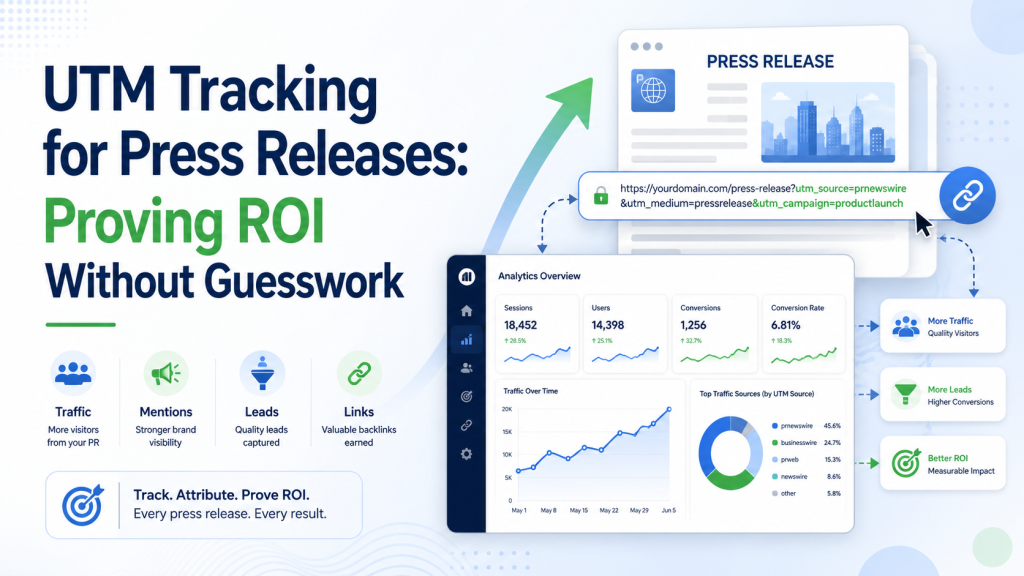
UTM links show what traffic came from your press release, which links people clicked, and what those visitors did next. They will not measure every ounce of PR value. Earned media often works indirectly. But they help you prove what happened on your own site instead of relying on hope, hunches, or pickup reports.
What Is a UTM Link?
A UTM link is a regular URL with tracking details added to the end.
Instead of linking to:
https://www.yoursite.com/new-product
You might use:
https://www.yoursite.com/new-product?utm_source=press_release&utm_medium=pr&utm_campaign=new_product_launch
The visitor sees the same page. You see better data.
Why UTM Tracking Matters
Many business owners judge a press release by the wrong question: “How many sites picked it up?”
Pickup matters, but it is only part of the story. A release can appear on hundreds of syndicated pages and still produce little action. Another release might generate fewer pickups but bring in qualified visitors, subscribers, demo requests, or sales inquiries.
UTM tracking helps you answer better questions:
- Did the release send people to our website?
- Which call-to-action link worked best?
- Did visitors sign up, buy, or request information?
- Did this campaign outperform the last one?
- Did PR support our larger marketing effort?
That is more useful than “We got 247 pickups, so I guess it worked.”
The Three UTM Fields You Need
Do not overcomplicate this. For most press releases, three UTM fields are enough.
Source: Where the traffic came from.
Use press_release or newswire.
Medium: The type of traffic.
Use pr, newswire, or earned_media.
Campaign: The specific announcement.
Use product_launch, funding_announcement, or new_location_opening.
A clean structure:
utm_source=press_releaseutm_medium=prutm_campaign=new_location_opening
You can also use Google’s Campaign URL Builder to create these links and reduce simple formatting mistakes.
The key is consistency. Do not use press-release one month, PressRelease the next, and pr_release after that. Your analytics will treat those as separate sources.
Where to Use UTM Links
Use UTM links on the URLs you control.
The best place is usually the main call to action: a product page, landing page, event registration page, media kit, investor page, or contact form.
Do not stuff every link in the release with tracking parameters. A release should still read like news, not a sales brochure.
One strong, relevant link is usually better than five scattered ones.
If you announce a new service, link to a landing page that gives visitors a next step. If you announce an event, link directly to registration. Do not send people to your homepage and make them hunt.
What to Measure After Distribution
Once the release is live, look beyond traffic alone.
Track:
- Sessions from the UTM campaign
- New users
- Time on page
- Form submissions
- Email signups
- Demo or consultation requests
- Purchases, if applicable
- Assisted conversions
That last one matters. PR rarely works in a straight line. Someone may see your release, visit your site, leave, come back later through search, and then convert. If you only credit the final click, PR may look weaker than it was.
A Simple Example
Imagine a small software company announces a new feature. The release links to a feature landing page with UTM tracking.
After distribution, the company sees 420 visits from the release campaign. Of those visitors, 38 sign up for a webinar, 11 request a demo, and 3 become customers over the next month.
Now the company has a real story: this announcement brought qualified traffic, produced leads, and supported sales.
That is the difference between activity and evidence.
What UTM Tracking Cannot Prove
UTM tracking is useful, but it is not magic.
It will not capture every journalist who reads your release. It will not measure brand trust. Some syndicated sites may strip links or use redirects.
That is fine.
PR has always included indirect value. Measure what you can, clearly and consistently.
Set It Up Before You Distribute
The biggest mistake is waiting until after the release goes out.
Create your UTM links before distribution. Test them. Make sure they point to the right page. Confirm your analytics platform is recording them properly. Then use the tracked URL in the release, your media pitch, and any owned channels supporting the announcement. For a broader look at building this into a real campaign, see this guide to press release distribution in 2026.
Over time, compare results across campaigns.
Which topics drove better traffic? Which calls to action worked? Which releases brought leads, not just clicks?
That is how you move press releases out of the guessing game and into a practical, measurable part of your marketing.

Mickie Kennedy founded eReleases.com in 1998 after watching PR firms charge small businesses a $20,000 minimum for a single press release. For 27 years, he’s been closing that gap — distributing 150,000+ releases via Cision PR Newswire, serving 30,000+ clients including Manscaped, Squatty Potty, and 40+ Shark Tank brands, and generating $132M+ in earned media. A sought-after podcast guest and two-time Amazon bestselling author of Beginner’s Guide to Writing Powerful Press Releases and The PR Strategy Manifesto. Mickie holds an MFA in Creative Writing from George Mason University. Based in Baltimore, MD. LinkedIn