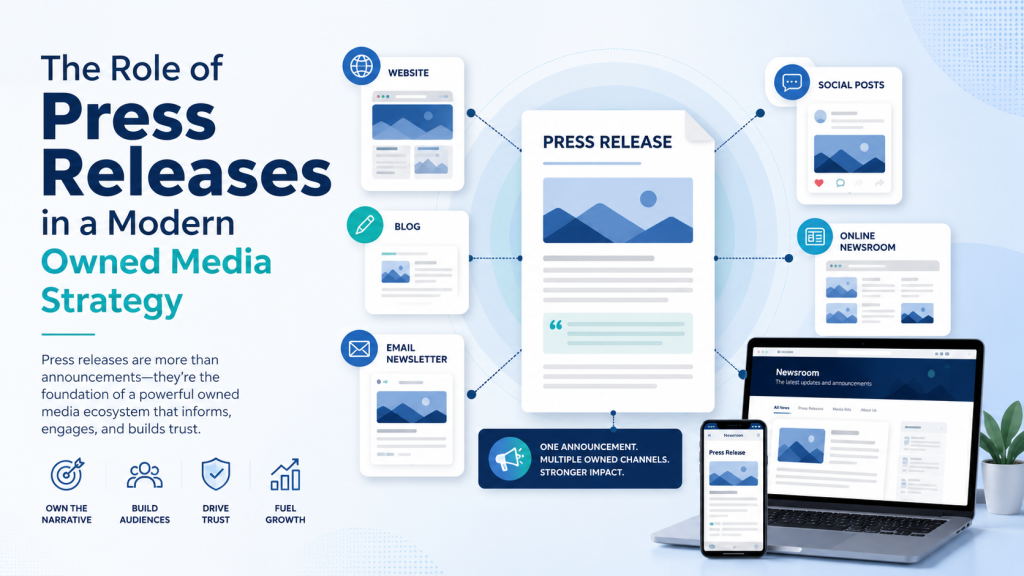
 Owned media is the part of your marketing you control.
Your website. Your blog. Your email list. Your newsroom. Your social channels. These are the places where your message can live without waiting for an algorithm, an ad platform, or a journalist to approve it.
So where does a press release fit?
Too often, a press release is treated as a one-time announcement. You write it, distribute it, hope for pickup, and move on.
That is too narrow.
In a modern owned media strategy, a press release does more than announce news. It creates a public record of what happened, why it matters, and how the announcement fits into the larger story of your business.
A strong owned media strategy gives those channels a clearer purpose instead of treating each blog post, email, or update as a one-off task.
Owned Media Needs Real News
A lot of businesses publish content because they feel they should.
They post tips. They write blog articles. They send newsletters. They share social updates.
That content can be useful. But owned media also needs proof that the company is moving. Otherwise, it can start to feel like commentary without evidence.
Press releases provide that proof.
They mark real moments: a product launch, a partnership, a funding announcement, a customer win, a new location, an award, a leadership hire, a research finding, or a community initiative.
These are credibility signals.
When someone visits your website, checks your newsroom, or searches your company name, they are looking for signs of life. Are you active? Are you credible? Are you growing? Are you doing anything worth noticing?
A thoughtful press release program helps answer those questions.
Press Releases Give Your Story a Spine
Owned media works best when it is organized around a clear story.
What does your company stand for? Who do you help? What problem do you solve? What progress are you making?
Press releases help structure that story.
Think of each release as a dated chapter in your company’s public record. One release may announce a product. Another may explain a partnership. Another may share customer results. Over time, those releases create a timeline.
That timeline matters.
A startup with one announcement may look new. A startup with six well-framed announcements over 18 months looks like it has momentum. A nonprofit that regularly shares programs, partnerships, and impact data shows ongoing mission movement.
The release is not the whole story. But it gives the story a spine.
Press Releases Should Feed Your Owned Channels
A press release should not sit alone.
The best use of a release is to make it part of a larger owned media system. The release provides the formal announcement. Your other channels explain, expand, and humanize it.
Say your company launches a new service. Before you distribute the announcement, make sure you understand how press release distribution works so the release supports both media outreach and your owned channels.
The press release states the news clearly: what launched, who it is for, why it matters, and who is quoted.
Your blog can go deeper into the problem the service solves. Your email newsletter can explain why customers asked for it. Your social posts can highlight one practical benefit at a time. Your sales team can use the release as a credibility link when prospects ask, “What’s new?”
That is how owned media and press releases work together. The release creates the official record. The rest of your content turns that record into useful context.
Press Releases Create Trust Signals
People are skeptical. They should be.
Every business says it is innovative. Every consultant says they are experienced. Every product says it is easier, faster, or better.
A press release forces you to be more specific.
What happened? When did it happen? Who is involved? What changed? What can be verified?
That discipline is useful.
Even when a release does not lead to a major feature story, it can still strengthen your owned media presence. It gives prospects, partners, investors, donors, employees, and journalists something concrete to evaluate.
A newsroom filled with clear, relevant releases says, “We are not just making claims. Here is what we have done.”
Of course, this only works if the news is real. Weak announcements do not build credibility. They do the opposite. If every release sounds inflated, your owned media starts to feel like a sales pitch wearing a necktie.
The goal is simple: document meaningful progress in plain language.
Press Releases Help Journalists Move Faster
Owned media is not just for customers. It is also for journalists.
When a reporter, editor, podcast host, or trade writer hears about your company, they often do a quick search. They may land on your site before they ever respond to a pitch.
What will they find?
If your owned media is thin, dated, or unclear, you make their job harder. If your newsroom includes strong releases, clean headlines, useful background, quotes, and links to related materials, you make their job easier.
A good release gives them the core facts, names and titles, a usable quote, company background, relevant context, a media contact, and a reason the announcement matters now.
That does not guarantee coverage. Nothing does. But it removes friction. And in media relations, removing friction is half the work.
Your Newsroom Should Be Easy to Use
Many companies bury their press releases. Some scatter them across old blog categories. Others publish a few updates and then let the page go stale.
That sends the wrong message.
If press releases are part of your owned media strategy, give them a proper home. A simple newsroom or press page can do the job.
Think of your online newsroom as the place where journalists, prospects, partners, and employees can find the current version of your company story.
It should include recent releases, your boilerplate, media contact information, leadership bios, approved images, notable coverage, and basic company facts.
One Release Can Become Many Assets
A common mistake is treating a press release as a single-use asset.
That is wasteful.
A good release can become a blog post, founder note, customer email, LinkedIn post, FAQ, website update, sales link, trade media pitch, or timeline entry.
Do not stop after distribution.
The release should be the source document. Your owned media channels should adapt it for different audiences.
Same news. Different framing.
The Practical Way to Start
Start simple.
Look at the next six months and identify three to five possible announcement moments. Do not force it. Look for real news.
Then decide how each announcement can support your owned media.
For each release, ask:
- What is the actual news?
- Who should care?
- Why does it matter now?
- What proof supports it?
- What owned channels can extend the story?
The release anchors the news. Your owned media carries it forward.
The Bottom Line
Press releases still matter because credibility still matters.
In a modern owned media strategy, the press release is not just a distribution tool. It is a record, a trust signal, a story anchor, and a source asset for the rest of your content.
Used well, it helps your company show momentum without shouting. It gives journalists a clearer path into your story. It gives prospects and partners proof that something real is happening.
And maybe most important, it keeps your owned media tied to actual progress.
That is where good PR starts.

Mickie Kennedy founded eReleases.com in 1998 after watching PR firms charge small businesses a $20,000 minimum for a single press release. For 27 years, he’s been closing that gap — distributing 150,000+ releases via Cision PR Newswire, serving 30,000+ clients including Manscaped, Squatty Potty, and 40+ Shark Tank brands, and generating $132M+ in earned media. A sought-after podcast guest and two-time Amazon bestselling author of Beginner’s Guide to Writing Powerful Press Releases and The PR Strategy Manifesto. Mickie holds an MFA in Creative Writing from George Mason University. Based in Baltimore, MD. LinkedIn