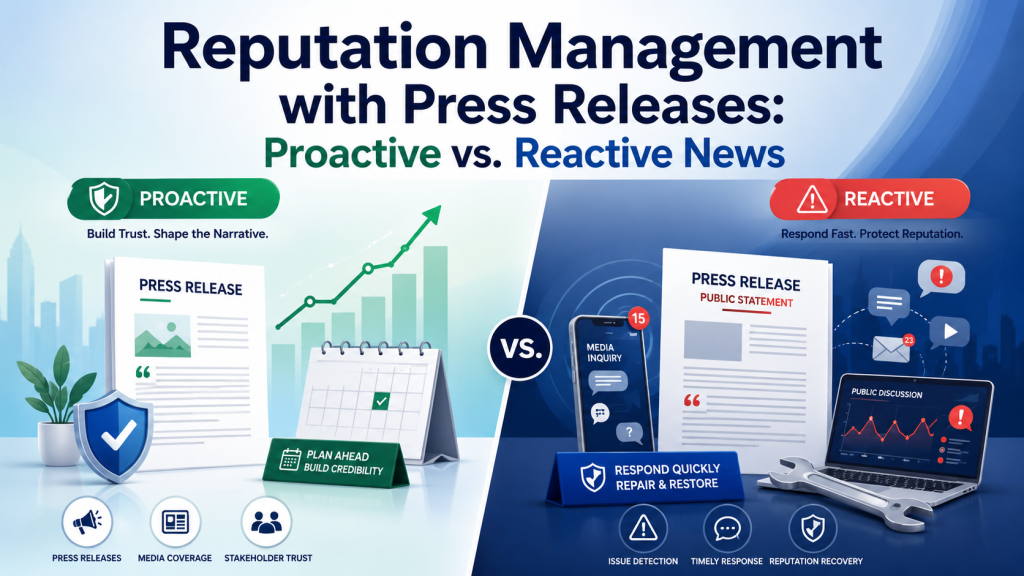
 Reputation is not built in one announcement. It is built in the pattern of what people hear about you over time.
That is why press releases can play a useful role in reputation management. Not because a release can magically fix a bad story. It cannot. But because consistent, credible news gives customers, journalists, partners, and searchers a fuller picture of who you are.
The key is knowing the difference between proactive news and reactive news.
Proactive news builds reputation before you need it. Reactive news helps you respond when something has already happened. Both matter. But they require different instincts.
What proactive reputation management looks like
Proactive reputation management is the work you do before there is a problem.
It is the steady rhythm of legitimate news that shows your company is active, useful, responsible, and moving forward. It gives people something real to find when they search your name.
A proactive press release might announce a new product, company milestone, partnership, leadership hire, award, community initiative, research finding, market expansion, or customer success story.
The point is not to brag. The point is to document progress.
Think of it like putting deposits into a trust account. Each honest, newsworthy announcement adds context. Over time, that context matters.
If all the public knows about your business is one negative review, one complaint, or one old article, that single result can carry too much weight. But if there are credible signals showing what your business does well, the picture changes.
For a deeper look at this side of the equation, here’s a practical guide on how to manage and mitigate bad PR.
Why proactive news works better than last-minute repair
Many businesses ignore reputation until something goes wrong. Then they want one press release to make the problem disappear.
That is a hard ask.
A press release is not an eraser. It is a public statement. If the issue is serious, vague or defensive language will not help. It can make things worse.
Proactive news works better because it is not arguing with a crisis. It is building the public record before there is pressure.
For example, say a local manufacturer has spent years issuing occasional releases about safety improvements, employee training, community partnerships, and environmental upgrades. If a problem occurs later, the company has a documented history of taking operations seriously.
That does not excuse the problem. But it gives context.
Now compare that with a company that has said nothing publicly for five years. When it suddenly issues a release after a controversy, people may wonder, “Why are we only hearing from them now?”
That is the difference.
What reactive reputation management looks like
Reactive reputation management happens after an issue, criticism, mistake, lawsuit, recall, investigation, public complaint, or rumor begins to affect how people see the business.
A reactive press release can help when there is something clear, factual, and useful to say. It can clarify misinformation. It can explain what happened. It can announce corrective action. It can share next steps.
But a reactive release should not be used to spin, minimize, or bury the issue.
A reactive press release may be appropriate when the public needs accurate information, customers need instructions, the company has taken specific corrective action, a false claim is spreading, or the issue affects safety, service, privacy, or trust.
The test is simple: does this release help people understand what happened and what comes next?
If the answer is yes, a release may help. If the answer is no, wait.
When a reactive release can hurt
Small wording choices matter, especially during a crisis, which is why it helps to understand common crisis communications press release mistakes.
A press release can hurt when it sounds like the company is trying to manage perception instead of handling the problem.
That often shows up in language like:
- “We take this very seriously” without saying what action is being taken
- “An isolated incident” before the facts are clear
- “We are committed to excellence” when customers need specifics
- Blaming others too early
- Overexplaining minor details while avoiding the main issue
People are good at spotting evasion. Journalists are even better at it.
If the company has not yet investigated the issue, say that. If customers need help, tell them where to go. If you made a mistake, own it plainly. If legal concerns limit what you can say, still communicate what you can.
Silence can be damaging. Empty language can be worse.
The role of press releases in search reputation
Press releases can also support search reputation, but this needs to be understood clearly.
A press release is not a magic SEO tool. You should not expect one announcement to outrank every negative result. Search engines do not work that neatly.
But consistent news can help create more credible, current, relevant information around your brand name.
When someone searches for your company, what do they find?
If the answer is outdated profiles, thin directory listings, old complaints, or nothing at all, press releases can help fill that gap with legitimate news.
The best releases for search reputation are not keyword-stuffed. They are clear, specific, and useful. They mention the company name naturally. They explain what changed. They include facts. They read like news, not sales copy.
How to build a proactive release calendar
You do not need to issue a press release every week. Most small businesses do not have enough real news for that.
But you should look ahead and identify moments worth announcing.
A simple quarterly plan might include one milestone announcement, one customer or community angle, one expert insight or report, and one partnership, hiring, product, or service update.
The best question to ask is: “Would someone outside our company have a reason to care?”
If yes, you may have a release. If no, use a blog post, email, or social update instead.
Prepare before you need to react
The CDC’s crisis and emergency risk communication principles are a useful reminder that credibility, consistency, and preparation matter when people are looking for answers.
Reactive PR works better when you have already done the thinking.
Know who approves public statements. Know who talks to the media. Know when legal or compliance review is needed. Know where customer updates will be posted. Know what issues require a formal release.
You do not want to figure this out while the phone is ringing.
Proactive vs. reactive: which matters more?
Both matter. But proactive reputation management gives you more room to breathe.
Reactive news is about response. Proactive news is about identity.
The mistake is waiting until the reactive moment to begin telling your story.
A company that only communicates during trouble trains people to associate its name with trouble. A company that communicates consistently gives people a broader frame.
A practical next step
Look at your company’s public footprint today.
Search your business name. Review the first page. Look at your newsroom, blog, and recent announcements. Ask yourself a blunt question:
“If a stranger saw only this, would they understand who we are and why we can be trusted?”
If the answer is no, start building the record.
Find three pieces of legitimate news you can share over the next six months. Write them clearly. Avoid hype. Include facts. Distribute them to the right audience. Follow up with relevant journalists when there is a real story.
Reputation management is not just what you say when something goes wrong. It is what you have been saying all along.

Mickie Kennedy founded eReleases.com in 1998 after watching PR firms charge small businesses a $20,000 minimum for a single press release. For 27 years, he’s been closing that gap — distributing 150,000+ releases via Cision PR Newswire, serving 30,000+ clients including Manscaped, Squatty Potty, and 40+ Shark Tank brands, and generating $132M+ in earned media. A sought-after podcast guest and two-time Amazon bestselling author of Beginner’s Guide to Writing Powerful Press Releases and The PR Strategy Manifesto. Mickie holds an MFA in Creative Writing from George Mason University. Based in Baltimore, MD. LinkedIn