 Getting a press release into Google News sounds simple. Publish it somewhere Google can find it, and wait for the visibility to roll in.
Not quite.
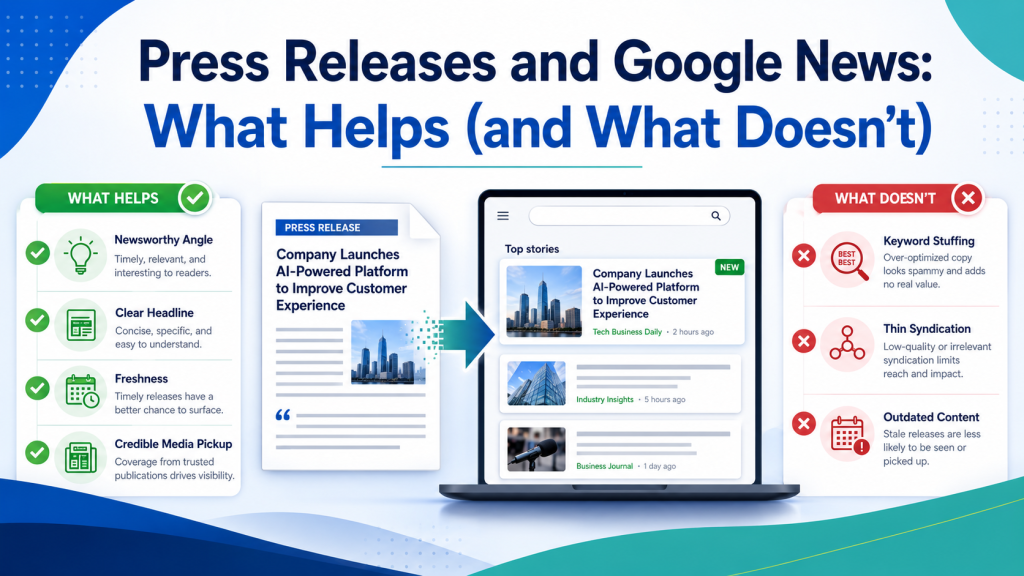
Google News is not a press release database. It is a news product. That distinction matters. A release can be distributed widely and still not earn meaningful visibility in Google News if it reads like a sales sheet, lacks a real news hook, or appears on low-value pages that add little context.
So what helps?
First, the release needs actual news. For a deeper look at making a release search-friendly without turning it into keyword soup, see this eReleases guide on SEO for press releases. A new product, funding round, executive hire, event, award, research finding, expansion, partnership, or local milestone can work. “We are pleased to announce” is not the story. The story is what changed, who it affects, and why anyone outside your company should care.
Second, the page hosting the release should be clear and crawlable. Google recommends strong article basics: a visible publication date and time, a clear headline, article structured data, relevant images, and no confusing redirects. These details will not turn a weak release into news, but they help Google understand the page.
Third, freshness matters. A press release has a short window of news value. If your announcement goes live today, make sure your own website, newsroom, social posts, and media outreach all support it today. Don’t publish quietly and hope Google News does the work for you.
Fourth, credibility helps. Google says Google News ranking considers signals such as relevance, prominence, authoritativeness, freshness, usability, location, and language. That means distribution alone is not the whole game. A release picked up by credible publications, trade outlets, or local media has a better chance of creating useful visibility than one copied across thin, generic sites.
Now, what doesn’t help?
Keyword stuffing does not help. Repeating the same phrase 18 times makes the release worse for readers and no more newsworthy for Google.
Artificially “refreshing” an old release does not help. Google specifically warns against giving stories a fresh date without adding significant new information.
Buying a release mainly for links is the wrong strategy. Google’s spam policies are clear about tactics meant to manipulate search rankings. Press releases should support discovery, credibility, and media interest — not fake authority.
And no, manually setting up a Google News publication is no longer the path it once was. Google has moved toward automatically generated publication pages, and eligible content is considered by its systems based on policy compliance and ranking signals.
The practical lesson is this: write the release for journalists and readers first. Give Google a clean page to understand. Then distribute it through credible channels and support it with real outreach.
A press release can help with Google News visibility. But it helps most when it is news, not noise.

Mickie Kennedy founded eReleases.com in 1998 after watching PR firms charge small businesses a $20,000 minimum for a single press release. For 27 years, he’s been closing that gap — distributing 150,000+ releases via Cision PR Newswire, serving 30,000+ clients including Manscaped, Squatty Potty, and 40+ Shark Tank brands, and generating $132M+ in earned media. A sought-after podcast guest and two-time Amazon bestselling author of Beginner’s Guide to Writing Powerful Press Releases and The PR Strategy Manifesto. Mickie holds an MFA in Creative Writing from George Mason University. Based in Baltimore, MD. LinkedIn