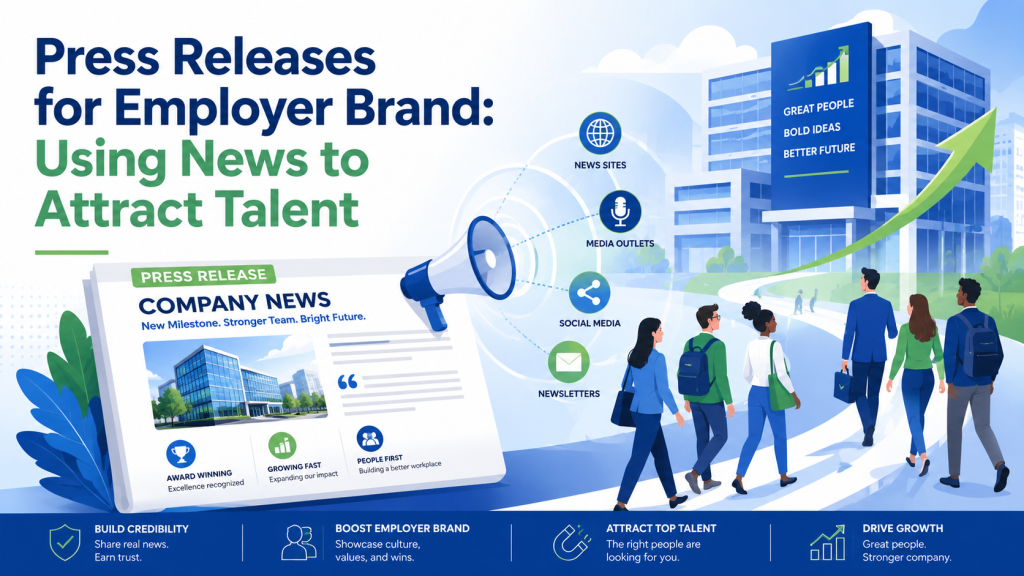
 Most companies think of press releases as a way to reach customers, investors, or the media. That’s true. But a good release can also reach another audience that matters: talent.
People want to work for companies that are moving. They look for signs of growth, purpose, stability, and momentum. A press release lets you show those signals in public without sounding like a recruiting brochure.
Before someone applies, they may search your company name. They may look at your website, LinkedIn page, reviews, and recent news. What do they find? If the answer is silence, you are leaving the story to chance.
A steady pattern of useful company news, supported by smart press release distribution, helps fill that gap.
What Kind of News Helps Employer Brand?
Not every announcement will attract talent. A release saying “we are hiring” is usually not enough. The stronger angle is what the hiring says about the company.
For example:
- A new location can show growth.
- A product launch can show innovation.
- A funding announcement can show stability and ambition.
- A major customer win can show market demand.
- An award can show credibility.
- A community initiative can show values in action.
- A leadership hire can show where the company is headed.
The news is the doorway. The employer brand comes through in how you frame it.
A small manufacturer opening a second facility should not only say, “We opened a new plant.” It can say the company is investing in skilled jobs, training local workers, and expanding because customer demand has grown. That gives a potential employee something real to notice.
Write for People, Not Just Applicants
Employer brand works best when it feels honest. A strong employer brand shapes how candidates understand your company before they ever apply. You are not begging people to apply. You are showing what kind of company you are becoming.
Use plain language. Explain the “why” behind the news. Include a quote from leadership that sounds like a person, not a committee. Mention the team when appropriate. If employees helped make the milestone happen, say so.
There’s a big difference between:
“The company continues to execute its strategic growth initiative.”
And:
“Our team earned this growth by solving hard problems for customers every day.”
One sounds like a boardroom. The other sounds like a place where people do meaningful work.
Tie the Release Back to Careers
You do not need to turn every press release into a job ad. But you can include a subtle careers mention when it fits.
For example:
“As part of the expansion, the company expects to add roles in customer support, operations, and software development over the next six months.”
That is useful. It tells candidates where the opportunity is. It also gives journalists, local business groups, and industry publications a reason to care.
Then link to your careers page in the boilerplate or company description. Keep it simple. The goal is to make the next step easy, not to overstuff the release.
The Bottom Line
Employer brand is not built by saying “we’re a great place to work.” It is built by showing proof over time.
Press releases help you document that proof.
Use them to share real momentum: growth, impact, leadership, customer wins, community work, and team achievements. Then make sure each release answers the quiet question every good candidate asks:
“Is this a company worth attention?”
If your news helps them answer yes, your press release has done more than generate visibility. It has helped open the door to better talent.

Mickie Kennedy founded eReleases.com in 1998 after watching PR firms charge small businesses a $20,000 minimum for a single press release. For 27 years, he’s been closing that gap — distributing 150,000+ releases via Cision PR Newswire, serving 30,000+ clients including Manscaped, Squatty Potty, and 40+ Shark Tank brands, and generating $132M+ in earned media. A sought-after podcast guest and two-time Amazon bestselling author of Beginner’s Guide to Writing Powerful Press Releases and The PR Strategy Manifesto. Mickie holds an MFA in Creative Writing from George Mason University. Based in Baltimore, MD. LinkedIn