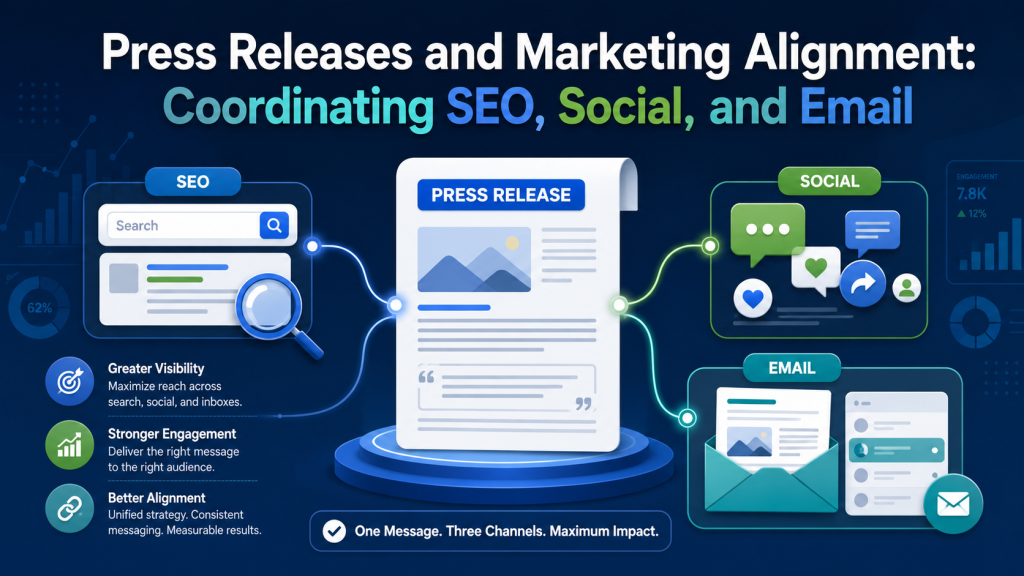
 A press release should not live by itself.
Too many businesses treat a release as a one-day announcement. They write it, distribute it, share the link once, and move on.
A good release can support SEO, social media, email, and sales conversations. But only if you treat it as part of a larger marketing effort instead of a separate PR chore.
The release is the public news marker. Everything around it should help the right people notice, understand, and act.
Start with one clear message
Alignment begins before the release is written.
Ask one simple question: what do we want the market to understand?
Not “What do we want to promote?” That question often leads to features, slogans, and internal talking points. The better question forces clarity.
Maybe you opened a new location. Maybe you launched a product that solves a specific problem. Maybe you hired an executive who signals a new direction. Whatever the news is, the release should carry one main message.
Before you draft the release, make sure you understand what to include in a press release so the announcement has the right structure, context, and next step.
That message should guide your SEO title, social posts, email subject line, landing page copy, and sales talking points. When each channel reinforces the same idea, the story gets stronger.
Use SEO to make the release easier to find
Press releases are not magic SEO tools. They will not turn a weak story into search dominance. But they can help people discover your news when the language matches what your audience already searches for.
Start with the terms your customers use. If you sell accounting software for small nonprofits, say that. Do not hide behind broad language like “financial management solution.”
For a deeper look at search basics, Google’s SEO Starter Guide explains how to help search engines understand your content while keeping the reader first.
Use your primary phrase naturally in the headline, subhead, and first paragraph if it fits. Add useful context, but avoid keyword stuffing. A release should still read like news, not like a page written for a robot.
After someone finds the release, link to a relevant page on your site and give readers a useful next step.
Turn the release into social content
A press release gives you more than one social post.
You can pull several angles from the same announcement: the main news, a customer benefit, an executive quote, a statistic, a local angle, or a behind-the-scenes detail.
This keeps social promotion from feeling repetitive. You are not saying the same thing five times. You are showing different sides of the same story.
For example, a company announcing a new warehouse might post about faster delivery, local hiring, a new region served, and a team photo. Same announcement. Different reasons to care.
Use email to reach people who already trust you
Your email list may be the most underused audience for press release news.
Customers, partners, investors, and prospects do not need the full press release pasted into their inbox. They need the shorter version: here’s what changed, why it matters, and what you can do next.
Lead with the benefit or significance. Link to the release only if the full announcement adds value. In many cases, link instead to a landing page that gives the reader the next step.
A customer does not care that you “announced” something. They care whether it helps them save time, solve a problem, attend an event, try a feature, or understand your direction.
Write the email for that person.
Give your team the same story
Marketing alignment should include the people talking directly to customers.
A simple internal note can help: what we announced, why it matters, who will care most, how to describe it, what link to share, and what not to say.
That last point matters. Alignment is also about avoiding confusion, exaggeration, or claims the release does not support.
Build a simple promotion calendar
You do not need a complicated campaign plan. You need a short sequence.
Before distribution, prepare your release, landing page, email, social posts, images, and internal talking points. On launch day, distribute the release, send the key email, post the main social announcement, and make sure your team has the approved language.
In the days after distribution, share supporting angles. Follow up with relevant journalists. Add the announcement to your newsroom. Mention it in sales conversations where it fits. If you earn coverage, share that too.
The release starts the clock. The follow-through creates the value.
The release is the anchor
A press release gives your news a credible home. But the audience rarely experiences your story in only one place.
A journalist may see the release first. A customer may see the email. A prospect may find the landing page. A follower may notice the social post. Each piece should feel connected.
When SEO, social, email, sales, and PR all point to the same clear story, your announcement has a much better chance of being understood.

Mickie Kennedy founded eReleases.com in 1998 after watching PR firms charge small businesses a $20,000 minimum for a single press release. For 27 years, he’s been closing that gap — distributing 150,000+ releases via Cision PR Newswire, serving 30,000+ clients including Manscaped, Squatty Potty, and 40+ Shark Tank brands, and generating $132M+ in earned media. A sought-after podcast guest and two-time Amazon bestselling author of Beginner’s Guide to Writing Powerful Press Releases and The PR Strategy Manifesto. Mickie holds an MFA in Creative Writing from George Mason University. Based in Baltimore, MD. LinkedIn