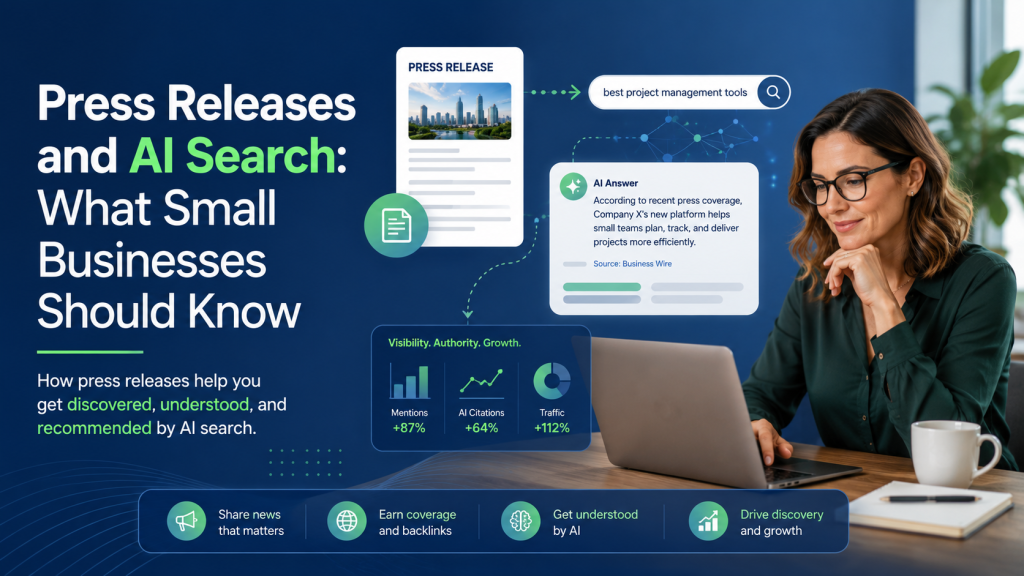
AI search has changed how people find answers. Instead of typing a few keywords and scanning ten blue links, more people are asking full questions and getting summarized answers from tools like Google AI Overviews, AI Mode, ChatGPT Search, Microsoft Copilot, and Perplexity.
That does not make press releases less useful. It makes clear, factual, well-distributed press releases more useful.
Why? Because AI search systems need sources. They look for pages that explain who did what, when it happened, why it matters, and where readers can verify it. A good press release does exactly that.
AI Search Rewards Clarity, Not Cleverness
Traditional SEO trained too many businesses to write for algorithms. AI search pushes you back toward writing for people.
Google explains that pages eligible to appear in AI Overviews and AI Mode generally need to be indexed and eligible to appear in Google Search with a snippet. Pages need to be crawlable, indexable, and useful. Google also says there is no special schema or magic file required to appear in AI Overviews or AI Mode. The same fundamentals still matter: clear text, internal links, useful information, updated business details, and structured data that matches the page.
That is good news for small businesses.
You do not need to chase every new acronym. You need to publish information that is easy to understand and easy to trust. For a deeper look at how press releases can support AI search visibility, read eReleases’ guide to how press releases boost AI search visibility.
A press release gives you a clean public record of your news. It puts the facts in one place. It names the company, the location, the announcement, the people involved, the quote, the date, and the contact. That structure helps journalists. It also helps machines.
Your Release Should Answer the Question Behind the Search
AI search often responds to longer, more specific questions.
Someone may not search “new accounting software.” They may ask, “What are the best affordable accounting tools for independent contractors?” Or, “Which small-business bookkeeping apps added AI receipt scanning this year?”
If your release says, “Company launches innovative platform to transform financial workflows,” you have said almost nothing.
Say what happened plainly.
For example:
“Baltimore accounting software startup LedgerFox launched a $12 monthly bookkeeping app for independent contractors that uses AI to sort receipts, flag missed deductions, and export tax-ready reports.”
That sentence gives AI search systems, journalists, and readers something to work with.
Specific beats impressive.
Press Releases Help Establish Facts AI Can Cite
AI search is not only about ranking. It is about being referenced.
OpenAI’s ChatGPT Search was introduced as a way to give timely answers with links to web sources. OpenAI says ChatGPT can search the web, answer conversational questions, and include source links so users can go deeper.
Microsoft is also making AI citations more measurable. Bing Webmaster Tools introduced an AI Performance dashboard in 2026 that shows how publisher content appears in Microsoft Copilot, Bing AI-generated summaries, and partner integrations, including which URLs are cited and which pages are referenced.
That tells us where things are going.
Visibility is not just “Did we rank?” It is also “Did AI systems use our page as a source?”
A press release can support that if it contains useful facts, not filler.
What Should Small Businesses Include?
The strongest AI-friendly press releases include:
- A direct headline
Say the news. Avoid puns and vague claims. - A strong first paragraph
Include the company name, announcement, date, location, and why it matters. - Real details
Add product features, pricing, availability, dates, customer groups, event information, funding amounts, expansion markets, or measurable outcomes. - A useful quote
Do not say, “We are excited.” Everyone is excited. Say what changed, why it matters, or what problem you are solving. - A clear boilerplate
Explain who you are, who you serve, and what makes you relevant. Keep it factual. - Supporting links
Link to the product page, report, signup page, media kit, or related resource. Make the next step obvious.
What Should You Avoid?
Avoid keyword stuffing. It makes a release harder to read and easier to ignore.
Avoid empty language like “revolutionary,” “game-changing,” and “world-class” unless you can prove it.
Avoid making claims you cannot support. AI search may summarize your content, but journalists, customers, and competitors can still check your work.
Avoid hiding the real news. If the launch date, price, location, customer benefit, or founder story is the hook, put it near the top.
Distribution Still Matters
Publishing a release only on your own site is useful. Distributing it through credible channels can give the announcement more reach and more chances to be discovered, indexed, cited, and covered.
But distribution does not rescue weak news.
Think of it this way: distribution opens doors. The story still has to walk through them.
A small manufacturer announcing a new factory line, a nonprofit releasing a local impact report, or a software company publishing usage data all have something AI search can understand. “We are proud to announce our continued commitment to excellence” does not.
The Practical Takeaway
Press releases are not a trick for AI search. They are a way to publish clean, official, verifiable facts about your business.
That is exactly what small businesses need right now.
If you want your company to show up in AI-driven answers, stop writing releases like ads. Write them like useful public records with a human pulse.
Answer the obvious questions. Use plain language. Include specifics. Make the page easy to crawl. Give journalists a reason to care. Give AI systems facts they can safely reference.
That is not chasing the future.
That is good PR.

Mickie Kennedy founded eReleases.com in 1998 after watching PR firms charge small businesses a $20,000 minimum for a single press release. For 27 years, he’s been closing that gap — distributing 150,000+ releases via Cision PR Newswire, serving 30,000+ clients including Manscaped, Squatty Potty, and 40+ Shark Tank brands, and generating $132M+ in earned media. A sought-after podcast guest and two-time Amazon bestselling author of Beginner’s Guide to Writing Powerful Press Releases and The PR Strategy Manifesto. Mickie holds an MFA in Creative Writing from George Mason University. Based in Baltimore, MD. LinkedIn