 Most press releases get treated like a one-day event.
You write it. You distribute it. You watch for pickup. Then you move on.
That makes sense for breaking news. But many small businesses miss the bigger opportunity: the second wave.
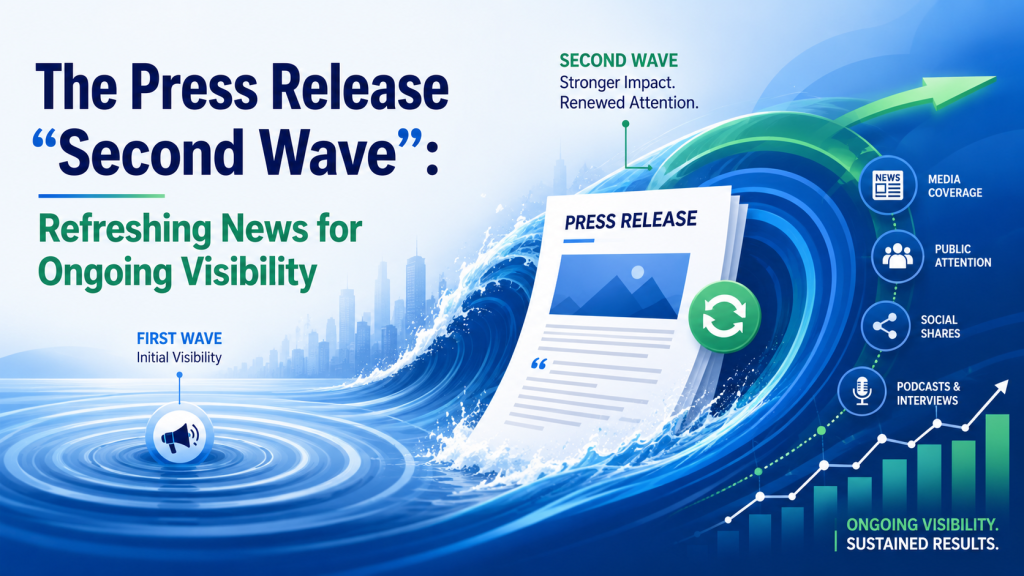
A second wave is when you take the original announcement and refresh it with a new angle, new proof, or new timing. You are not recycling old news. You are showing why the story still matters.
That distinction matters.
A journalist rarely wants the same announcement twice. But they may care about what happened after the announcement. Did customers respond? Did sales climb? Did a trend develop? Did the product expand into a new market? Did the event sell out? Did the nonprofit reach its fundraising goal?
That is where the second wave begins.
What Makes a Second Wave Newsworthy?
The best second-wave releases add movement.
For example, a company might announce a new product in January. That is the first wave. In March, the company can issue a second release if it has real traction: 10,000 users, a major retail partner, strong customer data, or a surprising use case.
The second release is not “we launched this product again.” It is “this launch produced a measurable result.”
That is a much better story.
A second wave can come from several places:
- Milestones
Sales numbers, user growth, downloads, funding progress, waitlist demand, or attendance goals. - Customer proof
Case studies, testimonials, survey results, adoption by a notable client, or a compelling customer story. - New timing
Seasonal relevance, industry trends, regulatory changes, economic shifts, or local market demand. - Expansion
New locations, new features, new partners, new audiences, or new availability. - Follow-through
Results from an event, campaign, study, contest, pilot program, or community effort.
The question to ask is simple: what changed since the first announcement?
If nothing changed, you probably do not have a second wave yet.
Why This Helps Visibility
A smart press release distribution plan gives journalists one entry point. A second wave gives them another.
That matters because timing is unpredictable. A reporter may ignore the first release because they are busy, the topic is not urgent, or the angle does not fit their current coverage. But two months later, with stronger evidence or a better hook, the same story may look more useful.
Second-wave releases also help your owned media. You can turn the update into a blog post, email, sales note, LinkedIn post, customer story, or pitch to trade publications.
You are building a trail of credibility.
One release says, “We did something.”
A second wave says, “It worked.”
How to Plan for It
Do not wait until after distribution to think about the next story.
Before your first release goes out, identify what you will track. Pick two or three signals that could support a follow-up release. If you are sending readers to a landing page, use Google’s Campaign URL Builder so you can see which announcement, pitch, or follow-up drove the visit.
For example:
- Product launch: users, sales, reviews, retailer interest.
- Event announcement: registrations, speakers, sponsors, post-event outcomes.
- Nonprofit campaign: donations, volunteers, community impact.
- New location: opening turnout, local partnerships, hiring numbers.
Then set a check-in date 30, 60, or 90 days later.
Not every release earns a second wave. That is fine. PR works best when it follows real momentum, not wishful thinking.
The Bottom Line
A press release should not be a dead end.
When your announcement creates proof, movement, or impact, you may have another story worth telling. The second wave keeps the conversation alive without forcing it.
That is good publicity: timely, useful, and grounded in something real.

Mickie Kennedy founded eReleases.com in 1998 after watching PR firms charge small businesses a $20,000 minimum for a single press release. For 27 years, he’s been closing that gap — distributing 150,000+ releases via Cision PR Newswire, serving 30,000+ clients including Manscaped, Squatty Potty, and 40+ Shark Tank brands, and generating $132M+ in earned media. A sought-after podcast guest and two-time Amazon bestselling author of Beginner’s Guide to Writing Powerful Press Releases and The PR Strategy Manifesto. Mickie holds an MFA in Creative Writing from George Mason University. Based in Baltimore, MD. LinkedIn