A press release is only useful if it reaches the right people.
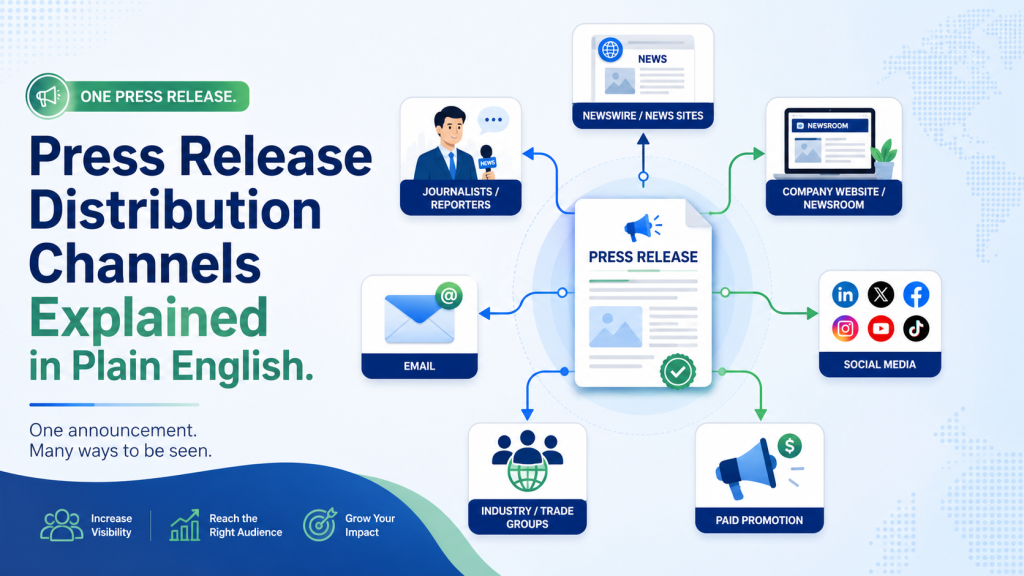
Press release distribution is not one channel. It is a mix of channels, each with a different job. Some give your announcement broad visibility. Some reach journalists. Some help customers, partners, and prospects see that something is happening.
The goal is not to use every channel. The goal is to use the right ones for the news you have.
1. Newswire distribution
A newswire sends your press release through a large network of media outlets, newsroom systems, websites, financial platforms, and databases.
Think of it as the formal distribution layer.
Newswire distribution can help your announcement appear on news and industry websites, reach newsroom systems, create a public record, and support credibility when people search for your company. For a deeper look at how the process works, see this guide on how to distribute a press release.
This channel works best when you have real news: a launch, funding announcement, new location, major hire, research report, partnership, award, milestone, or event.
But a newswire is not magic. It does not force journalists to write about you. It makes your news available. Coverage still depends on the strength of the story.
A weak announcement on a strong wire is still a weak announcement.
2. Targeted journalist outreach
This is where many of the best PR results happen.
Targeted outreach means sending your news directly to specific journalists, editors, bloggers, or producers who cover your topic.
Not “Dear editor.” Not a giant blind copy list. Not a pitch to every reporter in the country.
You identify people who already write about your industry, market, customer problem, or local area. Then you send a short, relevant note explaining why the announcement matters to their audience.
For example, if a software company launches a tool for independent accountants, the best targets may be accounting trade publications, small-business columnists, fintech newsletters, and niche podcast hosts.
The key is relevance. A journalist should see, in a few seconds, why you contacted them.
3. Your company newsroom or website
Your website should be the home base for your news.
Every press release should live on your own site, usually in a newsroom, press center, blog, or announcements section. This gives reporters, customers, prospects, employees, and partners one place to find the official version.
A simple newsroom can include press releases, media contact information, company background, executive bios, product images, logos, and past coverage.
This matters because people check your site when they want to verify you. A reporter may receive your release through a wire, then visit your site to see if you look credible.
Your site does not need to be fancy. It needs to be clear, current, and easy to navigate.
4. Email and social media
Your email list and social channels are not traditional media distribution, but they are useful.
Customers, prospects, partners, investors, employees, and followers may care about your news. They may not need the full press release, though.
In most cases, send or post a shorter version. Lead with what changed and why it matters.
For example:
“We opened a second location in Richmond, which means faster service for customers in central Virginia.”
That is more useful than sending a full corporate announcement with three quotes and a boilerplate.
On social media, do not just post a link. Pull out the part that matters: a strong statistic, customer benefit, founder quote, local angle, or short “why this matters” explanation.
One press release can become several posts. Each one should highlight a different angle.
5. Industry associations and trade groups
If your business belongs to an industry association, chamber of commerce, or local business organization, check whether they share member news. Many do.
This channel is often overlooked because it feels small. But small and relevant beats large and random.
A local chamber newsletter, industry bulletin, or association website may put your news in front of exactly the people you want to reach.
6. Paid amplification
Paid amplification means using ads or sponsored placement to extend the reach of your announcement.
This is not earned media. It is paid visibility.
That does not make it bad. It can help more people see your news, but it does not carry the same credibility as independent coverage.
Use it when the announcement supports a larger campaign, such as a product launch, event, report, or seasonal offer.
7. Your sales and customer teams
Your internal teams are a distribution channel, too.
If your sales team does not know about your announcement, they cannot use it. If customer service does not know, they cannot answer questions.
Give your team a simple summary: what happened, why it matters, who should care, what link to share, and what to say.
How to choose the right channels
Start with the story.
Is it broad business news? Use a newswire and targeted media outreach.
Is it local? Add local reporters, chambers, community calendars, and regional business groups.
Is it industry-specific? Focus on trade publications, niche newsletters, analysts, and associations.
Is it customer-facing? Use your email list, website, social channels, and sales team. PRSA also recommends distributing press releases strategically rather than treating every announcement the same way, including paying attention to timing, format, and supporting media assets.
The mistake is treating every announcement the same way. A new executive hire, charity event, research report, and product update do not need identical distribution.
The plain-English takeaway
Press release distribution is not just “putting it out there.” It is choosing the right paths for your news.
Use a newswire for broad visibility and a public record. Use targeted outreach for real media conversations. Use your website as the source of truth. Use email, social, associations, paid promotion, and your own team to reach the people who already have a reason to care.
You do not need to shout louder. You need to send the right story through the right channels.

Mickie Kennedy founded eReleases.com in 1998 after watching PR firms charge small businesses a $20,000 minimum for a single press release. For 27 years, he’s been closing that gap — distributing 150,000+ releases via Cision PR Newswire, serving 30,000+ clients including Manscaped, Squatty Potty, and 40+ Shark Tank brands, and generating $132M+ in earned media. A sought-after podcast guest and two-time Amazon bestselling author of Beginner’s Guide to Writing Powerful Press Releases and The PR Strategy Manifesto. Mickie holds an MFA in Creative Writing from George Mason University. Based in Baltimore, MD. LinkedIn