 A press release is not a magic button.
Too many businesses treat distribution as a single event. They write one release, send it once, check the pickup report, and move on. Then they wonder why the results feel thin.
The problem is not always the release. Often, the problem is the mindset.
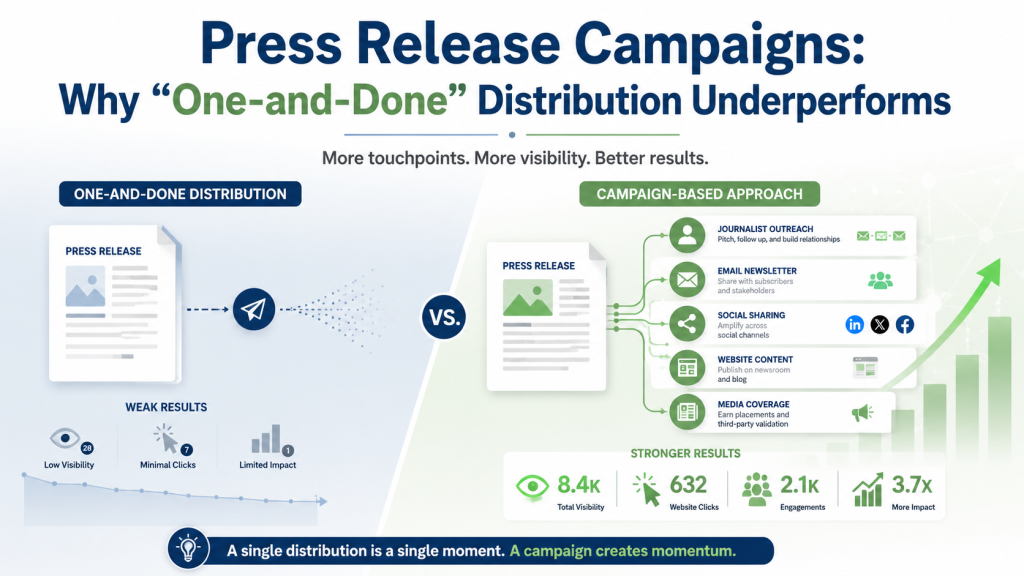
A press release works best as part of a campaign, not as a one-time announcement. Distribution can put your news in front of journalists, editors, search engines, industry sites, and potential customers. But visibility is only the first step. What you do before and after the release often determines whether the story gains traction.
Think about how journalists work. They do not sit around waiting for your announcement. They are sorting through deadlines, inboxes, source requests, breaking news, and editorial calendars. Even a good story can be missed the first time around. That does not mean it had no value. It means it needed support.
One-and-done distribution underperforms because it asks one press release to do too many jobs at once. It has to introduce the story, explain why it matters, reach the right audience, earn trust, create follow-up opportunities, support search visibility, and generate leads. That is a lot to ask from one send.
A campaign spreads that work out.
Start before the release goes out. Identify the strongest news angle. Build a short list of journalists who actually cover your topic. Prepare a plain-English pitch that explains why their audience should care. Make sure your website is ready for visitors. If someone reads the release and clicks through, what do they find?
Then use the release as the anchor. A smart campaign starts with reliable press release distribution, then builds on it with follow-up, owned content, and measurement.
After distribution, follow up with a small group of relevant journalists. The goal is to send a useful media pitch follow-up, not a vague “just checking in” email. Do not send a long essay. Send a useful note. Mention the release, give them the clearest angle, and offer a source, image, data point, or customer example. The goal is not to “circle back.” The goal is to make their job easier.
You can also repurpose the release. Turn the main idea into a blog post, customer email, LinkedIn post, FAQ, short video script, or sales talking point. A good release should not disappear after publication. It should feed the rest of your marketing.
For example, a company announcing a new product might issue the release, pitch trade publications, share the founder’s story with local media, publish a customer use case, and send a short email to prospects. Same announcement. More chances to be seen. More ways for the story to land.
This does not mean every release needs a massive campaign. Most small businesses do not have the time or budget for that. But even a simple plan helps:
- Send the release.
- Follow up with the right journalists.
- Share it through your owned channels.
- Repurpose the story.
- Track what creates real conversations.
The best press release campaigns are not louder. They are steadier.
A single release can create visibility. A campaign gives that visibility somewhere to go. That is where press releases become more than distribution. They become part of how your business builds trust, earns attention, and stays visible long after the first pickup report arrives.

Mickie Kennedy founded eReleases.com in 1998 after watching PR firms charge small businesses a $20,000 minimum for a single press release. For 27 years, he’s been closing that gap — distributing 150,000+ releases via Cision PR Newswire, serving 30,000+ clients including Manscaped, Squatty Potty, and 40+ Shark Tank brands, and generating $132M+ in earned media. A sought-after podcast guest and two-time Amazon bestselling author of Beginner’s Guide to Writing Powerful Press Releases and The PR Strategy Manifesto. Mickie holds an MFA in Creative Writing from George Mason University. Based in Baltimore, MD. LinkedIn