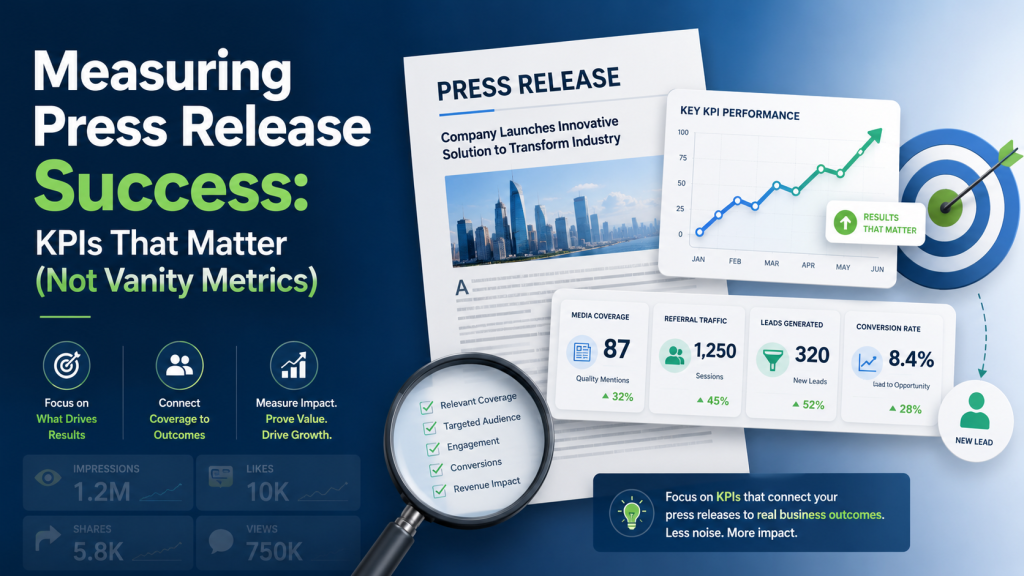
 A press release can look successful on paper and still miss the point.
A report with hundreds of pickups, dozens of links, and a long list of websites that published your announcement. It feels good. It gives you something to forward to the team.
But did a journalist care? Did the right audience see it? Did anyone visit your site, ask a question, book a call, or remember your company?
That is where real measurement begins.
Start with the goal
Before you judge a release, ask one question: what was this release supposed to do?
A product launch, funding announcement, local expansion, award win, and expert commentary pitch all have different goals, which is why a clear press release distribution strategy matters before you start measuring results.
A good release may support one or more goals: earned media coverage, credibility, qualified traffic, sales conversations, local or industry reach, or a public record of company momentum.
KPI #1: Earned media coverage
Newswire pickup has value, but earned media is different.
Earned coverage means a journalist, editor, newsletter writer, podcaster, or trade publication chose to cover your story in their own words. That carries more weight than a repost because someone outside your company decided the news was worth sharing.
Track original stories, outlet quality, audience relevance, quotes, links, product mentions, interviews, and follow-up opportunities.
One strong trade article can beat 300 automated pickups. The right 5,000 readers matter more than the wrong 500,000.
KPI #2: Relevant referral traffic
Traffic matters when it comes from the right people.
Look at visits from media placements, syndicated pickups, and follow-up outreach. Did readers click through? Did they stay? Did they visit the page you wanted them to see?
For cleaner tracking, you can use Google’s official Campaign URL Builder to help identify which outreach, email, or campaign links are sending traffic.
Measure referral visits, time on site, pages viewed, engagement rate, and traffic to campaign or product pages.
Do not panic if the numbers are modest. PR often builds trust before it drives volume. A prospect may see a mention, search your company later, and convert through another channel.
KPI #3: Conversions and assisted conversions
The best measurement connects visibility to action.
That action might be a purchase, demo request, consultation booking, newsletter signup, investor inquiry, app download, or event registration.
Track both direct and assisted conversions. Someone may not convert from the article itself. But the coverage may make them more likely to answer your email, click your ad, or trust your sales team.
For example, a small software company announces a feature. One strong trade article sends only 80 visits, but 9 people request demos.
That is success. Not loud success. Real success.
KPI #4: Search visibility and branded discovery
Press releases can support search, but not as a shortcut.
Most newswire links are not magic SEO fuel. The better value is visibility. A release creates more references to your company, product, people, and news.
Track branded search volume, search impressions, branded ranking movement, Google News visibility, industry search visibility, AI search mentions, and traffic to the release page.
This matters for newer companies. When people search your name, what do they find? Silence? Or credible announcements that show momentum?
KPI #5: Audience fit
Not all exposure is equal.
A pickup on a general website may look nice in a report. But if you sell healthcare software, coverage in a healthcare trade publication matters more.
Ask whether the release reached relevant trade outlets, local media, industry newsletters, customers, partners, or investors.
The audience matters more than the size of the logo.
KPI #6: Reuse value
Good PR should not live in a report.
A sales rep can send a media mention to a hesitant prospect. A founder can include coverage in an investor update. A nonprofit can use a local story in donor outreach.
Track how coverage gets reused: sales follow-up, investor updates, partner outreach, landing page proof, email newsletters, social posts, and future pitches.
If coverage helps you start better conversations, it has value.
Vanity metrics to treat carefully
Some numbers are not useless, but they are easy to overvalue.
Be careful with total pickup count, potential audience, “impressions,” low-quality reposts, automated syndication links, huge media database numbers, and report screenshots without context.
These show distribution activity. They do not prove business impact.
Use a simple scorecard
For each release, track five things:
- What was the goal?
- What meaningful coverage did it earn?
- What qualified traffic did it drive?
- What actions did people take?
- How can the coverage be reused?
You do not need a complicated dashboard. You need honest measurement.
A successful press release is not the one with the fattest report. It is the one that gets your story in front of the right people and gives them a reason to care.

Mickie Kennedy founded eReleases.com in 1998 after watching PR firms charge small businesses a $20,000 minimum for a single press release. For 27 years, he’s been closing that gap — distributing 150,000+ releases via Cision PR Newswire, serving 30,000+ clients including Manscaped, Squatty Potty, and 40+ Shark Tank brands, and generating $132M+ in earned media. A sought-after podcast guest and two-time Amazon bestselling author of Beginner’s Guide to Writing Powerful Press Releases and The PR Strategy Manifesto. Mickie holds an MFA in Creative Writing from George Mason University. Based in Baltimore, MD. LinkedIn