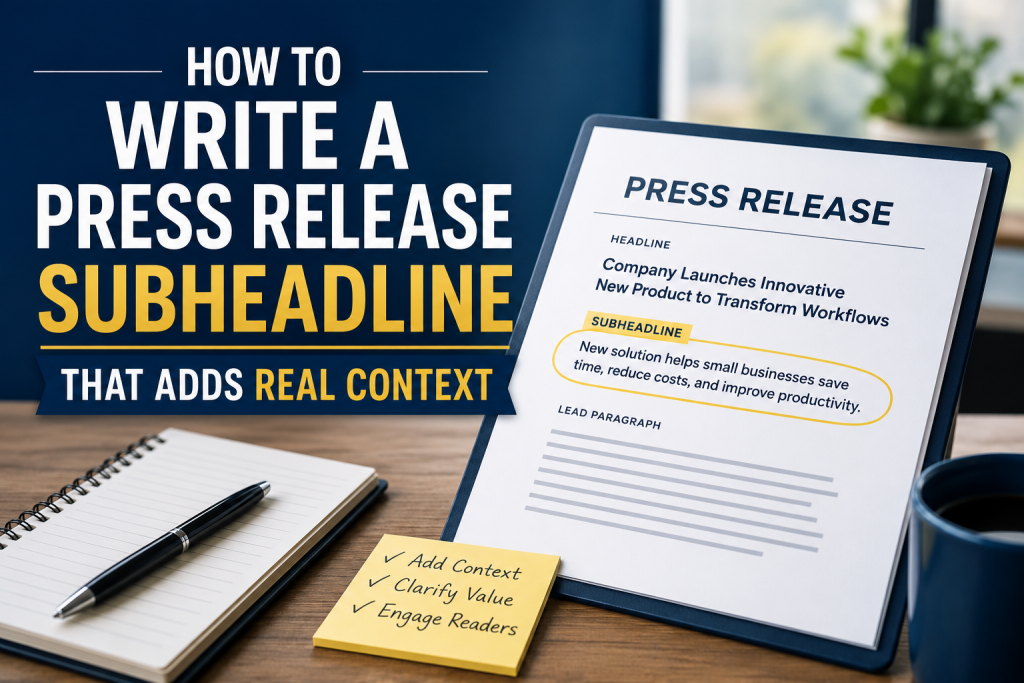
A good press release headline gets attention. A good subheadline tells the reader why that attention is worth keeping.
That is the job of the subheadline. It should not repeat the headline in softer language. It should add useful context before the reader gets to the first paragraph. For a broader look at how the headline, subheadline, dateline, lead, and boilerplate work together, review the key components of a press release.
Think of it as the bridge between the hook and the story.
What a subheadline should do
Your headline usually carries the main announcement:
“Acme Robotics Launches New Warehouse Automation Platform”
That tells us what happened. But it leaves questions open.
Who is it for? Why does it matter? What problem does it solve? Is there a number, market trend, location, or customer angle that makes the news stronger?
That is where the subheadline helps.
A stronger version might be:
“New platform helps mid-sized distributors reduce manual sorting time while integrating with existing warehouse systems.”
Now the reader has context. The story is not just “company launches product.” It is about a practical problem and a clear audience.
That makes a big difference.
Do not use it as a second headline
Many companies treat the subheadline like extra space for hype.
You will see lines like:
“Revolutionary solution transforms the future of business with unmatched innovation.”
That sounds important, but it says almost nothing.
A journalist, editor, or potential customer should learn something concrete from the subheadline. If the line could apply to almost any company, it is not doing its job.
Instead, ask: What can I add here that makes the announcement clearer?
Useful subheadlines often include one of these:
- The audience affected by the news.
- The problem being solved.
- A measurable result or milestone.
- The location or market involved.
- The reason the announcement matters now.
You do not need all five. One or two are enough.
Keep it specific, but not crowded
A subheadline should add context, not bury the reader in details.
Weak example:
“Company announces new partnership to help businesses grow.”
That is too vague.
Overstuffed example:
“Company announces a new multi-year partnership with a regional logistics provider, three software integrations, expanded customer support, and a new onboarding program for small retailers across six markets.”
That is too much.
Better:
“Partnership gives small retailers access to faster regional delivery and simpler order tracking across six markets.”
That line explains who benefits and why it matters. It leaves the smaller details for the body of the release.
Write the subheadline after the lead
Most people write the headline first, then force the subheadline to fit. That can work, but there is a better way.
Write your lead paragraph first.
The lead should answer the basic news questions: who, what, when, where, why, and sometimes how. Once you have that, look for the one piece of context that is important but too clunky for the headline. This follows the basic inverted pyramid structure, where the most important information comes first and supporting details follow.
That is often your subheadline.
For example, if your lead explains that a nonprofit has opened a new food pantry in response to rising local demand, your headline might be:
“Local Nonprofit Opens New Food Pantry in Dayton”
The subheadline could be:
“Expansion is expected to serve 400 additional families each month as grocery costs continue to strain household budgets.”
That gives the announcement weight without turning it into a speech.
Avoid claims you cannot support
A subheadline is a tempting place to make big claims. Resist that temptation.
Words like “first,” “best,” “leading,” “fastest,” and “most advanced” can create problems if you cannot prove them. Even when true, they often sound promotional.
Use facts instead.
Instead of:
“Industry-leading platform delivers the best results for small businesses.”
Try:
“New platform gives small businesses one dashboard to manage press outreach, pickup tracking, and follow-up.”
The second version is more useful because it shows what the product does. Readers can judge the value for themselves.
Use this simple formula
When you are stuck, try this:
“[News] helps [audience] do [specific outcome] with [important context].”
For example:
“New service helps independent restaurants manage takeout demand with lower-cost online ordering tools.”
It is not fancy. That is the point. A clear subheadline beats a clever one almost every time.
Final check before you publish
Before sending your release, read the headline and subheadline together.
Ask yourself:
Does the subheadline add new information?
Does it make the announcement easier to understand?
Would a journalist know why the story matters?
Could this line apply to almost any company?
If the answer to that last question is yes, rewrite it.
A strong press release subheadline does not decorate the headline. It earns its space. It gives the reader a reason to keep going.

Mickie Kennedy founded eReleases.com in 1998 after watching PR firms charge small businesses a $20,000 minimum for a single press release. For 27 years, he’s been closing that gap — distributing 150,000+ releases via Cision PR Newswire, serving 30,000+ clients including Manscaped, Squatty Potty, and 40+ Shark Tank brands, and generating $132M+ in earned media. A sought-after podcast guest and two-time Amazon bestselling author of Beginner’s Guide to Writing Powerful Press Releases and The PR Strategy Manifesto. Mickie holds an MFA in Creative Writing from George Mason University. Based in Baltimore, MD. LinkedIn