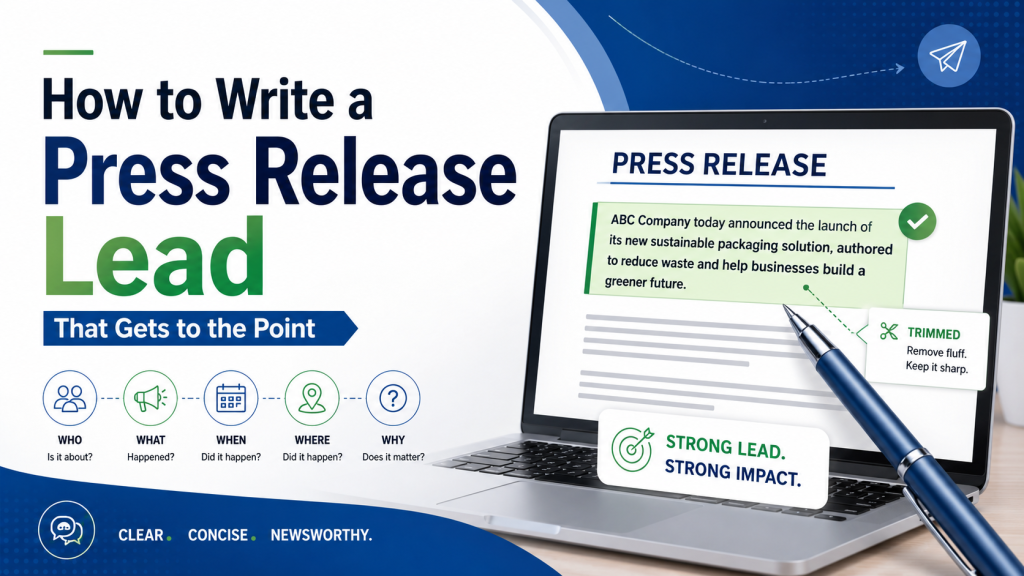
The lead is the first paragraph of your press release. It has one job: tell the reader what happened and why it matters.
That sounds simple. But this is where many releases go wrong. They start with background, praise, mission statements, or long introductions. By the time the news appears, the journalist has moved on.
A good lead does not warm up. It gets to the point.
This is the same idea behind the inverted pyramid structure, the journalism method that puts the most important information at the top.
Start with the news
Ask one question first: what is actually new?
Did you launch a product? Open a new location? Hire a key executive? Release a report? Win a major contract? Announce funding? That is the center of the lead.
If the news is weak or buried, the lead will be weak too. You cannot fix a vague announcement with polished wording. You need a clear event, change, milestone, or finding.
Here is a simple structure:
[Company] announced [news] to [benefit, impact, or audience].
For example:
GreenPath Foods announced today the launch of a compostable frozen meal tray designed to help regional grocery chains reduce plastic packaging waste.
That lead tells us who, what, and why it matters. No throat-clearing.
Answer the 5 Ws, but do not cram them all in
Your lead should usually cover the basics: who, what, when, where, and why. If you need a simple way to check whether your opening paragraph covers the essentials, review this guide to the 5 Ws of press releases before you rewrite the lead. But that does not mean every detail belongs in sentence one.
The most important pieces are usually:
- Who is making the announcement?
- What happened?
- Why should anyone care?
The date can sit naturally in the sentence. Add the location only if it matters.
Think of the lead as a front door, not the whole house. The next paragraph can add context.
Cut the praise
Many weak leads sound like this:
XYZ Company, a leading provider of innovative solutions, is proud to announce its exciting new platform.
That sentence uses space but says very little.
“Leading,” “innovative,” “proud,” and “exciting” are not news. They are claims. Journalists do not need your applause track. They need facts.
Try this instead:
XYZ Company launched a project management platform for independent contractors that combines invoicing, scheduling, and client approvals in one dashboard.
Now the reader knows what was launched and who it serves.
Put the audience in the lead
A strong lead often names the audience affected by the news.
This matters because journalists think in terms of readers. A business editor may ask, “Why would our audience care?” A trade reporter may ask, “Does this affect people in my industry?”
So do not just say what you did. Say who it helps.
A software update for “users” is vague. A software update for “small accounting firms preparing for tax season” is specific.
Keep it tight
A press release lead should usually be one short paragraph, often 25 to 45 words. If your first sentence runs past 50 words, it is probably carrying too much weight.
After writing your lead, ask:
- Can I identify the news in five seconds?
- Did I remove empty praise?
- Does the lead explain why this matters?
- Would someone outside my company understand it?
If the answer is no, rewrite it.
The best lead respects the reader
Journalists are busy. So are customers, partners, and industry people who may find your release later.
Getting to the point is not cold or dull. It is considerate.
A clear lead says, “Here is the news. Here is why it matters. Now you can decide whether to keep reading.”
That is the kind of opening that earns attention.

Mickie Kennedy founded eReleases.com in 1998 after watching PR firms charge small businesses a $20,000 minimum for a single press release. For 27 years, he’s been closing that gap — distributing 150,000+ releases via Cision PR Newswire, serving 30,000+ clients including Manscaped, Squatty Potty, and 40+ Shark Tank brands, and generating $132M+ in earned media. A sought-after podcast guest and two-time Amazon bestselling author of Beginner’s Guide to Writing Powerful Press Releases and The PR Strategy Manifesto. Mickie holds an MFA in Creative Writing from George Mason University. Based in Baltimore, MD. LinkedIn