Ask AI for a short summary of this article
If you’ve ever distributed a press release and then watched links start appearing online, it’s easy to think, “Great, we got media coverage.”
Maybe. Maybe not.
This is where a lot of businesses get confused. They see their announcement published across news sites, content networks, or local affiliate pages and assume that means journalists covered the story. In reality, press release pickup and earned coverage are not the same thing.
They can both help your visibility. They can both put your name in front of people. They can even work together. But they come from different processes, offer different value, and should be measured differently.
If you mix them up, you may end up overestimating your PR results or chasing the wrong goals.
Let’s clear that up.
What Is Press Release Pickup?
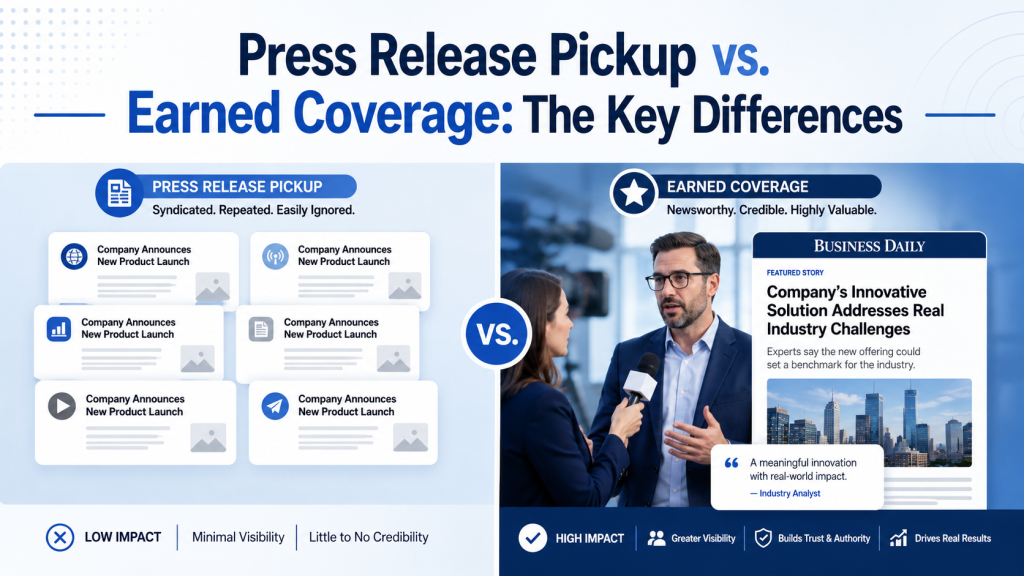
Press release pickup happens when your press release is republished, posted, or syndicated by websites, news portals, databases, or media-related platforms after distribution.
In simple terms, your release gets copied and displayed elsewhere.
This often happens through newswire distribution networks, syndication agreements, automated feeds, and online content systems. Your original release may appear on financial sites, local media websites, niche industry portals, or general news aggregators.
That pickup can create useful exposure. It can help with:
- Search visibility
- Brand discovery
- Social proof
- Online credibility
- Making your announcement easier to find
But here’s the key point: pickup usually happens because of distribution systems, not because a journalist chose to report on your story.
That distinction matters.
A posted release is still your message, your wording, your framing, and your announcement. It may live on a media-branded site, but that does not automatically make it reported news.
What Is Earned Coverage?
Earned coverage is when a journalist, editor, producer, blogger, newsletter writer, or other media gatekeeper chooses to cover your story independently.
That means they decided your announcement was worth turning into content for their audience.
They may:
- Write an original article
- Interview you
- Quote you
- Pull in outside sources
- Add context or skepticism
- Compare you to competitors
- Mention trends in your industry
- Include your company in a broader story
This is a very different thing.
Earned coverage is not just your release showing up online. It’s someone else deciding your story is worth attention and then creating independent editorial content around it.
That is why earned media usually carries more weight.
It comes with judgment. It comes with selection. It comes with third-party credibility.
And that credibility is what makes earned coverage so powerful.
The Fastest Way to Understand the Difference
Here’s the easiest way to think about it:
Press release pickup is distribution. Earned coverage is editorial choice.
Pickup says: “Your news was published.”
Earned coverage says: “Your news mattered enough for someone else to cover it.”
That’s the line.
A lot of small businesses blur the two because both may show up as links in a report. But one is mostly about reach. The other is about influence.
Both have value. They just serve different roles.
Why Businesses Confuse the Two
This confusion is common for a few reasons.
1. Both produce visible links
After a release goes out, you may receive a report showing placements across multiple websites. That feels like traction. And it is traction of a kind. But many of those links are syndicated copies, not independently reported stories.
2. Some pickups appear on recognizable media sites
A release may show up on a local TV affiliate site or a known business platform. That can look like real coverage at first glance. But often it is simply a feed-driven publication of your release.
3. The wording is often identical
If the article uses your exact headline and body text, that’s usually a clue that it’s pickup, not earned coverage. True earned coverage almost always changes the format, adds reporting, or includes outside voices.
4. PR reports can make everything look equal
A list of 75 placements sounds impressive. But 75 syndications are not the same as one strong feature in a respected trade outlet.
That doesn’t mean the 75 placements are worthless. It means they should not be measured by the same standard.
What Press Release Pickup Is Good For
Let’s give pickup its due. It has a job to do.
A good distribution can help your business in several real ways.
Visibility
Pickup helps put your announcement in more places online. That increases the chances that customers, partners, investors, and searchers will come across it.
Validation
When people search your business and see your news appearing on multiple sites, it creates a sense of legitimacy. You don’t look invisible. You look active.
Discovery
Some pickups happen on niche sites, regional portals, or topic-specific pages where people may discover your company for the first time.
Content footprint
Your announcement creates an online trail. That can support your broader digital presence, especially when someone is researching your company.
PR momentum
A visible release can make it easier for journalists to look you up, verify details, and see that you’ve formally announced something. In that sense, pickup can support earned media later.
That last point is important.
A press release is often the starting point, not the finish line.
What Earned Coverage Is Good For
Earned coverage does something pickup usually cannot do on its own.
It transfers credibility.
When a journalist or editor covers your story, readers see that someone independent thought it was worth sharing. That changes how the message lands.
Earned coverage can help with:
Trust
People trust third-party coverage more than self-published announcements. That’s just human nature. We all pay more attention when someone else tells the story.
Depth
A journalist may explain why your launch matters, how your product fits a trend, or what problem your business is solving. That extra context often makes the story stronger.
Reach to the right audience
A good earned placement may reach fewer total pages than broad pickup, but it often reaches a far more relevant audience.
Would you rather get copied onto 60 low-engagement sites or be featured once in the publication your ideal customers actually read?
That’s not a hard question.
Better conversions
Earned coverage often drives stronger action because the audience receives the story through a trusted editorial filter.
Long-term brand value
A strong article, interview, or feature can become something you reference for months or years in sales materials, investor conversations, and website trust sections.
The Structural Difference: Copy vs. Coverage
This is another useful way to frame it.
Pickup reproduces your message. Earned coverage interprets your message.
With pickup, the content is mostly unchanged.
With earned media, the content is often reworked, questioned, expanded, or contextualized.
That difference affects everything:
- How credible it feels
- How memorable it is
- How useful it is to readers
- How likely it is to influence behavior
A copied release may inform.
A reported story may persuade.
How to Tell Which One You Got
Here are a few practical signs.
It’s probably pickup if:
- The headline is identical or nearly identical to your release
- The wording matches your original text
- The piece includes no reporter byline
- There are no outside quotes or added reporting
- The page clearly labels it as a press release or announcement
- The publication came through a syndication or feed system
It’s probably earned coverage if:
- A journalist or editor is named
- The article is written in a different structure
- New context or reporting is added
- You were interviewed
- Other sources are included
- The story mentions your news as part of a larger article
- The outlet chose its own angle
Sometimes the line is slightly blurry. A publication may lightly edit a release before posting it. But in most cases, the distinction is pretty clear once you know what to look for.
Why This Difference Matters for Measuring PR
If you measure pickup as if it were earned coverage, you will likely overstate your results.
That leads to bad decisions.
You may think your story angle is working when really only the distribution system is working. Or you may believe your media outreach is stronger than it is because the release generated lots of online copies.
A better approach is to separate your PR results into categories.
For example:
Track pickup as visibility metrics
Look at:
- Number of syndications or reposts
- Search presence
- Referral traffic
- Brand mentions
- Indexed pages
- General announcement reach
Track earned coverage as influence metrics
Look at:
- Original articles secured
- Quality of outlets
- Audience relevance
- Referral traffic from editorial articles
- Lead quality
- Backlink quality when relevant
- Speaking, interview, or partnership opportunities that follow
Different outcomes. Different meaning. Different scorecard.
Which Matters More?
Usually, earned coverage matters more.
But that does not mean pickup is unimportant.
Think of it this way:
- Pickup helps your news exist in more places
- Earned coverage helps your story carry more weight
One gives you footprint.
The other gives you authority.
For many small businesses, pickup is the baseline benefit of distribution. It ensures the news is out there, visible, and searchable.
Earned coverage is the bigger win. That is where you start getting the kind of attention that can change perception, generate leads, and build long-term trust.
So no, they are not equal. But they are not enemies either.
The strongest PR campaigns often use both.
How Pickup Can Lead to Earned Coverage
This is where strategy comes in.
A press release by itself rarely guarantees earned media. But it can support it in several ways:
- It gives journalists a clean source for facts
- It creates a formal announcement they can reference
- It signals that something timely is happening
- It makes outreach easier because the details are organized
- It can help your company appear active and credible during research
But the release alone is often not enough.
To increase your chances of earned coverage, you usually need to add:
- A sharper angle
- Personalized media outreach
- A stronger news hook
- Relevant timing
- Good subject lines
- Clear spokesperson availability
- Fast responses to reporters
Here’s a real-world example.
A company announces a new service and distributes a release. The release gets picked up on dozens of sites. Nice start.
But then the founder sends a short, thoughtful pitch to five trade editors explaining why this service reflects a bigger shift in the industry. One editor bites, schedules an interview, and writes a reported piece.
Now the release did its job. But the earned coverage came from the angle, the outreach, and the editor’s judgment.
That’s how it usually works.
What Small Businesses Should Do Next
If you want better PR results, stop asking only, “How many pickups did we get?”
Ask better questions:
- Did the right people see the news?
- Did any journalists engage with it?
- Did we get original coverage?
- Did the release create trust or just visibility?
- Did it lead to conversations, traffic, or leads?
- What part was distribution, and what part was earned?
That shift alone will make you smarter about PR.
Because once you understand the difference between pickup and earned coverage, you stop chasing vanity numbers and start building a process that actually works.
Final Thought
Press release pickup is useful. Earned coverage is powerful.
Pickup helps spread your message.
Earned coverage helps validate it.
You want both. But you should never confuse one for the other.
A release appearing online means your news traveled.
A journalist covering it means your story landed.
That’s the difference. And if you’re serious about PR, it’s a difference worth respecting.

Mickie Kennedy founded eReleases.com in 1998 after watching PR firms charge small businesses a $20,000 minimum for a single press release. For 27 years, he’s been closing that gap — distributing 150,000+ releases via Cision PR Newswire, serving 30,000+ clients including Manscaped, Squatty Potty, and 40+ Shark Tank brands, and generating $132M+ in earned media. A sought-after podcast guest and two-time Amazon bestselling author of Beginner’s Guide to Writing Powerful Press Releases and The PR Strategy Manifesto. Mickie holds an MFA in Creative Writing from George Mason University. Based in Baltimore, MD. LinkedIn