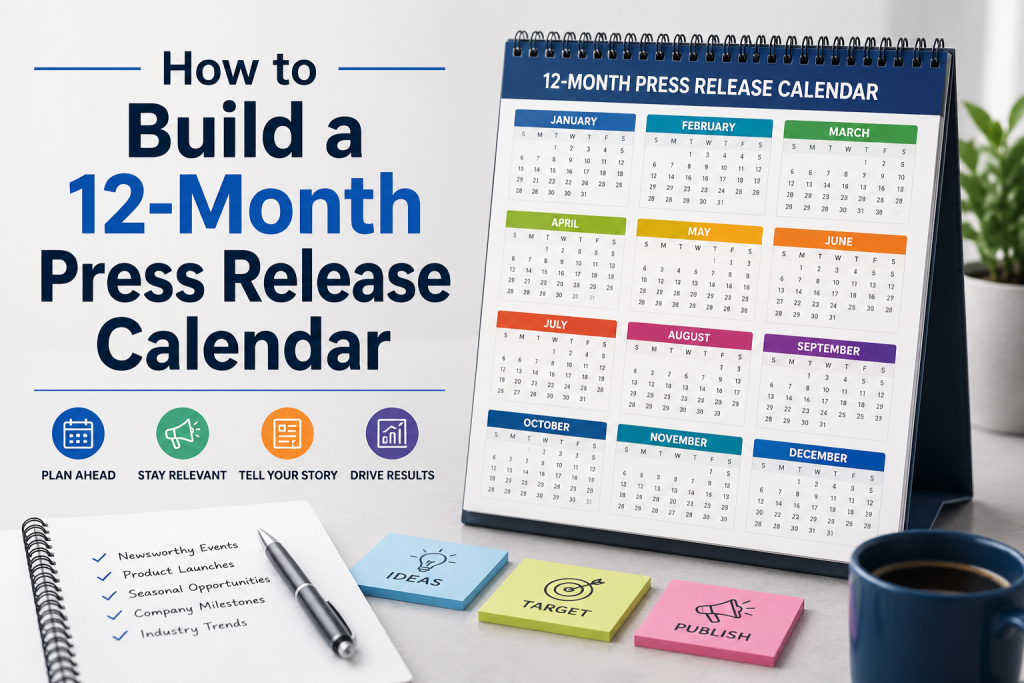
A press release calendar keeps publicity from becoming a last-minute fire drill.
Most small businesses do not have “no news.” They simply notice the news too late. A product update, customer win, award, event, survey, hiring milestone, or seasonal trend passes by, and someone says, “We should have announced that.”
A 12-month calendar fixes that. It gives you a simple plan for what to announce, when to prepare it, and how each release supports the larger story you want the market to understand.
Start with your business milestones
Open a spreadsheet or calendar and list the events you already know are coming. For a broader planning framework, start with a free PR plan template for small businesses before you map out individual announcements.
Include:
- Product launches or updates
- New locations
- Events, webinars, or trade shows
- Awards or rankings
- Funding, partnerships, or major customers
- Seasonal sales periods
- Company anniversaries
- Hiring or leadership changes
- Research, surveys, or reports
Do not judge the ideas yet. Just build inventory.
Add seasonal hooks
Journalists think in seasons. So should you. It can also help to review an editorial calendar, such as PRSA’s monthly editorial calendar themes, to see how topics are often planned around the year.
A tax software company should plan around January through April. A fitness brand should look at New Year’s goals, summer travel, and back-to-school routines. A nonprofit might plan around awareness months, giving season, or local events.
Ask one question: when will people already be paying attention to your topic?
That is when your release has a better chance of feeling timely.
Choose one main announcement per month
You do not need to issue a release every week. For many small businesses, one strong release per month is a healthy rhythm.
Some months may be quiet. That is fine. Other months may have two good opportunities. The point is not to force news. The point is to stop missing it.
For each month, choose one primary release idea. Then add one backup idea in case timing changes.
Build in lead time
A good press release is not written the morning it goes out.
Give yourself at least two to four weeks. That gives you time to confirm details, gather quotes, prepare images, review claims, and decide who should receive the announcement.
A simple workflow looks like this:
- Four weeks out: confirm the angle
- Three weeks out: draft the release
- Two weeks out: collect quotes and details
- One week out: approve and prepare distribution
- Launch day: distribute and begin follow-up
That rhythm saves a lot of scrambling.
Mix your release types
A healthy calendar should not sound like 12 versions of “we are pleased to announce.”
Mix the story types. One month might focus on a customer result. Another might highlight a trend report. Another might announce an event, partnership, or new product feature.
Variety gives journalists more ways to care. It also helps your audience see momentum, not just promotion.
Review the calendar every quarter
A calendar is a plan, not a prison.
Review it every three months. Move weak ideas out. Add better ones in. Ask what has changed in your business, your industry, and your customers’ world.
The best calendars leave room for surprise. Sometimes the strongest announcement is the one you could not have predicted in January.
The bottom line
A 12-month press release calendar turns everyday business progress into a steady public story.
You do not need constant breaking news. You need a thoughtful rhythm, enough lead time, and a clear reason for each release to exist.
Start with the next 12 months. Pick one solid announcement for each. Then revisit it every quarter.
That is how publicity becomes a habit instead of a panic.

Mickie Kennedy founded eReleases.com in 1998 after watching PR firms charge small businesses a $20,000 minimum for a single press release. For 27 years, he’s been closing that gap — distributing 150,000+ releases via Cision PR Newswire, serving 30,000+ clients including Manscaped, Squatty Potty, and 40+ Shark Tank brands, and generating $132M+ in earned media. A sought-after podcast guest and two-time Amazon bestselling author of Beginner’s Guide to Writing Powerful Press Releases and The PR Strategy Manifesto. Mickie holds an MFA in Creative Writing from George Mason University. Based in Baltimore, MD. LinkedIn