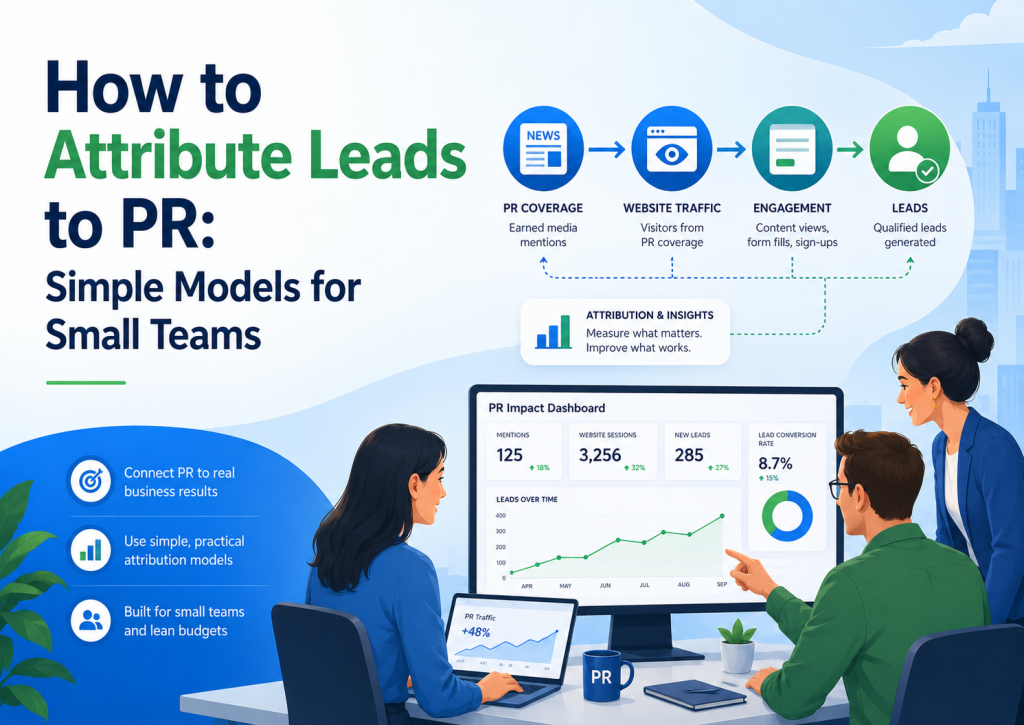
PR rarely works like paid ads.
A prospect may read your press release today, see a trade article next week, search your company name later, and fill out a form after visiting your site three times.
That makes attribution messy. But messy does not mean useless.
For small teams, the goal is not perfect tracking. The goal is to see which PR efforts create trust, traffic, and leads.
Here are five simple models.
1. First-touch attribution
First-touch attribution gives credit to the first source that brought someone to your site.
If a visitor clicks from a press release pickup and later becomes a lead, PR gets the credit.
This model shows whether PR is introducing new people to your business.
The weakness? It ignores everything after the first visit. PR may open the door, but email or sales calls may help close the lead.
Use it to answer: “Is PR bringing new people in?”
2. Last-touch attribution
Last-touch attribution gives credit to the final source before someone becomes a lead.
Someone may read a news story, leave, search your brand two days later, and fill out a form. In many analytics tools, organic search gets the credit.
This model is easy to understand, but it often undervalues PR. PR may have created the interest that caused the later search.
Use it to answer: “What converted the lead?”
3. Assisted attribution
Assisted attribution gives PR partial credit when it appears anywhere in the buyer’s path.
This is often the most honest model for PR.
A trade publication mention, podcast interview, release pickup, or local news story may not be the final click. But it may build enough trust for someone to keep paying attention.
Track this with a spreadsheet. Add columns for lead name, first visit source, last visit source, PR touchpoints, and sales notes.
When a lead says, “I saw you in that article,” write it down. It matters.
Use it to answer: “Did PR help influence this lead?”
4. Self-reported attribution
Ask people how they heard about you.
It sounds too simple, which is why many teams skip it.
Add one field to your contact form: “How did you hear about us?” Make it optional and open-ended.
You will get imperfect answers. Some people will say “Google.” Some will say “article.” Some will name a podcast or publication.
That is fine. You are looking for patterns, not courtroom evidence.
Use it to answer: “What does the prospect remember?”
5. Campaign-based attribution
Every PR campaign should have its own tracking setup.
Use UTM links in your press release, media pitch, online newsroom, and related social posts. Google’s campaign URL builder can help you create consistent tracking links so you can see which campaigns send traffic and leads.
spring-product-launch-pr
Then compare traffic, leads, branded search, referral visits, and form submissions during and after the campaign.
This will not catch every PR-driven lead. Some people will read a story and type your URL directly. Others will search your brand later.
But campaign tracking gives you a useful baseline.
Use it to answer: “What happened after this PR push?”
The simple setup I recommend
For most small teams, combine three things:
- UTM tracking for links you control.
- Self-reported attribution on forms and calls.
- A simple assisted-attribution spreadsheet.
If you are distributing through a press release distribution service for small businesses, make sure you also track the traffic and leads that come from links you control, such as your newsroom, landing page, and follow-up emails.
That gives you enough truth to make better decisions.
You will see which placements create conversations. You will see whether PR is attracting the right kind of leads, not just more website visits.
PR attribution will never be perfect. But it can be practical. And practical is enough to decide what to do next.

Mickie Kennedy founded eReleases.com in 1998 after watching PR firms charge small businesses a $20,000 minimum for a single press release. For 27 years, he’s been closing that gap — distributing 150,000+ releases via Cision PR Newswire, serving 30,000+ clients including Manscaped, Squatty Potty, and 40+ Shark Tank brands, and generating $132M+ in earned media. A sought-after podcast guest and two-time Amazon bestselling author of Beginner’s Guide to Writing Powerful Press Releases and The PR Strategy Manifesto. Mickie holds an MFA in Creative Writing from George Mason University. Based in Baltimore, MD. LinkedIn