People used to search by typing a few words into Google and clicking through links.
Now they ask questions like “What’s the best tool for this?” or “Who offers this service?”
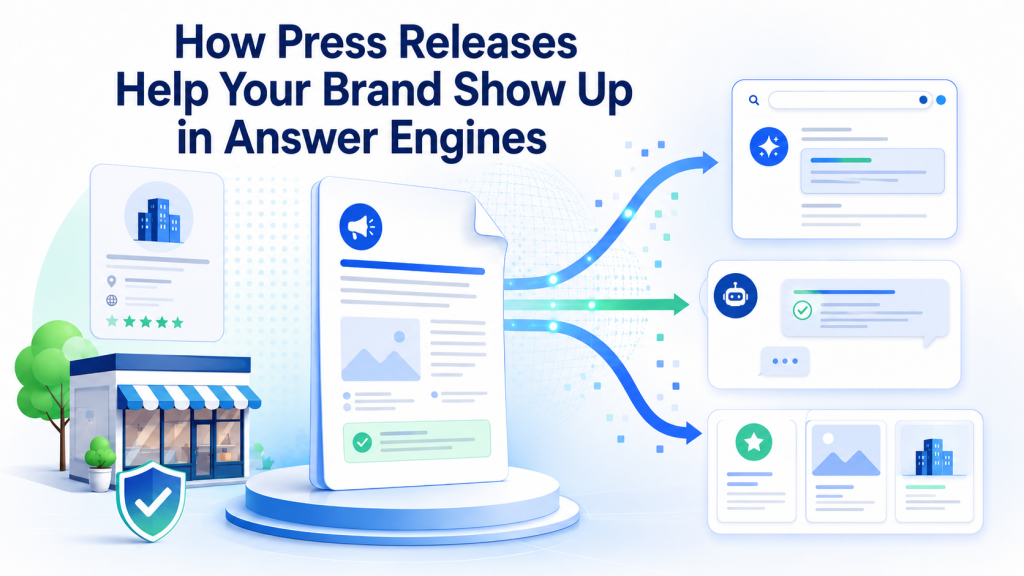
Those questions are increasingly answered by AI tools, search summaries, chatbots, and other answer engines. They do not just rank pages. They gather signals from many sources and return an answer.
Google explains that AI features in Search use web content to help generate answers, which is why clear, source-friendly company information matters.
That changes the job of PR.
A press release will not magically make your company show up everywhere. But it can help answer engines understand who you are, what you do, and where your brand fits.
Answer engines need clear signals
Answer engines summarize information. To do that, they need sources.
A strong release should also be written with modern search behavior in mind, including how press release SEO supports visibility in AI search and answer engines.
A strong press release gives them structured, public information about your company. It explains the news in plain language. It connects your brand to a topic, product, location, customer, milestone, or trend.
That matters because many small businesses leave too much unsaid. Their website says what they sell. Their social posts show activity. Their ads make claims. But none of that always explains the bigger story.
A press release fills that gap.
It gives the market a clean public record: this happened, why it matters, who is involved, and where to go next.
Press releases create third-party context
Answer engines look beyond your own website.
Your site matters. But if your brand only appears on your own pages, there is less outside confirmation.
When a press release is distributed properly, it can appear across news sites, industry pages, financial portals, local outlets, and other public databases. Journalists may also use it as a starting point for coverage.
That creates a wider footprint.
Think of it like leaving trail markers. One marker on your website helps. Several markers across credible places help answer engines connect the dots.
For example, a software company announcing a customer win should explain the problem solved and tie the result to a specific industry. That gives answer engines more useful material to work with.
Your language matters
Answer engines do not need hype. They need clarity.
Avoid vague claims like “revolutionary solution,” “industry-leading platform,” or “game-changing innovation.” Those phrases sound impressive, but they do not say much.
Use specific language instead.
Say what changed. Say who benefits. Say what problem you solve. Say what category you belong in. Say what makes the news timely.
If you want to be associated with “cybersecurity for small healthcare practices,” use that plain phrase.
Do not make the answer engine guess.
Each release builds your brand record
One release can help. A steady pattern helps more.
Answer engines benefit from repeated, consistent signals over time. A product launch, customer win, research report, partnership, and market expansion can all form part of your public record.
That record can show that you are active, what markets you serve, and what proof points support your story.
This is why “one-and-done” PR usually underperforms. A single release is a spark. A series of useful releases becomes a signal.
What should you publish?
Not every company update needs a press release. But many small businesses overlook real news.
Good topics include product launches, customer wins, case studies, original research, expansion, partnerships, awards, certifications, executive hires, events, webinars, and community initiatives.
The key is to connect the announcement to a question your audience already asks.
Why does this matter? Who does it help? What problem does it solve? What does it prove?
If your release answers those questions, it has a better chance of being useful beyond the day it is published.
Make your release easy to understand
A good release for answer engines is also a good release for journalists and readers.
Use a clear headline. Put the real news in the first paragraph. Include the company name, category, location if relevant, and a simple explanation of what happened.
Add one quote that explains why the news matters. Include facts. Add links to helpful pages.
The goal is not to stuff keywords. The goal is to make the story easy to parse.
The practical takeaway
Press releases help answer engines when they make your brand easier to understand and verify.
They give your company a public record. They connect your name to specific topics. They create context outside your own website. And when used consistently, they help build a clearer picture of your business over time.
Look at your next real company milestone and ask: “Would this help someone understand who we are, what we do, or why we matter?”
If the answer is yes, it may be worth turning into a press release. Not because every release will become a headline. Because every clear, useful release gives the market one more reason to know where you fit.

Mickie Kennedy founded eReleases.com in 1998 after watching PR firms charge small businesses a $20,000 minimum for a single press release. For 27 years, he’s been closing that gap — distributing 150,000+ releases via Cision PR Newswire, serving 30,000+ clients including Manscaped, Squatty Potty, and 40+ Shark Tank brands, and generating $132M+ in earned media. A sought-after podcast guest and two-time Amazon bestselling author of Beginner’s Guide to Writing Powerful Press Releases and The PR Strategy Manifesto. Mickie holds an MFA in Creative Writing from George Mason University. Based in Baltimore, MD. LinkedIn