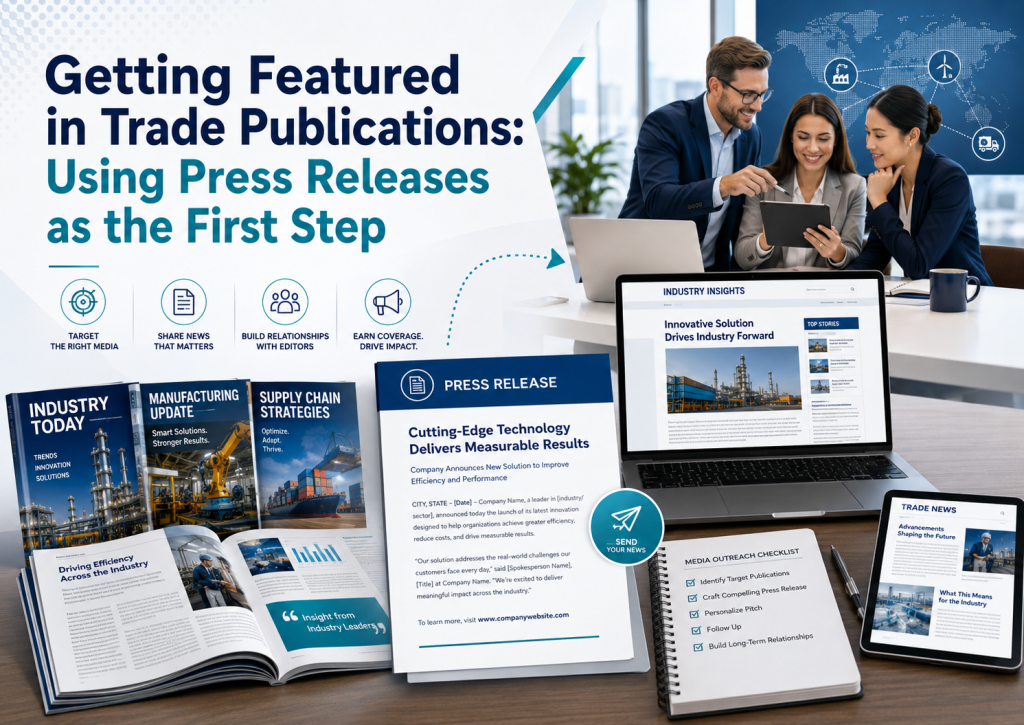
 Trade publications are one of the most overlooked paths to media coverage.
Most business owners aim for the biggest names first. They want the national headline, the TV segment, the splashy feature. But if you sell to a specific industry, trade publications may do more for your business than a broad mention in a general outlet.
Why? Because trade publications reach the people who already care. A good way to think about trade journals is simple: they are written for people who work in a specific trade or industry.
A story in a manufacturing magazine, healthcare technology newsletter, restaurant industry site, or construction trade outlet puts you in front of buyers, partners, peers, and decision-makers. These are not casual readers. They follow your industry because it affects their work.
A press release can help you get there. But only if you use it the right way.
A Press Release Is the Starting Point
A press release is not a finished article. It is not a guarantee. It is the starting point.
Think of the release as your clean, organized statement of news. It gives a reporter the facts: what happened, who is involved, why it matters, where it applies, and how readers can learn more.
For trade publications, that structure matters. Editors are busy. Many cover narrow beats with limited staff. A clear release helps them see whether your news fits their audience.
The release opens the door. The follow-up pitch helps you walk through it.
Start With Industry Relevance
Trade editors ask one simple question: “Why would our readers care?”
That question should guide the entire release.
A new product is not automatically news. A new product that helps independent pharmacies reduce prescription errors may be news to a pharmacy trade publication.
A new hire is not automatically news. A new hire who previously led compliance at a major food safety organization may interest a food manufacturing outlet.
A company milestone is not automatically news. A milestone that shows a shift in demand, adoption, regulation, or buyer behavior may be worth coverage.
The more specific the relevance, the better.
Before you write, name the audience. Not “business owners.” Not “consumers.” Name the industry reader.
For example: “This matters to commercial roofing contractors because material delays are changing how they bid projects.”
That one sentence can sharpen the whole release.
Give Editors a Real Angle
Trade publications like practical stories. They often want articles that help readers understand a trend, solve a problem, compare options, or prepare for change.
Instead of writing, “Company launches new software,” frame it around the industry problem:
“New scheduling software helps home health agencies manage last-minute caregiver cancellations.”
That is stronger because it names the pain.
A good trade angle may come from a common industry problem, new data, a regulatory change, a shift in customer behavior, a product built for a specific market, or an expert with useful insight.
The release should not read like an ad. It should read like useful news.
An ad says, “Look at us.”
A useful release says, “Here is something happening in your industry, and here is why it matters.”
Include Details Trade Writers Can Use
General claims rarely help.
Trade editors need specifics. They want numbers, context, examples, and quotes that sound like a real person said them.
If you have data, include it. If you have a customer example, include it. If you have a technical detail that matters, explain it in plain language.
This is weak:
“Our innovative solution empowers organizations to streamline operations.”
This is better:
“The platform helps small veterinary clinics reduce missed appointments by sending reminders tied to each pet’s treatment schedule.”
See the difference? One is fog. The other gives the editor something to work with.
Your quote should also add meaning. Do not waste it on “We are excited.” Use it to explain what changed, why the issue matters, or what the industry should watch next.
Build a Targeted Media List
Distribution helps create visibility, but trade coverage often comes from careful targeting. That’s why strategic press release distribution should match the release to the right industry, geography, and story angle—not just send it everywhere.
Make a list of trade publications that cover your market. Then identify the right editor, columnist, or reporter.
Look for people who have written about your topic before. Read a few of their articles. Notice what they cover: product news, trends, case studies, regulation, or executive interviews.
A short, specific email works best:
“I saw your recent piece on staffing shortages in home health. We just issued a release about a scheduling tool built around last-minute caregiver cancellations. It includes data from 300 agencies.”
That is useful. It connects your news to their beat.
Follow Up With a Story, Not a Reminder
After the release goes out, do not send a note that says, “Just checking to see if you received my press release.”
They probably did. That line adds nothing.
Instead, send a short pitch that expands the story angle. Give the editor a reason to care now. Offer an interview, data, photos, screenshots, a customer source, or a subject-matter expert.
Use this simple structure:
- Why you are writing.
- Why the news matters to their readers.
- What you can offer.
- A polite close.
That is enough.
Think Beyond One Announcement
Trade publication coverage often builds over time.
One release may lead to a short mention. A second may lead to a quote request. A third may position you as a useful source.
That is how relationships start.
Weak announcements train editors to ignore you. Send news when you have something useful to say.
The Real Goal
Getting featured in trade publications is not about chasing publicity for its own sake.
It is about showing up where your buyers, partners, and peers already pay attention.
A press release gives you the facts in a clean format. A targeted pitch gives the editor the angle. Together, they create a practical path to coverage.
Start with the trade reader. Make the news useful. Remove the fluff. Follow up with a real story.
That is how a press release becomes the first step toward being featured.

Mickie Kennedy founded eReleases.com in 1998 after watching PR firms charge small businesses a $20,000 minimum for a single press release. For 27 years, he’s been closing that gap — distributing 150,000+ releases via Cision PR Newswire, serving 30,000+ clients including Manscaped, Squatty Potty, and 40+ Shark Tank brands, and generating $132M+ in earned media. A sought-after podcast guest and two-time Amazon bestselling author of Beginner’s Guide to Writing Powerful Press Releases and The PR Strategy Manifesto. Mickie holds an MFA in Creative Writing from George Mason University. Based in Baltimore, MD. LinkedIn