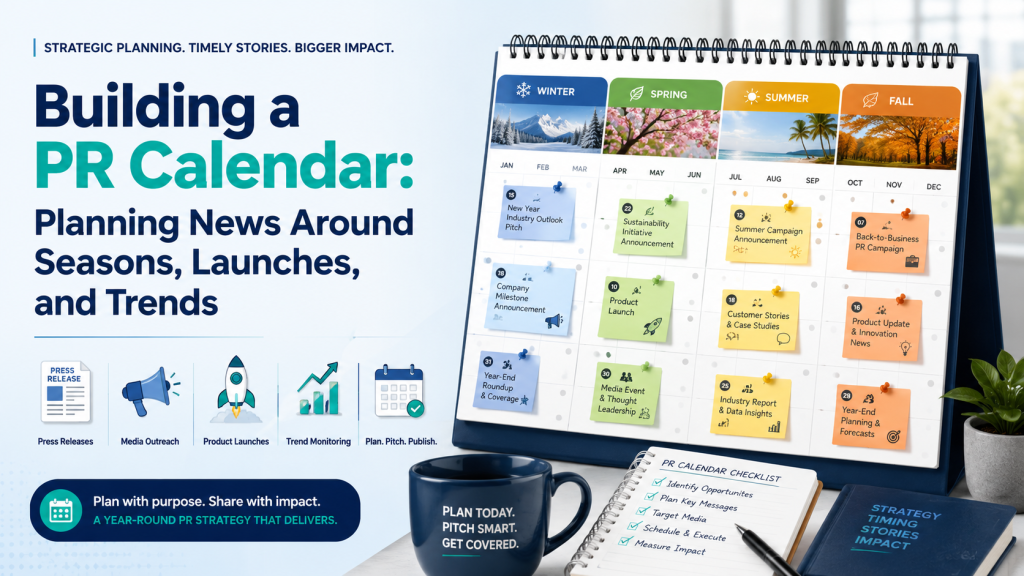
 Good PR rarely happens by accident. The best coverage usually comes from planning ahead, spotting the right moment, and giving journalists enough time to care.
A PR calendar is not just a list of dates. It is a simple tool that helps you decide when your business has something worth saying — and when the market is most likely to listen.
If you only think about publicity when you need attention, you’ll always be rushing. Plan around seasons, launches, and trends, and you give yourself a better chance of earning real coverage.
Start with your business milestones
Begin with what you already know.
Look at the next 12 months and mark key dates such as:
- Product launches
- New locations
- Funding announcements
- Major hires
- Awards
- Events
- Partnerships
- Anniversaries
- Research or survey results
- Seasonal promotions
- Community initiatives
Not every milestone deserves a press release. Before you add an announcement to the calendar, make sure it has a clear audience, a timely reason, and a story someone outside the company would care about. For a deeper breakdown, see this guide on how to choose a press release topic for small businesses.
A new feature may matter to customers but not to the media. A new location may interest local reporters. A funding announcement may interest business outlets.
The question is simple: who outside your company would care, and why now?
Add seasonal hooks
Seasons shape what journalists cover.
Retailers think about holidays. Accountants think about tax season. Fitness brands think about January. Landscapers think about spring. Education companies think about back-to-school. Nonprofits think about Giving Tuesday and year-end giving.
Your PR calendar should include the seasons that matter to your audience.
This does not mean forcing your business into every holiday. Nobody needs a “National Donut Day” pitch unless donuts are part of the story. But with a natural connection, seasonal timing can make your news easier to use.
For example, a cybersecurity firm could release data about holiday shopping scams in November. A tutoring company could share learning trends before back-to-school season. A real estate agent could discuss spring housing demand with local data.
The season gives the story a reason to exist now.
Watch industry trends
Trends can create openings for smart businesses.
If journalists are already covering a topic, your company may be able to add a useful angle. The key is to contribute something specific, not just jump on a headline.
Ask yourself:
- Do we have data that explains this trend?
- Do we have a customer story that makes it human?
- Do we have an expert who can clarify what is changing?
- Do we serve a group affected by this issue?
- Do we have a practical solution or point of view?
A trend hook works best when you can add evidence or experience. “AI is changing our industry” is too broad. “Small law firms are using AI to reduce intake delays by 30%” is more specific. A journalist can work with that.
Review trends monthly. Some fade quickly. Others build over time. Tools like Google Trends can help you spot seasonal search patterns, rising topics, and changes in audience interest before you build your next pitch.
Work backward from each announcement
A common mistake is adding a press release date to the calendar and stopping there.
That is not enough.
For each major announcement, work backward. Give yourself time to gather details, write clearly, secure approvals, build a media list, prepare images, and plan follow-up.
A simple timeline might look like this:
- Four weeks out: Confirm the news angle and audience
- Three weeks out: Gather quotes, data, and supporting details
- Two weeks out: Draft the release and build your media list
- One week out: Finalize approvals and prepare follow-up emails
- Release week: Distribute the announcement and pitch key contacts
- One week after: Follow up, track coverage, and repurpose the news
Small businesses often skip the early steps because everyone is busy. But rushed PR usually sounds rushed. It becomes company-centered instead of reader-centered.
Planning gives you time to find the real story.
Balance planned news with timely opportunities
A PR calendar should guide you, not trap you.
Some of the best opportunities will not be on the calendar. A regulation changes. A competitor closes. A local issue emerges. A national trend suddenly affects your customers.
Leave room for these moments.
Plan one strong announcement per month or quarter, then leave space for timely commentary when the right opening appears.
This keeps you from either extreme: going silent for months or issuing weak releases just to stay busy.
A fast-growing startup may have monthly news. A local service business may only have three or four strong announcements a year. Better to send fewer strong releases than a dozen thin ones.
Match each story to the right media lane
Your calendar should also note who the story is for.
Not every announcement belongs on a national wire. Some stories are better for local media. Some belong in trade publications. Some should be pitched to podcasts, newsletters, or industry blogs.
A new office opening may be local. A new study may fit trade media. A funding announcement may work for startup and business outlets. A founder’s opinion on an industry trend may be best as a contributed article or podcast pitch.
When you match the story to the right lane early, the release gets sharper. You know what details matter. You know which quotes to include.
Review the calendar monthly
A PR calendar is only useful if you use it.
Set a monthly review. Look at what is coming up, what changed, and what new angles have appeared.
Ask three questions:
- What news do we have in the next 60 days?
- What seasonal or industry hooks are coming?
- What can we prepare now so we are not rushing later?
This habit keeps PR from becoming a last-minute scramble.
The goal is better timing, not more noise
A PR calendar does not mean you need to manufacture news. It means you stop wasting the news you already have.
You notice better hooks. You give yourself time to shape stronger stories. You reach journalists when your announcement fits what they are already watching.
Publicity works best when timing, relevance, and clarity meet. A PR calendar helps you bring those three pieces together before the moment passes.

Mickie Kennedy founded eReleases.com in 1998 after watching PR firms charge small businesses a $20,000 minimum for a single press release. For 27 years, he’s been closing that gap — distributing 150,000+ releases via Cision PR Newswire, serving 30,000+ clients including Manscaped, Squatty Potty, and 40+ Shark Tank brands, and generating $132M+ in earned media. A sought-after podcast guest and two-time Amazon bestselling author of Beginner’s Guide to Writing Powerful Press Releases and The PR Strategy Manifesto. Mickie holds an MFA in Creative Writing from George Mason University. Based in Baltimore, MD. LinkedIn