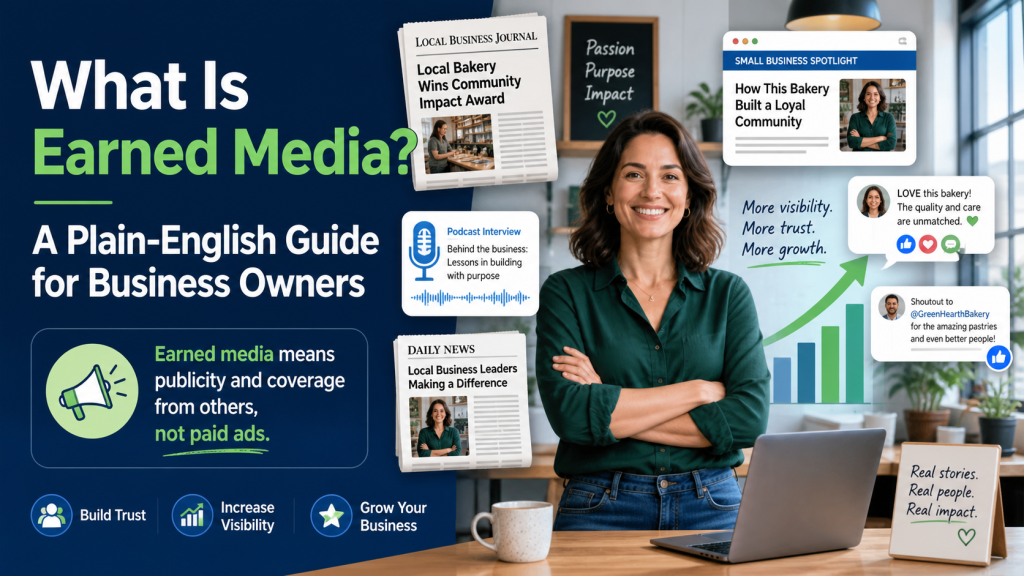
Earned media is coverage a third party publishes about you, your product, or your business without any money changing hands. A newspaper story, a TV mention, a customer review, a social media share from someone who genuinely loves what you sell: that’s earned media.
Nobody paid for it. You earned it.
What’s the Difference Between Earned, Owned, and Paid Media?
There are three types of media every business works with. Most people mix them up.
Paid media is anything you pay to place: ads, sponsored posts, display campaigns. You control the message and the timing. You stop paying, it stops running.
Owned media is any channel you control: your website, your blog, your email list, your social profiles. You produce it, you publish it, you own it.
Earned media is everything else. The coverage and mentions you didn’t pay for and don’t control. A journalist cites you as an expert. A customer posts a review. A trade publication features your launch. You didn’t buy it. You earned it.
| Paid | Owned | Earned | |
|---|---|---|---|
| Control | Full | Full | None |
| Cost | Per placement | Time to create | Effort to generate |
| Trust level | Low | Moderate | High |
| Longevity | Stops when spend stops | Permanent | Can last indefinitely |
Earned media requires you to do something worth covering, then get that news in front of the right people.
What Earned Media Is Not
Earned media is often confused with content that looks organic but isn’t.
Paid influencer posts are paid media, not earned, even when they read like personal recommendations. Payment is what disqualifies them, and FTC rules require disclosure. Audiences treat paid posts with more skepticism than organic mentions, which is exactly what makes the unpaid version more valuable.
Sponsored articles and branded content you pay a publication to run are advertising, regardless of format. The “sponsored” label is the tell.
Your own social media posts are owned media. Earned media is when someone else shares them, covers them, or writes about what you said.
One honest caveat: because you don’t control earned media, you can’t control the angle. Coverage can be mixed or critical. That unpredictability is the tradeoff for the trust.
The thing that counts is simple: if money changed hands for the placement, it’s not earned.
What Counts as Earned Media?
A startup sends a press release about its product launch. Two trade publications run stories the following week. Both articles are earned media.
Other forms include:
- Press coverage: A reporter writes about your company, quotes you as a source, or features your product in a roundup.
- Reviews and ratings: Customers leave unsolicited reviews on Google, Yelp, G2, or Amazon.
- Social shares and mentions: Someone with an audience talks about your business because they want to, not because you paid them.
- Broadcast coverage: A local TV news segment or radio interview.
- Podcast appearances: An interview you landed based on your expertise.
- Analyst citations: A research report references your company as an example.
- Organic backlinks: A publication links to you because your content was worth citing.
Not all earned media carries the same weight. A Wall Street Journal feature and a mention in a niche trade pub are both earned. What matters is whether the audience is the right one.
Is Earned Media the Same as PR?
PR is the practice. Earned media is the result.
Public relations is the outreach: building journalist relationships, writing press releases, pitching stories, and responding to media requests. When a reporter decides your pitch is worth a story, the coverage they publish is earned media.
Earned media doesn’t happen at scale by accident. Organic reviews and social mentions come naturally. Consistent media coverage from journalists requires a deliberate earned media strategy. That’s why press release distribution exists as a profession.
How Do Press Releases Generate Earned Media?
A press release is the standard format for getting news in front of journalists. When distributed through a wire service like PR Newswire, your release lands in the feeds and inboxes of reporters who cover your industry, through a channel they already check.
When it works: a journalist reads the release, verifies the story, and publishes a piece. That article is earned media. You didn’t pay for it. You didn’t write it. A third-party editor made the call.
The press release doesn’t guarantee coverage. Nothing does. But it puts your news in front of the reporters most likely to care. That’s the mechanism.
For small businesses without a PR team or existing journalist relationships, press release distribution is often the most practical path to consistent earned coverage. You don’t need to know reporters personally. You just need your compelling news story to reach them.
Why Earned Media Is Worth Pursuing
Credibility. A journalist’s article or an independent review carries authority that advertising cannot replicate. According to a 2013 Nielsen survey of 29,000 consumers across 58 countries, 84% trust recommendations from friends and family above all other forms of advertising, compared to 62% for TV ads and 45% for display ads. No budget closes that gap.
Decision-stage impact. Paid media builds awareness at the top of the funnel. Earned media hits hardest at the bottom, when a buyer is comparing options and a third-party article tips the decision. For example, Jason Templer, owner of Scoops Pet Waste Management Services, got coverage in 13 publications from his first eReleases release. “As a result of my very first press release with eReleases, I received 10 new clients,” he reported.
SEO. Coverage from established outlets generates high-authority backlinks. Those links improve your search rankings in ways paid placements cannot.
Durability. Ads stop working the moment you stop paying. Jeffrey Kay of Flippies.com put out one press release, landed a feature in Fast Company, and years later said: “The phone still rings from that article to this day.” Paid coverage disappears when you stop writing checks. Earned coverage compounds.
Ready to generate earned media for your business? A professionally distributed press release puts your story directly in front of journalists through PR Newswire’s national network. See how press release distribution works or view eReleases pricing.
Frequently Asked Questions
Which is an example of earned media?
– A journalist writes a story about your company after receiving your press release.
– A customer leaves a five-star review on Google without being asked.
– A blogger includes your product in a roundup.
All three are earned media: third-party coverage you didn’t pay for.
What qualifies as earned media?
Any coverage published by a third party who wasn’t paid to publish it. This includes news articles, broadcast segments, podcast appearances, social media mentions, customer reviews, and organic backlinks. If someone else said it and you didn’t pay them to say it, it’s earned media.
Is earned media the same as PR?
PR is the practice. Earned media is the result. Public relations is the outreach: building relationships, writing press releases, and pitching stories. When a reporter decides your pitch is worth a story, the coverage they publish is earned media.
Are influencers earned or paid media?
It depends on whether you paid them. A paid influencer partnership is paid media, and the FTC requires disclosure. An influencer who posts about your product without compensation is earned media. Audiences treat paid posts with more skepticism, which is exactly what makes organic mentions more valuable.
Does earned media cost money?
The placement itself is free. You don’t pay a publication to run the story. But generating it requires investment in PR outreach, press release distribution, or both. The cost goes into the effort, not the coverage.
What is earned media value?
Earned media value (EMV) is an estimate of what your coverage would have cost if you’d paid for equivalent ad space or airtime. It’s a common PR metric, but a limited one: it converts column inches into advertising dollars without accounting for the credibility advantage that makes earned coverage worth pursuing in the first place.
How do you measure earned media?
Common metrics include media mentions, share of voice (how often you’re mentioned compared to competitors), referral traffic from coverage, and backlinks generated. Track backlinks if you’re optimizing for SEO, outlet authority if you’re building credibility, and referral traffic if you want direct business impact.

Mickie Kennedy founded eReleases.com in 1998 after watching PR firms charge small businesses a $20,000 minimum for a single press release. For 27 years, he’s been closing that gap — distributing 150,000+ releases via Cision PR Newswire, serving 30,000+ clients including Manscaped, Squatty Potty, and 40+ Shark Tank brands, and generating $132M+ in earned media. A sought-after podcast guest and two-time Amazon bestselling author of Beginner’s Guide to Writing Powerful Press Releases and The PR Strategy Manifesto. Mickie holds an MFA in Creative Writing from George Mason University. Based in Baltimore, MD. LinkedIn