Ask AI for a short summary of this article
What Does PR Stand For? PR Meaning
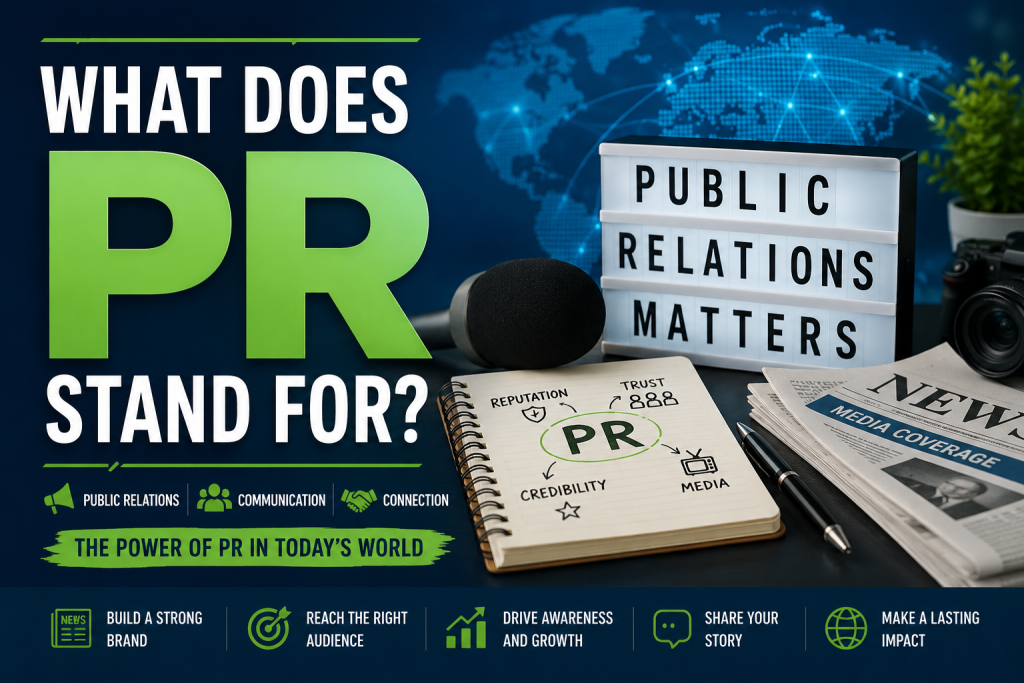
PR stands for Public Relations. It’s the strategic practice of managing communication between an organization and its publics to build mutually beneficial relationships, enhance reputation, and influence public perception.”
What Is the Definition of Public Relations?
Public relations is far more than just sending out press releases or getting your company’s name in the news. According to the Public Relations Society of America (PRSA), public relations is defined as:
- “A strategic communication process that builds mutually beneficial relationships between organizations and their publics.”
Let’s break down what this definition really means for your business.
Understanding the Core Elements of PR
Public Relations Is a Strategic Communication Process
PR isn’t random or reactive—it’s a planned, purposeful approach to communication. Every press release, social media post, or media interview serves a specific strategic goal, whether that’s launching a new product, managing your reputation, or building brand awareness.
PR Creates Mutually Beneficial Relationships
This is the key differentiator. Unlike advertising, which is one-way communication focused solely on promoting your message, PR creates value for both parties. When done right, PR provides useful information to journalists and their audiences while also building credibility for your organization.
Public Relations Communicates to Organizations and Their Publics
Notice it says “publics” (plural), not just “the public.” Your organization has multiple audiences—customers, employees, investors, media, local communities, and industry partners. Effective PR recognizes that each audience has different needs and requires tailored communication strategies
How PR Differs from Advertising and Marketing
While PR, marketing, and advertising often work together, they serve distinct purposes:
Public Relations focuses on earning credibility through third-party validation. When a journalist writes about your company or an influencer recommends your product, that endorsement carries more weight because it comes from an independent source, not directly from you.
Advertising involves paying for guaranteed placement of your message. You control exactly what’s said, where it appears, and when it runs—but audiences know you paid for it, which can reduce trust.
Marketing encompasses all activities promoting and selling your products or services, including advertising, sales, and yes, public relations. PR is one tool within the broader marketing toolkit.
Research shows that consumers trust earned media coverage 83% more than paid advertising, which is why PR remains such a powerful tool for building authentic credibility.
The Expanded Scope of Modern PR
Today’s definition of public relations extends well beyond traditional media relations. Modern PR encompasses:
Media Relations — Building relationships with journalists to secure news coverage in print, broadcast, and digital publications.
Digital PR — Managing your online reputation, securing digital media coverage, and building backlinks that improve SEO.
Social Media Management — Engaging directly with audiences, managing brand conversations, and amplifying your message across platforms.
Content Creation — Developing thought leadership articles, blog posts, whitepapers, and other content that positions your organization as an industry authority.
Crisis Management — Protecting your reputation during negative events through transparent, timely communication.
Community Relations — Building relationships with local communities and stakeholder groups.
Internal Communications — Keeping employees informed, engaged, and aligned with company goals.
Investor Relations — Communicating with shareholders and the financial community (especially important for public companies).
Why the Definition of Public Relations Matters
Understanding the true definition of public relations helps you recognize that PR is not:
- Just press releases
- Only for big corporations
- The same as advertising
- Something you do only when there’s a crisis
- One-time campaigns with no ongoing strategy
Instead, PR is an ongoing strategic function that builds and protects your organization’s most valuable asset: its reputation.
PR as a Strategic Business Function
According to the Edelman Trust Barometer, 58% of consumers buy from or advocate for brands based on their beliefs and values. This makes reputation management—and by extension, public relations—a business imperative rather than just a marketing tactic.
When executed strategically, PR:
- Builds credibility that supports sales efforts
- Creates awareness that drives customer acquisition
- Establishes thought leadership that differentiates you from competitors
- Manages reputation that protects against crises
- Generates earned media that improves SEO
- Creates shareable content that extends your reach
The bottom line? Public relations is the practice of strategically managing all communication between your organization and the audiences that matter most to your success. It’s about building trust, earning credibility, and creating relationships that deliver value to everyone involved.
The Evolution of Public Relations
Public relations has evolved significantly from its early days of simple press agentry. Today’s PR landscape requires an integrated approach that combines traditional media relations with digital strategies.
The Historical Evolution of PR:
- Early 1900s: One-way propaganda and publicity
- Mid-20th century: Two-way asymmetric model focused on persuasion
- Late 20th century: Two-way symmetric model emphasizing mutual understanding
- 21st century: Integrated communications across multiple platforms
Today, 87% of PR professionals report that digital communication is now “very important” to their strategy, highlighting how the field has transformed in the internet age.
The Five Key Components of Effective Public Relations
Modern public relations encompasses five essential elements that work together synergistically to build and strengthen your company’s reputation. Let’s explore each component in detail:
Strategic Media Relations
Media relations forms the cornerstone of traditional PR, focusing on how you cultivate relationships with journalists and news outlets to secure positive coverage for your organization.
- Effective media relations requires:
- Building genuine relationships with key journalists in your industry
- Understanding what makes a story truly newsworthy
- Crafting compelling pitches that address the needs of specific media outlets
- Providing journalists with accurate, timely information and expert sources
- Measuring and analyzing media coverage results
According to Cision’s 2023 State of the Media Report, journalists receive an average of 150-300 pitches per week, making strategic media relations more important than ever. Your approach must be targeted, personalized, and genuinely valuable to stand out.
The PESO Media Model in Modern PR
Today’s PR professionals utilize the PESO model (Paid, Earned, Shared, Owned) to create comprehensive communication strategies:
Paid Media
- Paid media refers to any promotional content you purchase, including:
- Digital advertisements on search engines and social platforms
- Native advertising and sponsored content
- Influencer partnerships with disclosed compensation
- Traditional advertising (TV, radio, print, billboards)
The key advantage of paid media is control—you determine exactly how your message appears, where it’s placed, and who sees it. However, consumers typically trust paid media less than earned coverage.
Owned Media
Owned media encompasses all the communication channels your organization controls directly:
- Company website and blog
- Email newsletters and direct communications
- Mobile apps and proprietary platforms
- Corporate social media accounts
- Podcasts, webinars, and original content
Owned media provides complete creative control while building long-term assets. Content marketing through owned channels has become increasingly central to PR strategy, with 91% of B2B marketers using content marketing as part of their PR approach.
Earned Media
Earned media represents third-party validation of your organization, including:
- News coverage in print, broadcast, and digital publications
- Industry analyst reports and reviews
- Expert commentary and feature articles
- Awards and recognitions
- Unsolicited reviews and testimonials
Earned media carries the highest credibility since it comes from independent sources. Studies show that consumers trust earned media 83% more than paid advertising, making it the gold standard of public relations outcomes.
2. Strategic Content Development and Distribution
While press releases remain important PR tools, today’s content strategy must be much broader:
Press Release Strategy
The modern press release should:
- Focus on genuinely newsworthy information
- Include multimedia elements (images, videos, infographics)
- Provide quotes from key stakeholders and industry experts
- Contain data and statistics that support your story
- Include a clear call to action for journalists
- Be optimized for digital distribution and search engines
Beyond Press Releases
- Effective PR content now includes:
- Thought leadership articles and executive bylines
- Case studies and success stories
- White papers and research reports
- Visual storytelling through infographics and videos
- Podcasts and webinar content
According to Edelman’s Trust Barometer, technical expertise and thought leadership significantly enhance brand trust, making these content types essential to modern PR.
3. Digital and Social Media Relations
In today’s interconnected world, digital PR has become inseparable from traditional public relations:
Strategic Social Media Management
Effective social media PR involves:
- Platform-specific strategies tailored to different audience segments
- Consistent brand voice and messaging across channels
- Proactive engagement with followers and communities
- Real-time monitoring and rapid response capabilities
- Integration with broader PR initiatives and campaigns
Digital PR Tactics
Beyond social media, digital PR encompasses:
- SEO-driven content strategies
- Online reputation management
- Influencer partnerships and collaborations
- Community building and engagement
- Digital newsrooms and media resources
Research shows that 82% of consumers research companies online before making purchase decisions, making your digital presence a critical component of public relations.
4. Strategic Crisis Communications and Reputation Management
Despite the old cliché that “there’s no such thing as bad PR,” negative publicity can severely damage your brand. Effective crisis management is essential in today’s 24/7 news cycle and viral social media environment.
Modern Crisis Communications Framework
A comprehensive crisis communications plan should include:
- Risk assessment and crisis scenario planning
- Designated crisis response team with clear roles
- Pre-approved messaging templates for common scenarios
- Multi-channel communication strategy (internal and external)
- Media training for key spokespersons
- Regular simulation exercises and plan updates
- Post-crisis analysis and reputation recovery strategy
Crisis Response Timeline
Modern crisis management follows a compressed timeline:
- First 15 minutes: Initial acknowledgment and statement
- First hour: Preliminary response across all channels
- First 24 hours: Comprehensive response with action plan
- First week: Regular updates and transparent communication
- Recovery phase: Rebuilding trust through consistent actions
Recent Crisis Management Case Studies
While Johnson & Johnson’s Tylenol response remains a classic example, modern cases provide new insights:
- Starbucks’ 2018 racial bias incident and store closure for company-wide training
- Southwest Airlines’ 2023 operational meltdown and customer communication
- Airbnb’s transparent response to pandemic cancellations
These examples demonstrate how speed, transparency, and authentic human response are critical in today’s crisis landscape.
Proactive Reputation and Brand Management
Rather than waiting for crises, modern PR emphasizes proactive reputation building:
- Ongoing sentiment monitoring across all channels
- Regular stakeholder perception research
- Corporate social responsibility initiatives
- Environmental, Social, and Governance (ESG) commitments
- Transparent communication of company values and ethics
According to the Edelman Trust Barometer, 58% of consumers buy or advocate for brands based on their beliefs and values, making reputation management a business imperative rather than just a PR function.
5. Strategic Thought Leadership and Stakeholder Engagement
The fifth pillar of modern PR focuses on establishing your organization and its leaders as authoritative voices in your industry.
Comprehensive Thought Leadership Strategy
Effective thought leadership encompasses:
- Executive positioning through speaking engagements and media appearances
- Original research and data-driven insights
- Industry trend analysis and forward-looking perspectives
- Participation in industry associations and standards bodies
- Authorship of books, articles, and significant publications
LinkedIn’s research shows that 58% of decision-makers read one or more hours of thought leadership content weekly, and 55% use it to vet organizations they’re considering working with.
Strategic Stakeholder Engagement
Modern PR recognizes diverse stakeholder groups requiring tailored approaches:
- Investor relations for financial stakeholders
- Employee communications for internal audiences
- Government relations for regulatory bodies
- Community relations for local engagement
- Customer communications for product/service users
Each stakeholder group requires specialized messaging, channels, and engagement strategies while maintaining consistent overall brand positioning.
PR vs. Marketing: Understanding the Critical Differences
While PR and marketing work closely together in an integrated communications strategy, they serve fundamentally different purposes:
| Public Relations | Marketing |
|---|---|
| Builds relationships and reputation | Drives sales and revenue |
| Focuses on earned and shared media | Emphasizes paid and owned media |
| Targets multiple stakeholder groups | Primarily targets customers and prospects |
| Measures awareness, sentiment, and trust | Measures leads, conversions, and ROI |
| Long-term relationship building | Often campaign-driven |
| Centers on organizational positioning | Centers on product/service promotion |
According to the Harvard Business Review, organizations with integrated PR and marketing strategies outperform those with siloed approaches by up to 20% in terms of brand value and market share.
Why Effective PR Matters More Than Ever
In today’s hyper-connected, information-saturated environment, strategic public relations provides:
- Trust building in an era of declining institutional trust
- Differentiation in crowded marketplaces
- Crisis resilience and rapid response capability
- Authentic stakeholder connections beyond transactions
- Long-term reputation assets that transcend individual campaigns
Frequently Asked Questions About PR (Public Relations)
Understanding PR Basics
What does PR stand for?
PR stands for Public Relations. It’s a strategic communication discipline that helps organizations build and maintain positive relationships with their target audiences, including customers, employees, investors, media, and the general public.
What is the meaning of PR in business?
In business, PR (Public Relations) refers to the practice of managing how information about a company is shared with the public. It encompasses all communications designed to build trust, enhance reputation, and create mutually beneficial relationships between organizations and their stakeholders.
Unlike advertising, PR focuses on earning credibility through third-party endorsements and authentic storytelling.
What is the official definition of public relations?
According to the Public Relations Society of America (PRSA), public relations is “a strategic communication process that builds mutually beneficial relationships between organizations and their publics.“
This definition emphasizes that PR is not just about sending messages, but about creating two-way communication that benefits both the organization and its audiences.
What is the difference between PR and marketing?
While PR and marketing often work together, they serve different purposes.
Marketing focuses on promoting and selling products or services directly to consumers through paid channels.
PR focuses on building reputation, managing communications, and earning media coverage through credibility and newsworthiness.
Marketing is typically paid and controlled, whereas PR often relies on earned media, which carries higher credibility with audiences.
What is the difference between PR and advertising?
Advertising involves paying for space or time to place promotional messages in media channels, giving you complete control over the content and placement.
PR seeks to earn media coverage through newsworthy content and relationships with journalists.
tudies show that consumers trust earned PR coverage 83% more than paid advertising because it comes from independent, editorial sources rather than the brand itself.
Types and Components of PR
What are the main types of public relations?
The main types of PR include:
Media Relations: Building relationships with journalists to secure news coverage
Corporate Communications: Managing internal and external company messaging
Crisis Management: Handling reputation threats and emergency situations
Community Relations: Engaging with local communities and stakeholders
Digital PR: Managing online reputation and social media presence
Investor Relations: Communicating with shareholders and the financial community
Internal Communications: Keeping employees informed and engaged
Government Relations: Managing interactions with policymakers and regulatory bodies
What is the PESO model in PR?
The PESO model is a comprehensive framework for modern public relations that includes four types of media:
Paid Media: Advertising, sponsored content, and paid promotions you purchase
Earned Media: News coverage, mentions, and features you secure through media relations
Shared Media: Social media engagement and content shared by others
Owned Media: Content you create and control, like blogs, websites, and email newsletters
This integrated approach helps PR professionals create comprehensive communication strategies across all channels.
What does a PR professional do?
PR professionals manage an organization’s reputation and communications by:
– Writing and distributing press releases
– Pitching stories to journalists and media outlets
– Managing social media presence and engagement
– Monitoring media coverage and public sentiment
– Developing communication strategies and messaging
– Handling crisis communications
– Creating content like blog posts, articles, and thought leadership pieces
– Building relationships with media, influencers, and stakeholders
– Organizing events and media opportunities
– Measuring and reporting on PR campaign results
What is media relations in PR?
Media relations is the practice of building and maintaining relationships with journalists, editors, bloggers, and other media professionals to secure positive coverage for your organization.
According to research, journalists receive 150-300 pitches per week, making strategic, personalized, and valuable media relations more critical than ever.
Effective media relations requires understanding what makes content newsworthy and tailoring your approach to each journalist’s specific beat and needs.
PR Tools and Tactics
What is a press release in PR?
A press release (also called a news release) is an official written statement distributed to media outlets to announce newsworthy information.
It follows a standard format including a headline, dateline, lead paragraph with the who, what, when, where, why, and how, body content with supporting details, company boilerplate, and contact information.
Press releases remain a fundamental PR tool for sharing announcements about product launches, company milestones, events, and other newsworthy developments.
What is earned media in public relations?
Earned media refers to publicity and coverage gained through promotional efforts other than paid advertising.
This includes news articles, editorial mentions, social media shares, reviews, and word-of-mouth recommendations.
Earned media is considered the most credible form of publicity because it comes from independent, third-party sources rather than the brand itself. It “earns” its place through newsworthiness and media relationships rather than being purchased.
What is a PR package?
A PR package is a curated collection of products, information, and branded materials sent to influencers, journalists, or media professionals to generate awareness and coverage.
These packages typically include product samples, personalized notes, brand information, and creative elements that tell your brand story.
PR packages are especially valuable for small businesses, product launches, and companies with visual or experiential products.
Modern and Digital PR
What is digital PR?
Digital PR combines traditional public relations tactics with digital marketing strategies.
It focuses on building online visibility, securing digital media coverage, managing social media presence, improving SEO through online mentions and backlinks, and engaging with audiences across digital platforms.
Digital PR has become inseparable from traditional PR in today’s interconnected world.
How does PR help with SEO?
PR supports SEO (Search Engine Optimization) in several ways. When your company earns media coverage on reputable websites, you often receive backlinks that signal authority to search engines.
Press releases distributed through newswires appear on multiple news sites, creating more indexed content.
Media mentions increase brand awareness, leading to more branded searches.
Thought leadership content positions your company as an authority, and social media sharing from PR efforts drives traffic and engagement signals that search engines value.
What is the role of social media in PR?
Social media has become essential to modern PR strategy.
It allows organizations to communicate directly with audiences in real-time, share news and updates instantly, monitor brand sentiment and conversations, manage reputation and respond to concerns quickly, build community and engagement, amplify earned media coverage, and create shareable content that extends reach.
Effective social media PR requires platform-specific strategies, consistent brand voice, and authentic engagement with followers.
PR Strategy and Measurement
Why is PR important for small businesses?
PR is crucial for small businesses because it:
– Builds credibility and trust with potential customers
– Levels the playing field against larger competitors
– Creates brand awareness without large advertising budgets
– Generates third-party validation through media coverage
– Attracts new customers through authentic recommendations
– Establishes thought leadership in your industry
– Improves online visibility and SEO
– Supports sales efforts with social proof and credibility
For businesses with limited marketing budgets, the authentic advocacy from well-executed PR can be more valuable than paid advertising.
What makes something newsworthy in PR?
Content is considered newsworthy when it meets one or more of these criteria:
Timeliness: Current, recent, or related to trending topics
Significance: Important impact on the audience or industry
Proximity: Local relevance or geographic connection
Prominence: Involvement of well-known people or organizations
Human Interest: Appeals to emotions or tells compelling stories
Conflict: Controversy, challenges, or opposing viewpoints
Novelty: Unique, unusual, or first-time occurrences
Relevance: Directly related to audience interests and needs
Understanding what makes content newsworthy helps PR professionals pitch stories that journalists actually want to cover.
How do you measure PR success?
PR success can be measured through various metrics:
Media Coverage: Number and quality of placements secured
Reach and Impressions: Potential audience size exposed to coverage
Share of Voice: Your visibility compared to competitors
Sentiment Analysis: Positive, neutral, or negative tone of coverage
Website Traffic: Visits driven by PR efforts
Social Engagement: Shares, comments, and interactions
Backlinks: Quality links from media coverage improve SEO
Lead Generation: Inquiries or conversions attributed to PR
Brand Awareness: Measured through surveys or search volume
Message Penetration: Key messages appearing in coverage
The most meaningful metrics align with your specific PR goals and business objectives.
What is crisis management in PR?
Crisis management is the process of protecting an organization’s reputation during negative events or emergencies.
Effective crisis PR requires speed, transparency, and authentic human response.
Modern examples include Starbucks’ 2018 response to racial bias incidents with company-wide training, Southwest Airlines’ 2023 operational meltdown communications, and Airbnb’s transparent pandemic cancellation policies.
Companies should prioritize proactive reputation building over waiting for crises, as 58% of consumers base their purchasing decisions or advocacy on a brand’s beliefs and values.
Getting Started with PR
Do I need a PR agency, or can I do PR myself?
Both options have merit depending on your situation.
You can handle PR yourself if you have time to build media relationships, understand what makes content newsworthy, can write professional press releases, have basic media monitoring capabilities, and possess strong communication skills.
Consider hiring a PR agency or consultant if you lack internal resources or expertise, need established media connections, face a crisis requiring immediate expert response, want to scale efforts beyond what your team can handle, or require specialized industry knowledge.
Many small businesses start with DIY PR and add professional support as they grow.
How much does PR cost?
PR costs vary widely based on approach and scope:
DIY PR: Free to minimal costs for tools and distribution
Press Release Distribution Services: $100-$1,700 per release, depending on reach
Freelance PR Consultants: $75-$300 per hour
Small PR Agencies: $2,000-$10,000 monthly retainer
Mid-Size PR Firms: $10,000-$30,000 monthly retainer
Large PR Agencies: $30,000+ monthly retainer
For small businesses, using affordable distribution services like eReleases (starting at $399) combined with DIY efforts can deliver strong results without enterprise-level costs.
Remember that successful PR campaigns often require multiple press releases over time rather than a single announcement.
PR: Beyond the Acronym
So what does PR stand for? While the literal answer is “Public Relations,” the true meaning encompasses the strategic, multifaceted discipline of building mutually beneficial relationships between organizations and their stakeholders through authentic communication.
In today’s complex media landscape, effective PR combines time-tested principles with innovative approaches to help organizations navigate challenges, seize opportunities, and build lasting trust with all their publics.
Need help developing or enhancing your PR strategy? Contact our team of experienced PR professionals today to discuss your specific needs and goals. We specialize in creating powerful press release distribution approaches that deliver measurable results for small to medium-sized businesses.

Mickie Kennedy founded eReleases.com in 1998 after watching PR firms charge small businesses a $20,000 minimum for a single press release. For 27 years, he’s been closing that gap — distributing 150,000+ releases via Cision PR Newswire, serving 30,000+ clients including Manscaped, Squatty Potty, and 40+ Shark Tank brands, and generating $132M+ in earned media. A sought-after podcast guest and two-time Amazon bestselling author of Beginner’s Guide to Writing Powerful Press Releases and The PR Strategy Manifesto. Mickie holds an MFA in Creative Writing from George Mason University. Based in Baltimore, MD. LinkedIn